


The shift away from energy drinks comes down to one thing: people got tired of drinking 54 grams of sugar just to stay awake.
The caffeine pouch market sat at roughly $500 million in 2025. Analysts project it reaching $1.8 billion by 2033, a 15% compound annual growth rate (Market Report Analytics, 2025). That kind of growth doesn’t come from novelty. It comes from people actually switching.
Caffeine pouches are small sachets placed between the upper lip and gum. Caffeine is absorbed through the oral mucosa directly into the bloodstream, bypassing the digestive tract. No liquid, no carbonation, no sugar. Products like Cream Energy Cool Mint Caffeine Pouches carry no tobacco, no nicotine — just caffeine with xylitol and sucralose for flavor.
The Sugar Gap
One can of the most popular energy drinks puts you at or over the recommended daily limit for added sugar before you’ve eaten anything.
The Dietary Guidelines for Americans 2020–2025 places that ceiling on added sugar at 10 percent of daily calories, which amounts to 50 grams on a standard 2,000-calories-a-day diet. Here’s how the major brands stack up:
| Brand | Can Size | Sugar |
|---|---|---|
| Red Bull | 12 oz | 38g |
| Monster | 16 oz | 54g |
| Rockstar | 16 oz | 63g |
A standard energy drink contains approximately 160mg of caffeine or more, taurine, guarana (a kind of seaweed), ginseng, and B vitamins — none of which have controlled trial evidence for the effects they claim to deliver in clinical settings, according to the Harvard T.H. Chan School of Public Health.
Daily Caffeine Limits
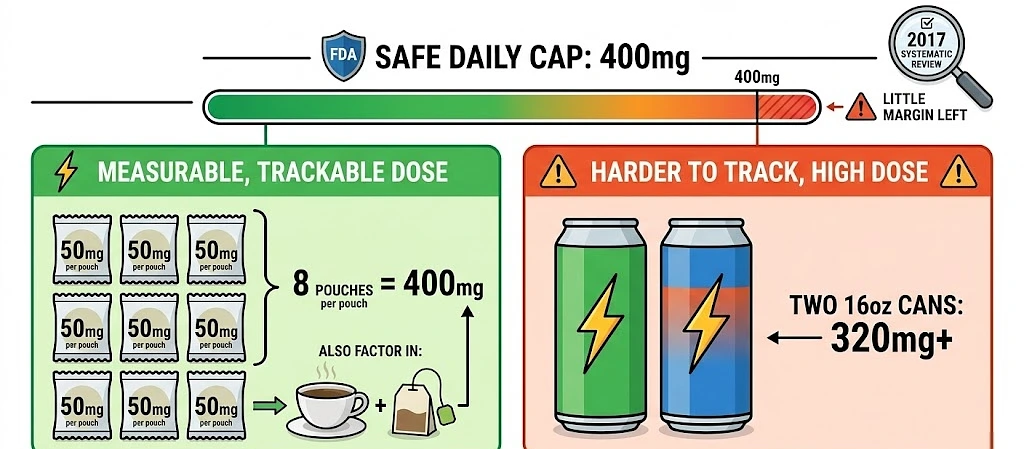
The FDA puts the safe daily caffeine limit at 400mg for healthy adults — a figure confirmed by a 2017 systematic review.
This is what the FDA considers the Generally Recognized as Safe (GRAS) level for caffeine, below which negative effects are generally not associated with consumption. In a 2017 systematic review by the Institute for the Advancement of Food and Nutrition Sciences, researchers confirmed the 400mg cap (FDA, updated August 2024).
At 50mg per pouch, users have a measurable, trackable dose against that ceiling — with room to factor in coffee or tea on top. Energy drinks make this harder. Two 16-ounce cans of some brands alone push past 320mg, leaving little margin for anything else in the day.

For People Quitting Nicotine
Caffeine pouches use the exact same format as nicotine pouches — same size, same placement under the lip — which makes them a direct physical substitute.
The global nicotine pouch market was estimated at $5.10 billion in 2024 and is expected to grow with a compound annual growth rate of 31.5%, reaching $45.60 billion by 2032. A large part of that userbase is made up of former smokers who switched to pouches but have not quit nicotine. The ritual — slipping something under the lip, the little pause, the tactile habit — is hard to beat.
Caffeine pouches slot into that exact behavior. Same pouch, same action, no nicotine. Long-term cessation data specific to this swap is still limited, but the format overlap is direct rather than approximate.
What Goes Into a Pouch
Unlike energy drinks, caffeine pouches carry a short, transparent ingredient list with no proprietary blends.
A typical caffeine pouch contains:
- Caffeine
- Plant-based filler (usually cellulose)
- Sweeteners (xylitol, sucralose)
- Flavoring
No taurine. No guarana. No undisclosed “energy blend.” The same direct-to-consumer infrastructure that buried nicotine pouches in the mainstream — online sales accounted for 40% of North American nicotine-pouch sales in 2024 — is now sending caffeine pouches through those same pipes.
Health Considerations
Caffeine pouches are a young category — long-term oral tissue exposure data is limited, and the 400mg daily limit still applies regardless of delivery method.
The 2024 health report from the American College of Cardiology states that consuming more than 400mg of caffeine per day can impact the autonomic nervous system in healthy humans, causing increased heartbeat and blood pressure. Caffeine has a half-life in the body of about five hours, so consuming it later in the day carries some risk of disrupting sleep.
For many adults transitioning from energy drinks with a lot of sugar, the overall risk profile becomes more favorable. Fewer ingredients, no sugar and a dose that’s easy to count. That said, people with cardiovascular conditions or caffeine sensitivity should consult a doctor before making the switch.