


You trust your eyes to complain when something is wrong. Something gets in, they water. Too bright, you squint. That deal holds for almost everything that can go wrong with your vision, and glaucoma is the disease that breaks it. No ache, no blur, no warning on any ordinary day. It just quietly takes, and by the time you notice anything is missing, the part that is gone is gone for good.
What Glaucoma Actually Is

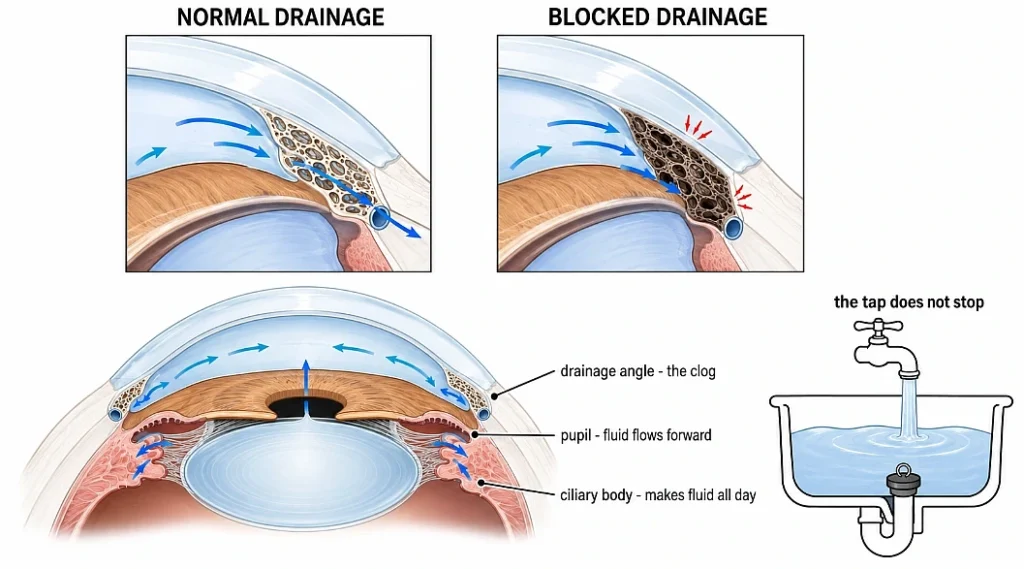
Glaucoma is a group of eye diseases that damage the optic nerve, the cable that carries everything your eye sees to your brain, and the damage usually comes from fluid pressure building up inside the eye. That is the whole definition, and one everyday picture makes it stick.
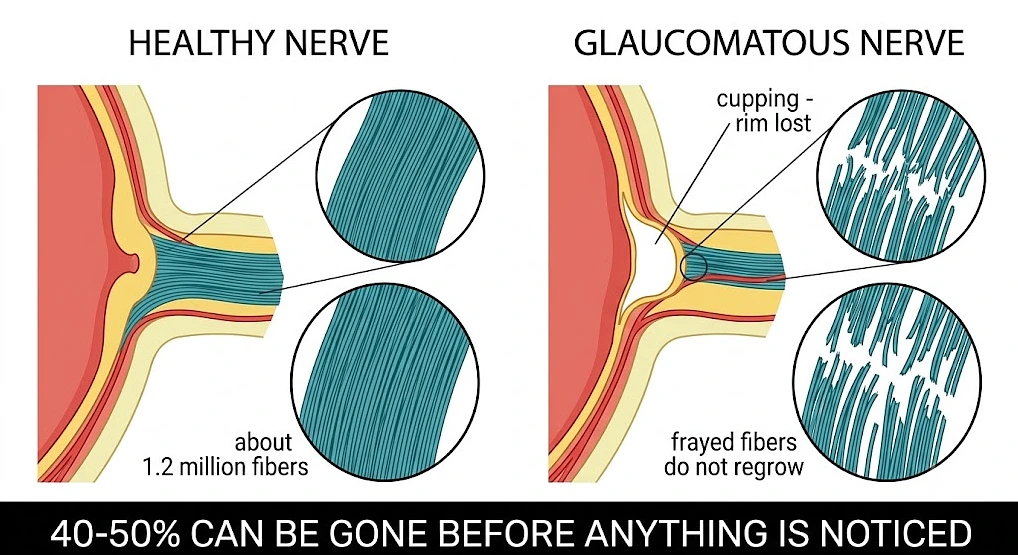
Your eye is a sink with the tap always running. It makes fluid all day, every day, and that fluid drains out through its own tiny plumbing. In glaucoma the drain clogs. The tap does not stop, so pressure builds, and that pressure sits on the optic nerve. Think of the nerve as an HDMI cable with about a million tiny wires inside, running from the back of your eye to your brain. Pressure frays those wires a few at a time, and frayed wires in this cable do not regrow. Ever.

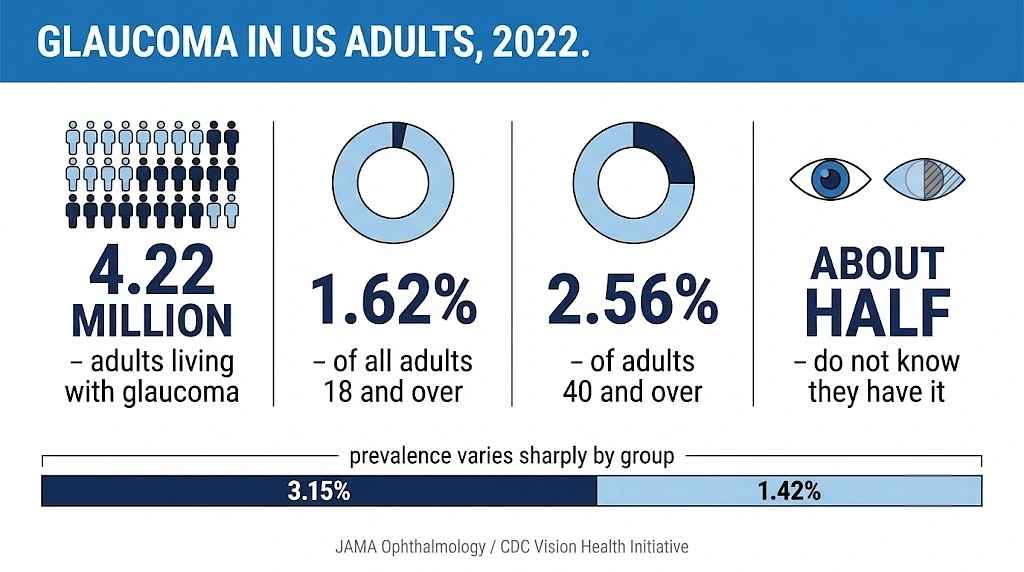
The numbers on this are plain. About 4.2 million American adults have glaucoma, roughly 1.6 percent of everyone over 18, and among adults over 40 it climbs to about 2.6 percent. About half of the people who have it do not know they have it. And that second number is the one this whole article is really about, because it sounds like carelessness and it is not. It is the disease’s actual design.
Your Brain Is Covering For The Disease
So how does a person lose real vision and genuinely not notice? Because the loss starts at the edges, in your peripheral vision, and your brain treats missing pieces of your vision the way your phone treats a typo. It autocorrects. The gap does not show up as a black patch or a blurry smear, the brain just fills it in with a best guess and moves on, so smoothly you never see the correction happen.
And that is why glaucoma gets called the silent thief of sight. The name comes from the CDC and the National Eye Institute, not from a marketing department. You are not ignoring a warning sign. There is no warning sign. The alarm system is the thing being stolen.
I keep coming back to the autocorrect picture because it explains the half who do not know better than any statistic can. They are not skipping symptoms. Their own brain is smoothing the evidence away in real time, and it will keep doing that until the missing area gets big enough that no guess can cover it. By then the wires that served that area are frayed, and vision lost to glaucoma does not come back with drops, surgery, or anything else medicine currently has.
Which flips the usual logic of when to see a doctor. For most conditions, symptoms send you in. For this one, waiting for symptoms means waiting until part of your sight is already gone. Screening is the only net there is.
Who Actually Needs To Worry

Not everyone carries the same risk. The exam every one to two years matters most if any of these describe you:
- You are over 40, and the risk keeps climbing from there.
- Glaucoma runs in your family. A parent or sibling with it raises your odds several times over.
- You are Black or Hispanic, groups where the disease shows up earlier and hits harder.
- You have diabetes, or you are very nearsighted.
- You have used steroid medications long term.
The advice for that list is boring and I will not dress it up. A dilated eye exam, every one to two years, where a doctor actually looks at the drain and the cable. Twenty minutes. That is the entire prevention plan, and it is the National Eye Institute’s own recommendation, because catching pressure early is the one point in this whole story where the damage can still be stopped before it starts.
When The General Eye Doctor Is Not Enough
According to dr chamberlain eye doctor at Intermountain Eye Centers, trained specifically in glaucoma and complex anterior segment disease, a regular ophthalmologist can check your pressure and catch trouble, the way your GP can read an ECG. But when it is your heart on the line, you want the cardiologist, the person who does hearts all day and has seen every strange version of the problem. Same organ, different depth. Glaucoma has its own version of that specialist: the fellowship trained glaucoma surgeon, someone who spent an extra year after residency doing nothing but this disease.
Dr Chamberlain also separately helped establish a glaucoma fellowship program in Tanzania, which tells you something about how deep in this one disease he actually works. The point of a credential like that is not admiration. It is that every treatment option genuinely sits on the table, because the surgeon across from you has done all of them.
The minimally invasive part matters more than it sounds. Old glaucoma surgery was opening the engine bay, effective and heavy. The newer procedures, MIGS, go in through the keyhole instead, tiny incisions, faster recovery, and often done during cataract surgery you were already having, so one operation quietly handles two problems. Not every eye qualifies. Knowing which eyes do is exactly what the fellowship year was for.
The Short Version
Glaucoma is a clogged drain putting pressure on a cable that cannot be repaired, and your own brain autocorrects the early damage out of view. About half the Americans who have it do not know. If you are over 40, or it is in your family, or you sit anywhere else on that risk list, the move is an unglamorous one: book the dilated exam, repeat it every year or two, and let screening do the job symptoms never will. And if the exam does find something, sit down with someone who does this disease all day. The wires you save are the only ones you get.