


Danny Sullivan from Google was at the Search Central Live event in Toronto back in April and he showed this slide that has basically gone viral in the SEO community since. Two columns. On the left, commodity content. On the right, non-commodity content. Three examples from different industries showing what Google considers generic interchangeable stuff versus what it considers worth rewarding.
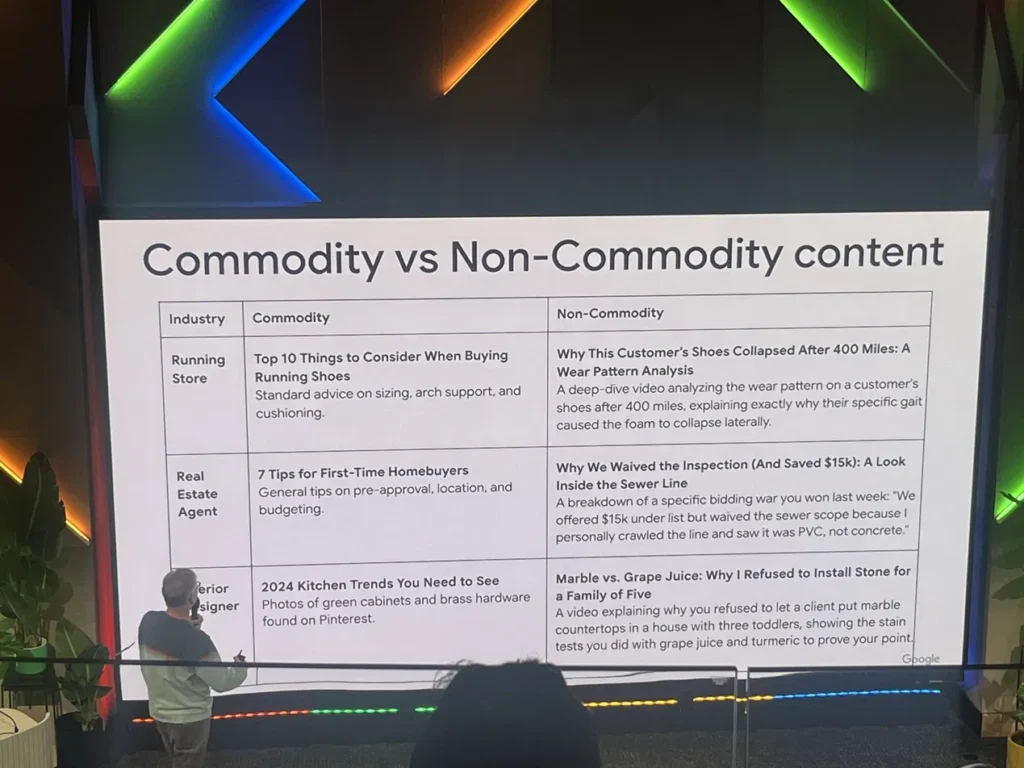
The message was pretty straightforward. Google wants publishers to stop producing content that anyone could write by summarising top search results or asking ChatGPT to rewrite them. They want content that only you could create, from actual experience, with specific details and real expertise behind it.
The SEO community mostly nodded along with this but there is a question that nobody on that stage answered and it is the one that actually matters to anyone running a website.
If We Stop Writing Commodity Content, How Does Anyone Find the Non-Commodity Stuff?
Look at the third example on Sullivan’s slide. The commodity version is “Kitchen Trends You Need to See” with photos of green cabinets and brass hardware pulled from Pinterest. Fine, that is generic, nobody is arguing otherwise. The non-commodity version is “Marble vs. Grape Juice: Why I Refused to Install Stone for a Family of Five” where an interior designer explains why they would not let a client install marble countertops in a house with three toddlers, complete with stain tests using grape juice and turmeric to prove the point.
Brilliant content honestly. But who is searching for that? Nobody types “why a designer refused marble for a family of five” into Google. People search “best kitchen countertop materials” or “marble vs quartz” or “kitchen trends” and those are the exact commodity queries that Google is saying they do not want to reward anymore.
The non-commodity version is clearly better content, nobody would disagree with that. But it does not match how people actually search. It does not trigger any keywords. It has no search volume behind it. You could write the most incredible first-person piece about refusing to install marble and it just sits there with zero impressions because nobody is looking for it through search, unless Google surfaces this post via Discovere, but they also have selected favourites for Discover.
So where does the traffic come from then? Google Discover maybe, if your site qualifies. Social media if you get lucky with shares. But organic search, the channel most publishers actually depend on, that whole system is built around people typing common questions and getting matched to results. Non-commodity content does not really fit into that.
The Concern That Nobody Is Saying Out Loud
This is the part that keeps nagging at me and I know other publishers are thinking the same thing.
Google has already trained its AI on pretty much all the dictionary knowledge, all the science, all the historical facts, all the how-to guides, basically all the commodity content that the internet has produced over the last twenty years. That training is done. The models already know the benefits of eating apples, the steps to buying a house, the best running shoes for flat feet. They do not need more of that.
What AI models have not been trained on enough is first-person experience. Real stories from real situations. The kind of content where a real estate agent talks about crawling through a sewer line during an inspection or where a running store owner analyses the wear pattern on a customer’s shoes after four hundred miles of use.
So when Google goes on stage and sweetly asks us to please create more non-commodity experience-based first-person content, is that actually about rewarding better content? Or is it about getting publishers to produce exactly the kind of material that AI models still need for training?
Because think about what happens right now. You write that first-person experience article. Google indexes it. The AI picks up the insight from it. Next time someone asks a related question the AI Overview just answers it using the knowledge your content provided. The user gets what they need without ever clicking through to your site. You get an impression in Search Console if you are lucky. Maybe a citation. But the traffic is barely there.
A field experiment by researchers at the Indian School of Business and Carnegie Mellon found that AI Overviews cut organic clicks by 38% on queries where they showed up. Zero-click searches went from 54% to 72%. And only about 1% of users actually clicked on sources cited within the AI Overview itself.
So even when your content gets cited you are mostly getting visibility, not traffic. And the deal Google seems to be offering is basically this — create harder, more personal content that takes real expertise and genuine effort, and in return we will use it to answer queries before anyone clicks through to you.
I am not saying this is deliberately manipulative. Maybe Google genuinely believes non-commodity content is better for users and for the internet. It probably is. But you can understand why publishers are suspicious when someone asks them to invest more effort while also building systems that reduce what they get back from that effort.
Commodity Content Is Saturated, Fine, We Know
To be fair Sullivan is not wrong about the problem itself. The internet genuinely does not need another article listing the benefits of eating apples. Or another listicle of first-time homebuyer tips. Or another “top ten things to consider when buying running shoes” that says the same things as the three hundred articles already ranking for that keyword.
AI made this worse. The barrier to producing commodity content basically dropped to zero the moment ChatGPT launched. Anyone can generate a decent article on any common topic in thirty seconds now. The amount of commodity content out there is basically endless and even the AI-generated stuff reads clean enough to pass at surface level.
So competing on commodity content is not a winning strategy anymore. That much is clear. But the question remains whether non-commodity content actually gets rewarded in a way that makes the extra effort worth it, or whether Google is just pushing publishers toward harder content that the AI will scrape just as quickly.
Commodity Content Actually Works Brilliantly Though, Just Not as Blog Posts
Think about your own behaviour for a second. You scroll through Instagram Reels or TikTok or YouTube Shorts every day right? You have probably watched a thirty-second video about the benefits of some fruit, or a quick kitchen hack, or one of those “five things you did not know about” clips. And that video had hundreds of thousands of views, maybe millions.
That is commodity content. The exact same kind of commodity content Google says does not deserve search rankings anymore. But on video platforms it pulls massive numbers because the way it reaches people is completely different. Nobody searches for it. They scroll into it. The platform serves it based on what it thinks you are interested in, not because you typed a keyword.
A Reel about “why you should eat apples every day” can get two million views. A blog post covering the same information barely gets two hundred visits because the AI Overview already answered the query and by the time you scroll past Reddit and Quora and YouTube and Forbes and maybe India Today there is room for maybe two small publisher sites at the bottom. Maybe.
So if you are a publisher sitting on commodity knowledge, recipes, tips, how-to guides, product comparisons, basic industry education, the play is not more blog posts. The play is video. Short form specifically. That content finds its audience through the platform algorithm, people do not have to search for it. And the video platforms are still hungry for this kind of material.
That is actually good news if you are willing to shift format. The knowledge you already have is still valuable. The channel where it works just changed.
For businesses looking to adapt different approaches highlighted by clickintelligence.co.uk or how AI-driven SEO can align content with intent rather than just keywords. Growth now comes from clear positioning, relevance, and answering real questions, rather than keyword-heavy pages.
What About Text Bloggers Then
If commodity blog posts are a dead end and non-commodity experience pieces struggle with search volume then what is actually left for people who write?
Discovery content. And not repackaged old information dressed up with a new headline.
The text content that still works is stuff that AI has not been trained on yet and that no dictionary or textbook has covered. New tricks, new findings, new observations from your industry that nobody else has written about because they are happening right now in real time.
Quick example from SEO. Facebook group posts recently started showing up in Google search results. That is not in any guide. No textbook covers it. An SEO who noticed this, tested it, and wrote about how to use Facebook groups for search visibility, that article gets picked up by Google Discover if the site is clean and the quality is there. People share it because it is genuinely new information. It drives traffic because there are not three hundred competing articles saying the same thing already.
Every industry has this kind of content sitting right there. Things happening right now that have not been documented yet because they are too new or too niche for the commodity content machine to have covered them. A plumber who finds a specific pipe fitting failure showing up in new builds. A social media manager who notices that a particular posting pattern triggers LinkedIn differently than it did six months ago. A local baker who figures out that Google Maps rankings shifted after updating their business profile photos.
That is the discovery layer. Not past knowledge repackaged but current knowledge being written about for the first time. And it has the advantage of being genuinely non-commodity while also having a realistic shot at traffic through Discover, social shares, and niche communities picking it up and passing it around.
For businesses trying to figure out how to actually adapt to all of this, understanding how AI-driven SEO works in the current search environment rather than how it worked three years ago is becoming pretty important. The old model of targeting keyword volume with commodity articles and crossing your fingers for page one is not the only option anymore.
Before I close, one more question from Google and friends.
I wrote this article, now I have shared breakdowns of the current tension in the SEO community. I have identified the fatal flaw.
So how does anyone find this? Only one Google product would do it, and that is Google News or Discover. But what if my site is not approved for Google Discover? Then all efforts are zero.
Now you might say, “Share on social media.” Yes, that is the only way. I post on Twitter or Reddit and it gets picked up. So the answer is simple: it is social media that is sending traffic to my posts.
What good did Google do for me, apart from scraping my posts for training their AI? And how will I get visitors to this page from Google?
The Model Changed and We Need to Change With It
Google is not going to reverse AI Overviews. Zero-click searches are not going to slow down. Commodity blog content is not going to suddenly start performing again. The way search works now is just different from how it worked before and that is not going back.
But people still need information. They still need services and products and businesses they can trust. They still need to find those things somehow. The way they find them is what shifted.
Video for commodity knowledge. Discovery content for text. Non-commodity experience pieces for building authority and trust even if the search volume is not directly there. And honestly just accepting that Google is not your only traffic source anymore and probably should not have been for a while now.
The publishers who adjust to that will be fine. The ones sitting around waiting for things to go back to how they were will keep watching traffic decline and wondering why nothing works like it used to.