


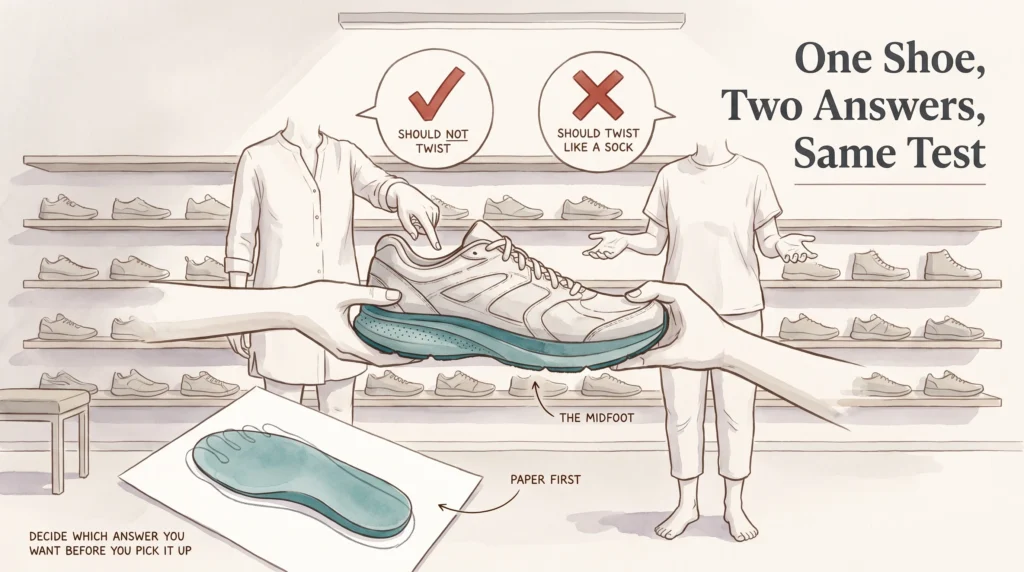
Pick up a shoe in any store and try to wring it out like a wet towel. A podiatrist watching you would want it to fight back. A barefoot shoe fan standing right next to them would want it to twist like a sock. Same test, same two hands and they grade it in opposite directions and most of the shoe advice online just picks a side without mentioning there is another one.
We looked into five checks people pass around and only a couple of them mean the same thing to both camps.
Tracing Your Foot On Paper Tells You More Than The Size Label
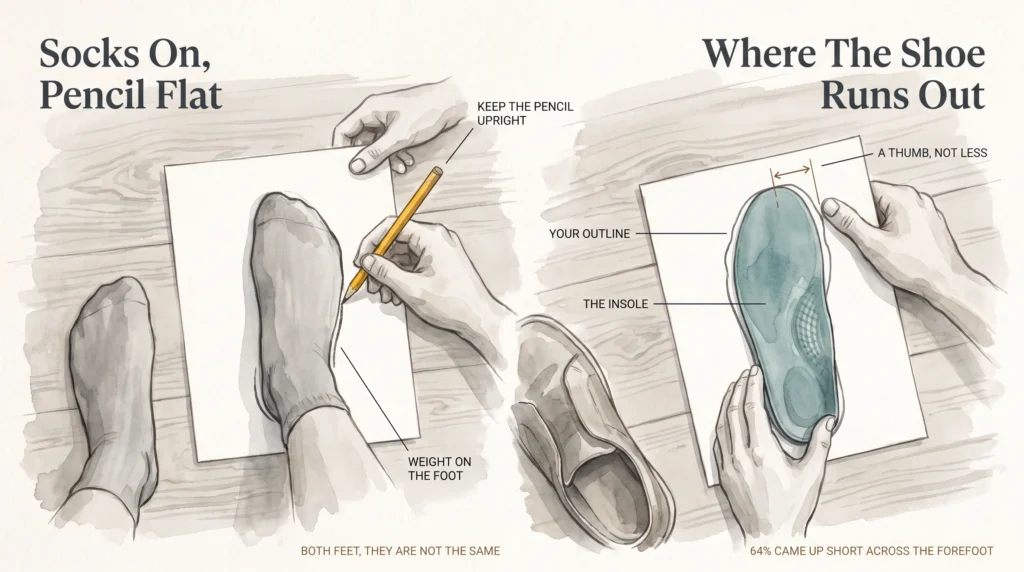
You can do this by standing on a sheet of paper in your socks and tracing around your foot. Then pull the insole out of the shoe and lay it over the drawing. If the insole covers your outline with about a thumb’s width past the longest toe, good. If the front of it narrows to a point while your drawing is still wide, your toes are going to spend the whole day pressed together and breaking the shoe in won’t change that.
It sounds like something off a kindergarten craft table, but researchers use almost the same method. A 2025 study in the Journal of Foot and Ankle Research traces the soles of everyday shoes worn by women with bunions on paper and this is what it finds.
- 64% of those shoes were narrower than the women’s own forefoot.
Which is a lot and it isn’t unusual either. A 2018 review by Andrew Buldt and Hylton Menz found that between 63% and 72% of people across the studies they looked at were in shoes that didn’t match the width or the length of their feet and the ones most often squeezed were older people and people with diabetes. Most of us have been buying the same size since high school without anybody ever measuring and feet do spread out with age.
Narrow shoes are one of the few bunion risks you can actually do something about. So, pencil first.
Why Podiatrists And Barefoot Brands Grade The Twist Test Differently
If we look at the American Podiatric Medical Association, their advice is short: a shoe shouldn’t twist in the middle. Peter Redko, a podiatrist in Petaluma, California, says “The shoe should only bend where your toes bend,” and if it folds right through the arch he doesn’t think it can protect the plantar fascia, the band of tissue that runs along the bottom of your foot.
The barefoot people want the opposite and a lot of that idea actually started at Nike. Back in 2001 some Nike designers were visiting Stanford and watched coach Vin Lananna’s runners training barefoot on the university golf course. Lananna told them he figured it made their feet stronger and three years later Nike put out the first Nike Free. They even gave it a number, barefoot was a 0, a regular running shoe was a 10 and the Free sat at 5.0, right in the middle, like a shoe that couldn’t make up it’s mind.
Which Result You Should Actually Be Looking For
I’m standing in the aisle wringing out a sneaker and I have no clue whether it’s supposed to fight me or not.
If you’ve got flat feet, plantar fasciitis or you’re on your feet all day for work, go with the podiatrists and a shoe that twists like a dishrag probably isn’t yours. If your feet are healthy and you’ve already spent a while easing into thinner shoes, the barefoot version is fine. Either way you need to know which answer you want before you pick the shoe up, otherwise the test doesn’t really tell you anything.
Heel Drop: Lower It Slowly, If At All
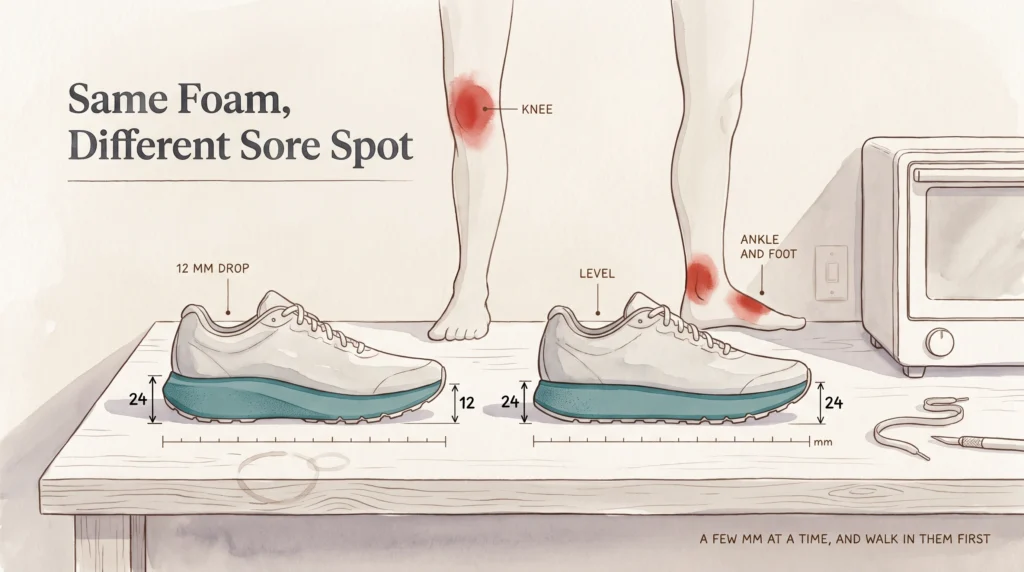
Through most of the 1990s a normal running shoe sat at roughly 24 millimeters under the heel and 12 under the toes. Golden Harper, working in his family’s running store in Orem, Utah, thought that was shoving people onto their heels every time they ran and his fix was, well, a toaster oven. He asked his dad how hot to set it and got told “275, just wait until the glue starts to bubble.” He left them in too long anyway and melted the laces. Glued in some flat foam, went for a run, liked it a lot.
The store ended up selling around a thousand pairs done the same way that first year, the big brands weren’t interested and that is more or less how Altra started. Every Altra is still built level, heel and toe at the same height.
Well, it’s a genuinely fun story. Doesn’t mean everyone needs flat shoes though and the studies are messier than the fans would like. Researchers in Luxembourg gave runners shoes with the exact same cushioning and only changed the drop. Overall injuries came out about even, they just showed up in different places:
- 10 mm drop: more knee problems
- Zero drop: more ankle and foot problems
A 2015 review also found people got hurt more often while switching over to minimalist shoes, mostly calves, Achilles and arches, in the weeks their legs were still catching up with their feet.
So if you want to go lower, drop a few millimeters at a time and walk in the new pair before you run in it. Going from regular sneakers straight to flat ones is pretty much a guaranteed ticket to sore calves by Friday.
Thin, Firm Soles And Balance In Older Adults
1992, a balance beam, 25 men over 60 and a pile of shoes with different midsoles. The researchers went in expecting the soft, thick running shoes to do best. That didn’t happen. Soft soles and thick soles both left the men wobblier and the paper came down on the side of thin, hard soles for balance in older people.
The same paper also said something that tends to get left out, that older people who’ve already had a fall or who are plainly unsteady, shouldn’t be going barefoot. Thin and firm, yes. Nothing on the feet, no.
Not everybody selling thin shoes stuck to what the evidence could hold up, though. Vibram, the company behind the FiveFingers toe shoes, got hit with class action suits over health claims like stronger feet and fewer injuries. It didn’t admit to anything, but in 2014 it agreed to:
- set aside $3.75 million for refunds of up to $94 a pair
- stop making those claims without scientific support
Some of the checks that eventually turned up in people’s mailboxes were for about twenty bucks. Skechers had already paid $40 million to settle with the FTC over it’s Shape-ups toning shoes, so Vibram wasn’t exactly on it’s own there.
The Heel Check Both Sides Agree On
You just press both sides of the heel with your thumbs. It should feel firm and not squash in, that’s APMA’s check and the barefoot crowd wants the same thing, because a roomy toe box is no use if your foot slides forward into it on every step. Lace up properly and walk around the store for a full minute, not three steps to the mirror and back. Heel stays put, toes can still wiggle.
I’ve got diabetes, should I even be trying any of this? Talk to a podiatrist first and the same goes if you’ve had a fall this past year or your feet have been hurting for weeks.
Our order would be paper, then heel, then the twist. Most people do it the other way around, fall for how a shoe bends in their hands and only find out it’s too narrow on day three.