


If you have ever Googled how to clear THC before a drug test, you have probably seen the same advice repeated everywhere. Hit the gym, sweat it out, burn the fat where THC is stored, and you will show up clean on test day. It sounds reasonable on the surface because THC really does get stored in fat cells and exercise really does burn fat, so the logic seems to connect. But the actual research on what happens when regular cannabis users exercise before a test points to the opposite outcome, and most people doing the sweat-it-out routine the night before a screening are unknowingly increasing their odds of failing rather than passing.
This is one of those situations where the popular advice gets the biology backwards. The short version is that exercise can pull stored THC out of your fat and dump it back into your bloodstream right when you do not want it there, and there is published human research showing exactly that effect.
What Actually Happens to THC in Your Body

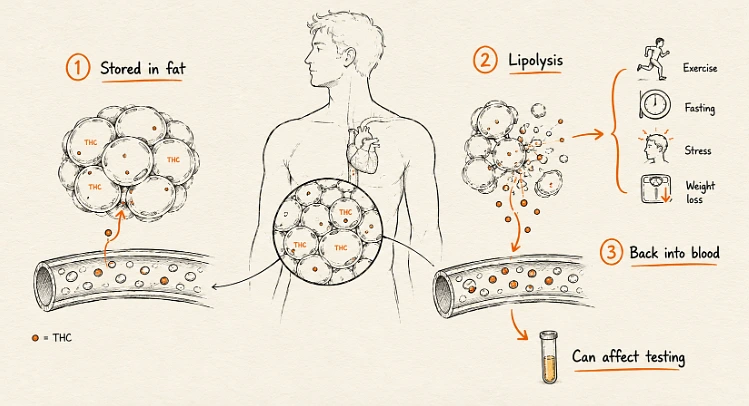
To understand why exercise backfires you first have to understand where THC sits in the body in the first place. THC is highly lipid soluble, which means it dissolves in fat much more readily than in water, and once it enters the bloodstream it gets rapidly taken up by fat tissue throughout the body. The plasma half-life of THC is roughly 1 to 3 days in occasional users and stretches to 5 to 13 days in chronic users, mostly because the THC stored in adipose tissue keeps leaking back into the blood slowly over time.
This is the part that matters for drug testing. THC is not just sitting in your blood waiting to be flushed out. It is parked in your fat cells, and the body releases it back into circulation gradually as those fat cells go through their normal turnover. THC has actually been detected in human fat tissue up to 28 days after last use in some cases, which is why heavy users can test positive weeks after stopping even though they feel completely sober and their last dose was long gone from any active effect.
The thing that triggers a bigger release of stored THC is anything that breaks down fat faster than normal. Lipolysis, which is the technical term for fat breakdown, happens during fasting, weight loss, stress, and yes, exercise. And when lipolysis ramps up, the THC that was sitting quietly in your fat cells gets dumped into the bloodstream along with the fatty acids your body is mobilizing for energy.
The Study That Confirmed the Exercise Effect
The clearest evidence for the exercise paradox came from a 2013 human trial run by researchers at the University of Sydney and the National Drug and Alcohol Research Centre. The study, “Exercise increases plasma THC concentrations in regular cannabis users,” was published in Drug and Alcohol Dependence and showed that a single 35-minute bout of moderate exercise on a stationary bike caused a measurable spike in plasma THC levels in regular cannabis users.
The setup was straightforward. Fourteen regular cannabis users, all of whom had abstained for at least 24 hours, did 35 minutes of cycling at 50% of their aerobic capacity. Researchers took blood samples before exercise, immediately after, and two hours later. The result was that THC plasma concentrations went up by roughly 15% on average right after the workout, with a strong statistical effect size that ruled out chance. The effect was also positively correlated with body mass index, meaning participants with higher body fat showed bigger spikes, which fits exactly with the storage mechanism because more fat means more THC to release.
A follow-up study published the next year in Basic & Clinical Pharmacology & Toxicology, titled “Can Physical Exercise or Food Deprivation Cause Release of Fat‐Stored Cannabinoids?” tested the same idea in six abstinent chronic users with a 45-minute moderate workout and 24 hours of fasting. The exercise effect was smaller in their sample and they concluded the changes were unlikely to disrupt most drug testing programs. So the size of the spike varies and not every person sees a dramatic shift. But the underlying mechanism, fat breakdown releasing stored THC, is the same in both studies, and the original Sydney result has been replicated in animal work too where rats pre-treated with THC showed elevated plasma cannabinoid levels after fasting and exercise.
The honest read on the research is that exercise can absolutely raise your THC levels above where they would have been at rest, the size of the effect depends on how much THC you have stored and how hard you push, and trying to time a workout the night before a test is rolling dice you do not need to roll.
Why This Specifically Hurts Drug Test Results

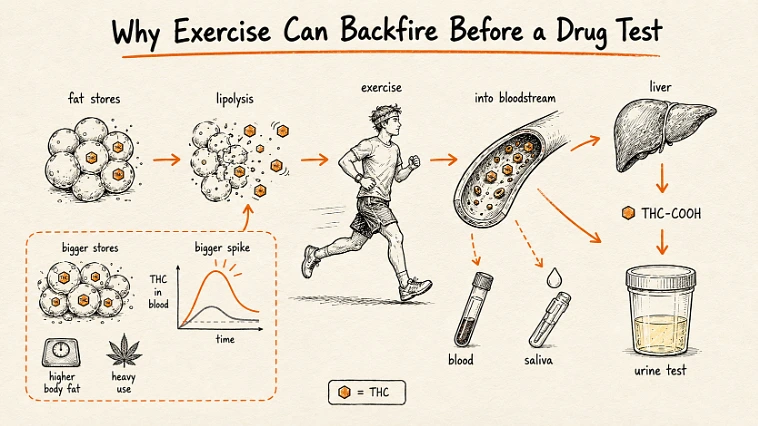
Drug tests do not measure THC in your fat. They measure what is circulating in your blood, urine, or saliva at the moment the sample is taken. So anything that increases what is in circulation right before that sample is the opposite of what you want.
The urine test is the most common workplace screening and it measures THC-COOH, the metabolite your liver produces after breaking down THC. When stored THC gets released back into the blood through lipolysis, the liver processes it, generates more THC-COOH, and that metabolite ends up in your urine. So a workout the night before a urine test does not just affect your blood numbers, it can push more metabolite into the exact sample the lab will be checking.
The body fat correlation makes this worse for the people who are already most at risk. Heavy users with higher body fat percentages have the largest THC stores, take the longest to clear naturally, and also show the biggest spikes from exercise. The exact group of people who most need a clean test are the ones for whom exercise backfires hardest.
What This Means for Test Timing
If you are anywhere near a scheduled drug test, the practical takeaway from the research is that the 24 to 48 hours before the sample is collected should be the least active period of your prep, not the most. The instinct to “burn it off” right before the test is exactly backwards, you want your fat cells to be as stable as possible heading into the sample collection, not actively breaking down and dumping their contents into your blood.
This does not mean exercise is bad for clearing THC in general. Over a longer window, regular activity helps reduce overall body fat, which is the actual long-term mechanism by which active people clear faster than sedentary ones. The problem is the timing of the lipolysis. Burning fat over weeks reduces your THC reservoir gradually. Burning fat the night before a test pulls a chunk of that reservoir into your bloodstream right when the test is measuring it.
If you want a realistic timeline for your own situation, a THC detox calculator is going to give you a much more personalized estimate than the generic timelines you find in forums, because it factors in usage patterns, body composition, and the type of test rather than just averaging across everyone.
A Few Other Common Mistakes Worth Knowing About

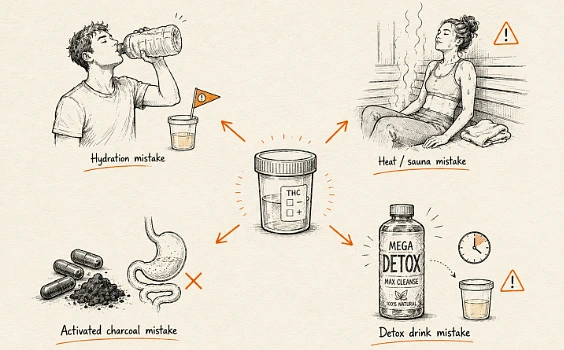
The exercise paradox is the most counterintuitive part of THC clearance but it sits next to a few other things people get wrong about the same general timeline.
Hydration is one. Drinking gallons of water the morning of a test does not flush THC out because THC is not water soluble, it is fat soluble. Excessive water intake just dilutes urine, and modern labs check for that by measuring creatinine and specific gravity, so a diluted sample often gets flagged as invalid and you end up retaking the test under closer supervision instead of passing the first one.
Sauna sessions and hot yoga marathons fall in the same bucket as workouts. THC metabolites leave the body primarily through the gut and urinary tract, not through sweat glands, and any intense heat or activity right before a test runs the same lipolysis risk as a workout.
Activated charcoal does not help either. It binds to substances still sitting in your digestive tract, but THC has been absorbed into your bloodstream long before charcoal would ever reach it, and the metabolites in your urine are coming out of your liver and fat stores, not your stomach.
Same-day detox drinks from smoke shops mostly work by diluting urine for a few hours and packing it with B vitamins and creatinine to mask the dilution. Sometimes that works. Often it does not, because labs have gotten much better at spotting the signature, and you are betting your test result on a window that lasts maybe an hour or two.
What Actually Helps Over Time
The boring honest answer is that there is no shortcut for THC. The only real way to clear it is to stop using, give your body time, and let your liver and kidneys do their normal job of processing the metabolites and excreting them. For occasional users that takes a few days. For heavy daily users it can take a month or more. Body fat percentage, metabolism, and recent usage patterns all push the number in either direction.
Detox Drinks and Quick Fixes Guarantee a Pass
Walk into any smoke shop, and you’ll see the bright bottles promising to clean you out in an hour. They don’t. Most same-day detox drinks remove zero THC. What they do is dilute your urine for a few hours and pack it with B vitamins and creatinine so the dilution is harder to spot.
Sometimes that works. Most of the time it doesn’t. The window is short, it varies from person to person, and labs have gotten much better at catching the signature. You’re betting a job on a coin flip with way worse odds than a coin flip.
The approach that holds up is slower and less exciting. Stop consuming, eat fiber, stay reasonably active, and give your liver time to work through the backlog. Some people add a liver-support supplement like the Marivana Liver Cleanse to that routine. Just know what it is. It’s a support for the process, not a substitute for it. Nothing in a bottle pulls THC out of your fat cells.
If you have weeks of runway before a test, regular moderate exercise as part of an overall fat reduction strategy will help shrink your THC reservoir gradually, which is the version where exercise actually works in your favor. If you have days or hours before a test, the smartest move is to stop adding more, eat normally, hydrate normally, and avoid any sudden lipolysis triggers like fasting, intense workouts, or sauna sessions in the final 48 hours.
Verifying where you actually stand before walking into an official screening is also worth doing. At-home test strips are cheap and accurate enough to tell you if you are likely to pass, and they remove the guessing that pushes people into desperate last-minute moves like exercise binges that work against them.
The whole topic gets simpler once you stop fighting the chemistry. THC behaves the way it behaves because of how fat-soluble compounds move through the body, and no amount of sweating or chugging water changes that. The strategies that actually work line up with the biology. The ones that backfire are the ones that work against it.
This article is for informational purposes only and is not medical or legal advice. Drug test outcomes vary based on individual physiology, testing methodology, and lab procedures, and you should consult a qualified professional for guidance specific to your situation.