


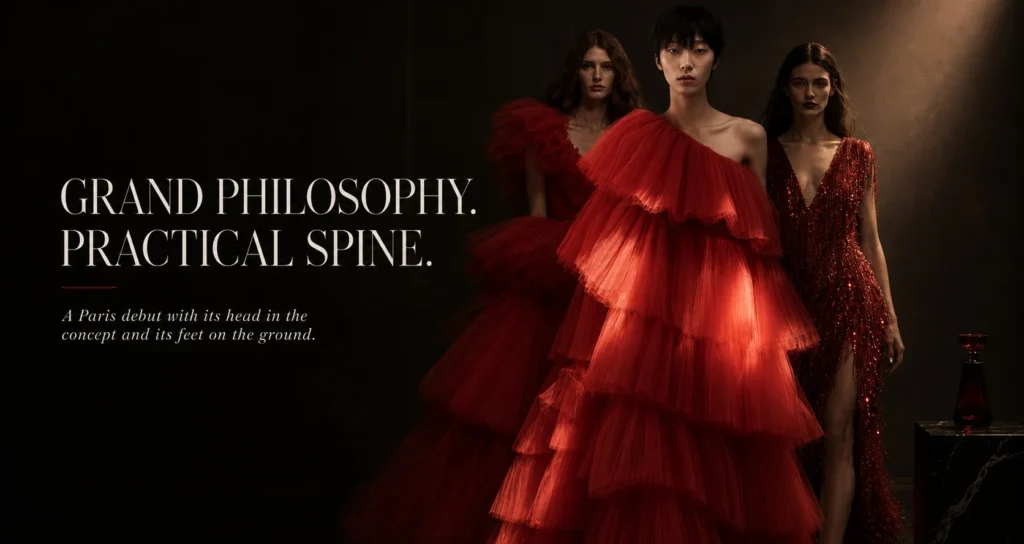
Jordan Hyatt made her official Paris Couture Week debut on July 9, 2026, with an off-schedule show at the Palais de Tokyo and the collection, titled Transformation, arrived wrapped in the kind of lofty conceptual language couture runs on. Identity as fluid, garments as living architecture, clothing that reveals “successive states instead of a final form.” All of which would be easy to wave off as the usual couture poetry, except for one thing: the designer behind it keeps undercutting her own mysticism with something refreshingly blunt. “I’m not the couturier who makes costumes for the runway,” Hyatt told WWD. “I want to make dresses you can wear.” That contradiction, between the grand philosophy and the practical woman stating it, is the most interesting thing about this collection and the reason it works.
The Debut And What’s Actually Behind It

This isn’t a new brand having a lucky moment. Hyatt founded the Canadian label RVNG in 2014 and it’s spent over a decade building quietly, dressing women for red carpets and appearing at the Oscars and the Met Gala before this Paris bow. It was named Womenswear Designer of the Year at the 2026 Canadian Arts and Fashion Awards. So the debut reads less as an arrival out of nowhere and more as a house stepping onto the biggest stage it’s earned it’s way toward.
The brand name, pronounced “revenge,” sets the tone, though not the one you’d expect. Hyatt is clear it carries no animosity. It’s about presence, “standing up in your moments, about showing up, no matter what,” dressing a woman for the moment she’s finally ready to own a room. It’s revenge as arrival, not as grievance.
The Concept, Stated As Grandly As Couture Demands

The show notes make their case at full volume. Transformation, they argue, isn’t a single event but a continuous process, something that happens through movement and tension and the accumulation of choices. Each garment is meant to be a responsive structure completed only by the body wearing it, shifting as it moves.
Take that as far as you like and it’s the sort of thing that either moves you or makes you roll your eyes and couture has trained us to expect it either way. What keeps it from floating off into pure abstraction is that Hyatt actually built the clothes to deliver on it, which is rarer than the genre admits.
Where The Philosophy Becomes Real Construction

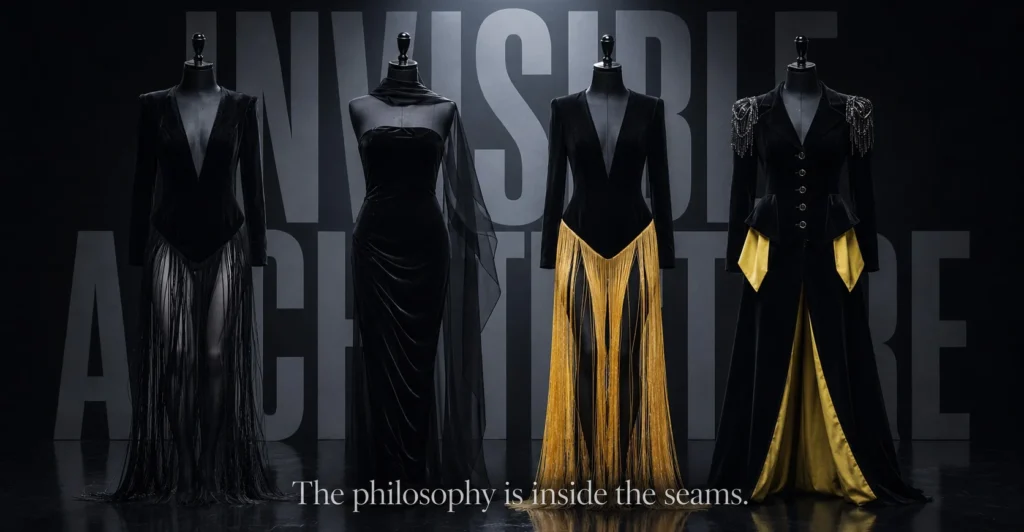
The collection’s actual argument is made under the surface and this is where Hyatt’s practicality shows. The structure starts with what you can’t see: hidden wire frameworks and internal armatures she calls an “invisible architecture,” patterns draped and drafted directly on the body with guidelines basted by hand.
And here’s the tell that separates her from the runway-costume crowd, she gives equal weight to what’s inside the garment. Built-in bras, corsetry, internal strapping, all engineered so there’s no slippage or strain when a woman actually wears the thing for a full evening. That’s not a poetic flourish, that’s a designer who has thought about a real body standing in a real room for four hours. When she says she has “body” and understands body, this internal engineering is what she means and it’s the practical spine under all the philosophy.
The materials carry the tension between structure and fluidity. Silk tulle and velvet layered to preserve air and movement, glass-beaded fringe that registers every gesture, brocade lending weight and depth. It’s built to move without collapsing, which is the whole thesis made tangible.
Black As The Spine, Color As The Interruption
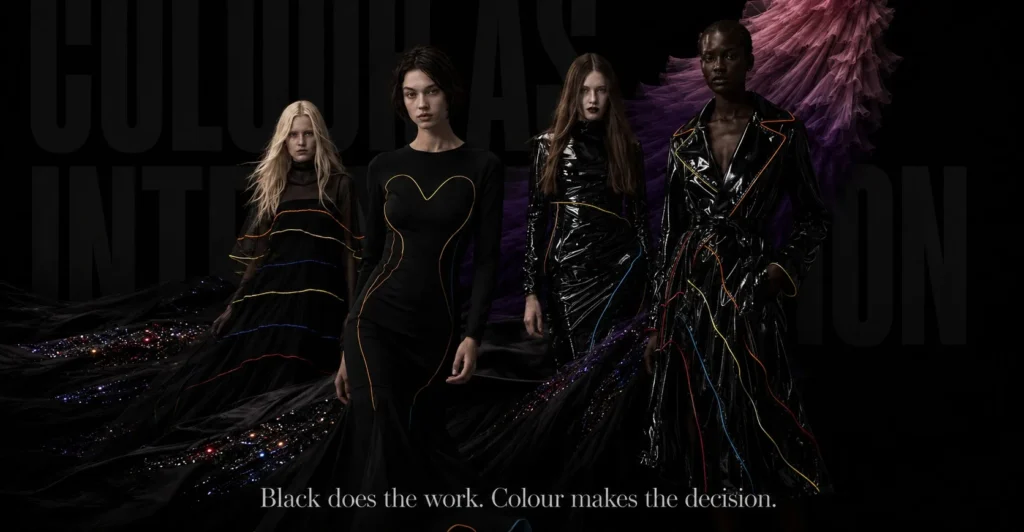
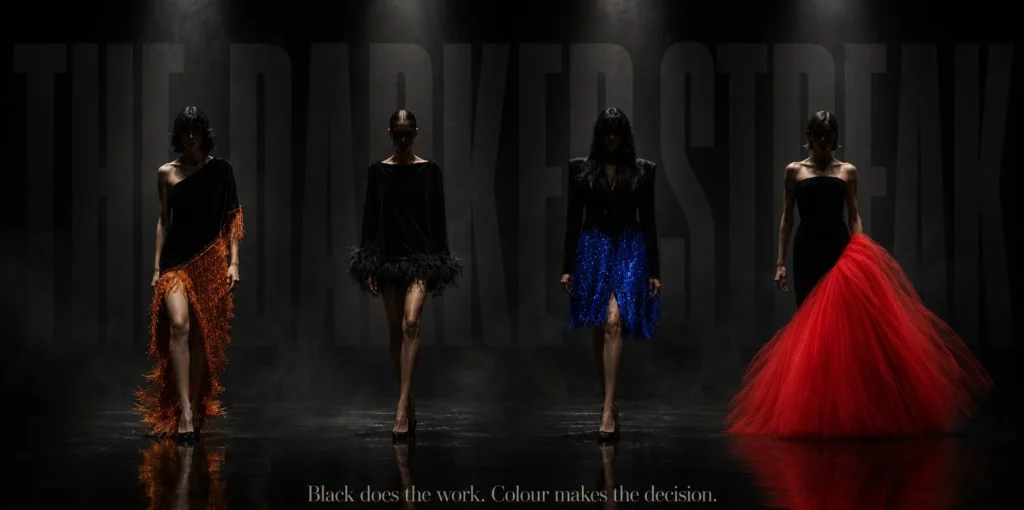
The color story is where the collection organizes itself visually. Black does the structural work and Hyatt leans into it hard this season, black-on-black, taffeta, latex, floor-skimming fringe extending the silhouette past the body. She’s described calling on her “darker streak” here and the black creates a kind of concentrated space where line and proportion become unmistakable.
Against that, saturated color arrives with intent rather than decoration, crystal fringe throwing off flashes of cobalt, crimson and amber before vanishing back into shadow. Elsewhere the palette softens into transitional runs, pinks and blues and yellows, a movement from light pink through lilac to deep purple, ombre tulle that looks swept through smoke and ink. The restraint is the point: color interrupts the black rather than flooding it, so each burst reads as a decision.
The Woman She’s Actually Dressing
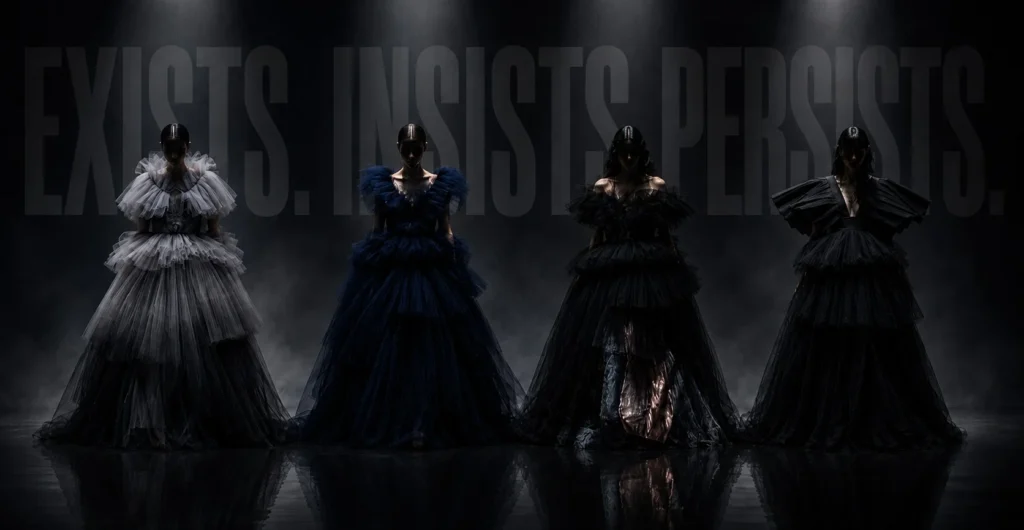
Strip away the show-note philosophy and what’s left is clarity about who this is for and it’s the most convincing part. Hyatt isn’t dressing an abstraction. Her client, as she puts it, isn’t a woman who pleases but one who “exists, insists and persists,” dressed as though she has nothing left to apologize for. The whole 23-piece collection is built around the “stand-up moment,” the award, the red carpet, the room finally ready to be owned.
What makes it land is that Hyatt refuses to soften herself to sell it. She’s built a real business, recently extended into a lower-priced ready-to-wear resort line and she has no interest in mass appeal. “If everybody likes me, then I’m not doing enough,” she said. “I’m not looking to be universally loved.” That’s the actual philosophy of this house, more than any line about fluid identity, a designer who protects her independence specifically so she can keep making exactly what she means to.
The debut works because the concept and the person behind it pull in slightly different directions and the clothes hold both. The show notes reach for transformation and continuous states of becoming; Hyatt reaches for a bra that won’t slip and a hem that moves right. A lesser designer would pick one register and bore you with it. RVNG’s Paris arrival is the rarer thing, a couture collection with it’s head in the philosophy and it’s feet firmly on the ground, made by someone who clearly trusts the second part more than the first.