


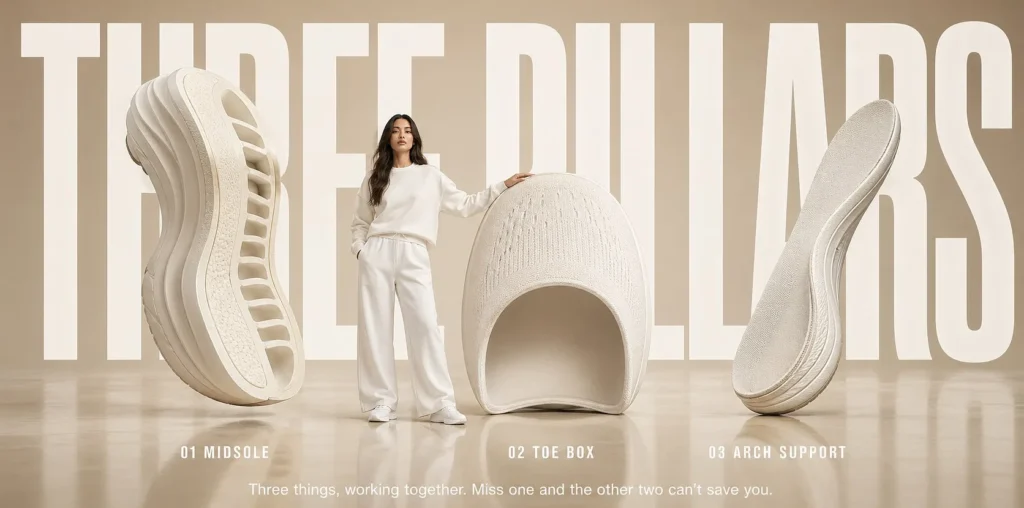
A comfortable shoe needs three things working together: a midsole that absorbs and returns energy correctly, a toe box wide enough to match your foot’s actual shape, and arch support matched to your specific foot type. Miss any one of them and the other two can’t compensate.
Most people pick shoes based on how they look. Maybe the sole feels soft when you press it in the store. Maybe the size seems right. They wear them for a week and something starts aching — the heel, the ball of the foot, the outside edge — and they assume they just need to break them in.
Sometimes that’s true. Mostly it isn’t.
Comfort in a shoe isn’t about softness or style. It comes down to three specific things happening correctly at the same time — and most shoes on the market only get one or two of them right.
1. What Is the Midsole Actually Doing Every Time Your Foot Hits the Ground?
The midsole is the layer between the outer sole and the insole. It’s the part that does the actual work of absorbing impact — and the part most people pay the least attention to when buying shoes.
When your heel strikes the ground, the force traveling up through your body is roughly 1.5 to 3 times your body weight, depending on whether you’re walking or running. That force has to go somewhere. The midsole’s job is to absorb it, spread it, and return some of it as energy — the last part being what prevents your legs from feeling dead after a few hours on your feet.
Research published in Scientific Reports found that different midsole structures significantly impact gait phase and gait ratio — including foot balance, forefoot loading, and stance phase stability. In plain terms: the midsole directly shapes how your weight moves through each step. Get it wrong and the foot compensates, which is usually when pain starts showing up somewhere with no obvious reason.
Studies on midsole density gradation showed something counterintuitive:
- Softer foam performs better under the lateral toes and heel edges
- Firmer foam is needed under the metatarsal and arch zones
- A flat, uniformly soft midsole — which feels great in the shop — often feels exhausting after two hours
This is why that cheap cushioned flat can feel comfortable at first and wrecked by afternoon. It’s giving the same response to parts of the foot that need completely different things.
ScienceDirect research on EVA midsole densities found strong associations between cushioning perception and actual ground reaction forces and plantar pressures. The feel isn’t just psychological — it tracks directly with what’s physically happening underfoot.
One thing worth knowing: most foam midsoles lose meaningful cushioning performance after 300 to 500 miles of use, even if the upper and outsole look perfectly fine. That aching that starts six months in isn’t always a fit problem. It’s often a midsole that’s hit its limit.
2. Does the Toe Box Shape Actually Matter That Much?
More than almost anything else — and it’s the dimension most people never think to check.
The toe box is the front section of the shoe where the toes sit. Most shoe designs taper toward the toe. It’s an aesthetic decision — tapered shoes look sleeker. The human foot does not taper toward the toe. The widest point of most people’s feet is at or near the toes, which means a tapered toe box compresses the foot’s widest part into the shoe’s narrowest part from step one.
A systematic review found that:
- 50% of women and 34.3% of men were wearing footwear narrower than their foot by more than 5mm
- 22% of those wearing shoes smaller than their feet reported foot pain
- Only 9.5% of those wearing correctly sized footwear reported the same
The consequences compound over time. A large epidemiological study in PMC found that women who wore narrow or very narrow toe boxes in their twenties and thirties had significantly higher rates of hallux valgus — bunion deformity — decades later. Decades of compression changes foot structure. It doesn’t reverse quickly.
A study in the Journal of Orthopaedic & Sports Physical Therapy found that individuals wearing shoes with a wide toe box reported a 34% reduction in bunion pain compared to those in narrow-toed shoes.
It goes beyond bunions. Common consequences of chronically narrow toe boxes include:
- Hammertoes — toes bending abnormally to fit cramped spaces
- Morton’s neuroma — a painful nerve condition worsened by compression between toes
- Blisters and calluses from constant toe overlap and friction
- Reduced circulation — emerging research suggests toe misalignment may impede blood flow
A 2024 randomised crossover study published in Bioengineering found that toe box shape significantly affects in-shoe foot displacement and deformation during running — wider toe boxes reducing both dorsal and plantar pressures and lowering injury risk.
The practical check: stand on a piece of paper, draw around your foot, then place your shoe on top. If the shoe outline is narrower than your foot outline at the toes, your shoe is compressing your toes every single time you wear it. Most people find this surprising. Almost nobody’s shoes actually match their foot shape.
3. What Is Arch Support Really Doing — and How Much Do You Actually Need?
The arch of the foot is a load-bearing structure. It compresses under weight, stores energy, and releases it during push-off. When properly supported, that mechanism works efficiently and the surrounding tendons don’t get overloaded. When it isn’t — the plantar fascia, the thick band of tissue running along the bottom of the foot, takes the strain.
A clinical study from a tertiary centre in Boston found that arch support insoles work through two key mechanisms:
- Anatomical foot realignment — measurable changes in radiological bone positioning
- Pressure redistribution in the heel — reducing the load concentration that causes pain
Research published in PLOS One found that arch support insoles:
- Reduce peak vertical ground reaction force at the heel
- Provide better medial-lateral control of the foot’s centre of pressure
- Improve stability during walking
- Lead to measurable improvements in basic mobility and overall comfort
The nuance that matters: the right amount of arch support depends on your foot type.
- Flat feet — where the arch collapses under load — benefit from more structured support
- High arches — more rigid, less shock-absorbing — need different geometry than flat feet
- A generic insole that works for one foot type can actively make things worse for another
A 2024 trial on long-term heel pain found that a structured barefoot walking programme produced greater improvements in pain and function than walking in shoes — suggesting the goal isn’t maximum support at all times, but appropriate support matched to your foot’s actual structure.
For everyday shoes, the benchmark is simple: a defined heel cup and a contoured footbed that follows the natural curve of the arch. A completely flat insole gives the arch nothing to work with. Fine for short periods — cumulative stress builds fast when standing or walking for hours on a flat surface, which is why cheap flat shoes always feel worse by the end of the day, not just different.
Why All Three Have to Work Together
Here’s where most shoes fail — they get one right and miss the other two.
- A shoe with good cushioning but a narrow toe box is compressing the foot’s widest point regardless of how well the foam performs
- A shoe with a wide toe box but a flat midsole gives the toes room while loading the heel and forefoot unevenly
- Arch support without an appropriate midsole puts structural demand on the insole it wasn’t designed to handle alone
All three have to be right at the same time. That’s the standard most shoes don’t meet — and the reason the most comfortable shoe you’ve ever worn probably hit all three without you knowing it.
Sources: Scientific Reports/Nature · ScienceDirect — EVA Midsole Cushioning · PMC — Incorrectly Fitted Footwear Systematic Review · PMC — Hallux Valgus Epidemiology · PMC/Bioengineering — Toe Box Shape 2024 · PLOS One — Arch Support and Flatfoot · PMC — Plantar Fasciitis Arch Support Boston