


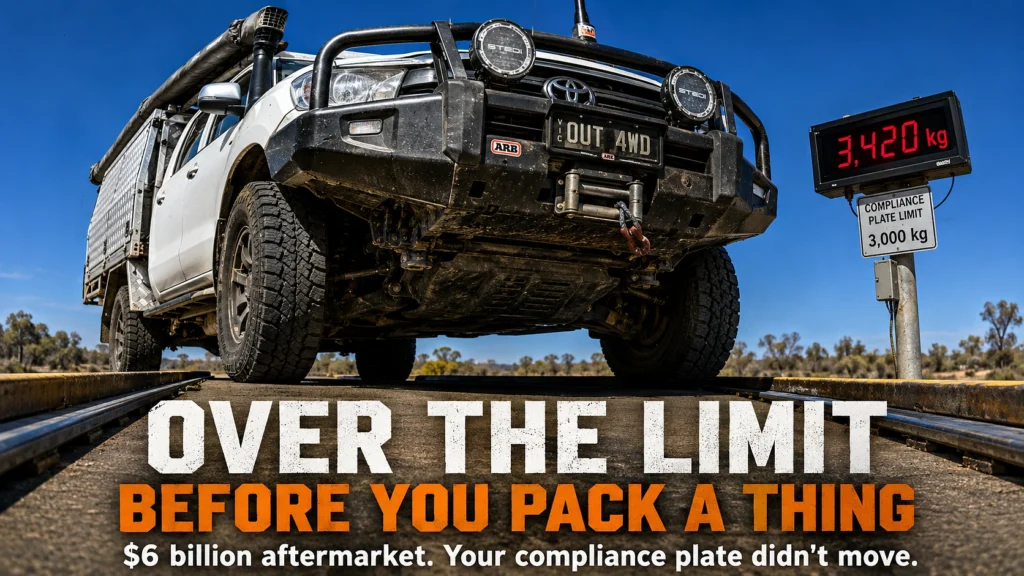
A fully built touring rig can sit over its legal weight while completely empty. No water, no fridge, no swags. Just the bar, winch, drawers, dual battery and rooftop tent, and the weighbridge already reads past what the compliance plate allows. The truck gets heavier with every upgrade. The weight you’re legally allowed to carry doesn’t move at all, and people are bolting on plenty. The 4WD aftermarket is now around 2,100 businesses, turning over about $6 billion a year.
Your payload is a fixed budget, and accessories spend it fast
Work it out in one line: GVM minus tare equals payload. On a 3,000kg GVM with a 2,200kg tare, that leaves 800kg for everything you add, passengers included. Here’s where that 800kg goes:
Payload to start (3,000kg GVM minus 2,200kg tare): 800kg
- Steel bull bar plus winch: ~90kg
- Drawers plus fridge: ~80kg
- Dual battery plus wiring: ~30kg
- Rooftop tent: ~75kg
- Canopy and storage setup: ~60kg
Accessories alone: ~335kg
Add two adults (~160kg), 80L of water (~80kg), plus fuel and camp gear, and the 800kg is basically gone.
Most of that weight ends up behind the rear axle, in the tray, which is exactly where you don’t want it.
A GVM upgrade buys back payload, but not towing capacity
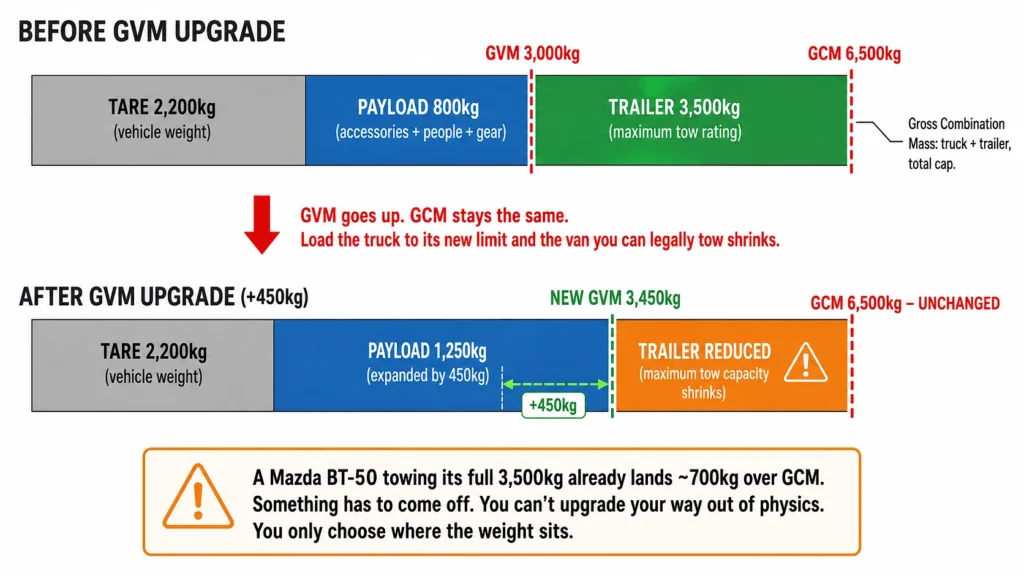
A certified upgrade lifts a 200 Series LandCruiser from 3,350kg to 3,800kg, about 450kg more payload. Good news with a catch:
- It does nothing to your Gross Combination Mass, the combined limit for truck plus trailer.
- Load the truck to its new limit, and the van you can legally tow shrinks.
- A Mazda BT-50 towing its full 3,500kg already lands roughly 700kg over its GCM, so something has to come off.
You can’t upgrade your way out of physics. You only choose where the weight sits.
Sort the weight first, then choose the canopy

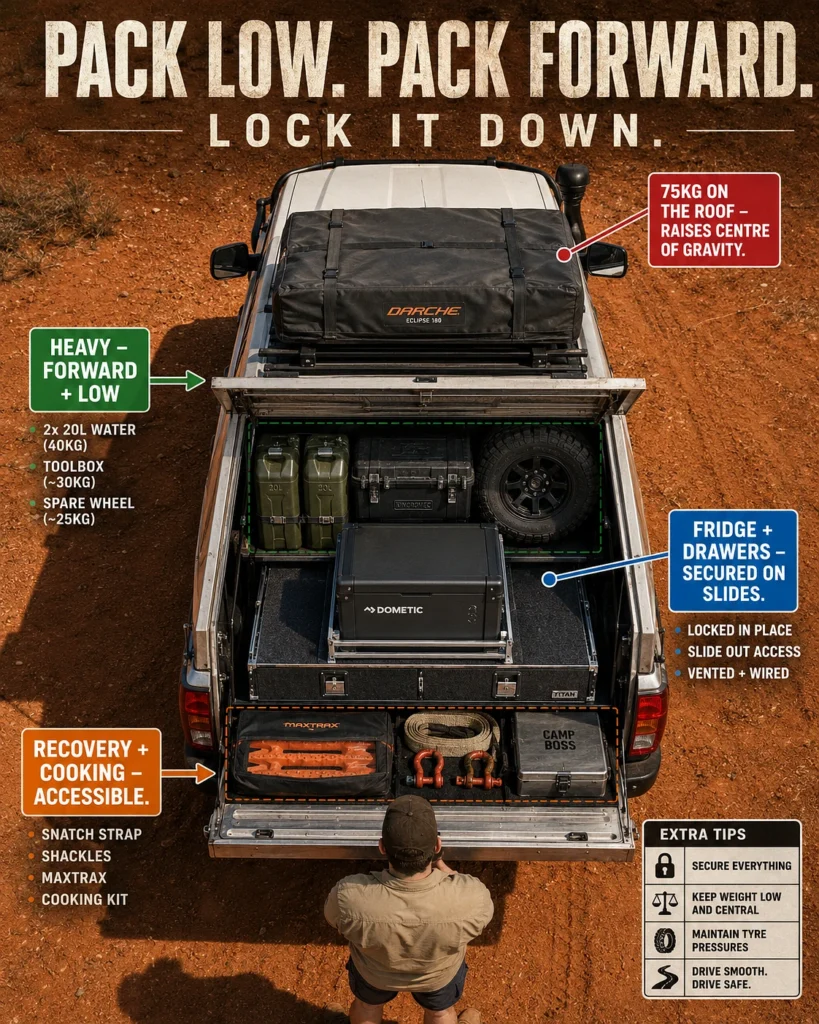
How you pack the back matters more than what you bolt on. Aluminium has beaten fibreglass for touring because:
- It’s lighter, and every kilo comes out of that fixed budget.
- It handles corrugations without the cracking that fibreglass can pick up over time.
- Modular drawers, fridge slides and the right canopy accessories keep heavy gear low, forward and locked down.
Recovery gear where you can reach it fast, cooking kit in one spot, sleeping gear in another, nothing loose enough to shift on a bad track.
Power is the easy part
The lightest battery wins. Lithium auxiliary batteries replaced AGM mainly because they’re lighter for the same usable capacity, which ties straight back to payload. A 2,000W inverter runs the cooktop and coffee machine, a solar panel keeps the fridge happy, and a correctly sized cable stops voltage drop in the heat.
So weigh the rig before the next upgrade tempts you. Build around what it can legally carry, get the heavy gear low and forward, and you’ll have a truck that drives right and won’t have you sweating at a weighbridge.