


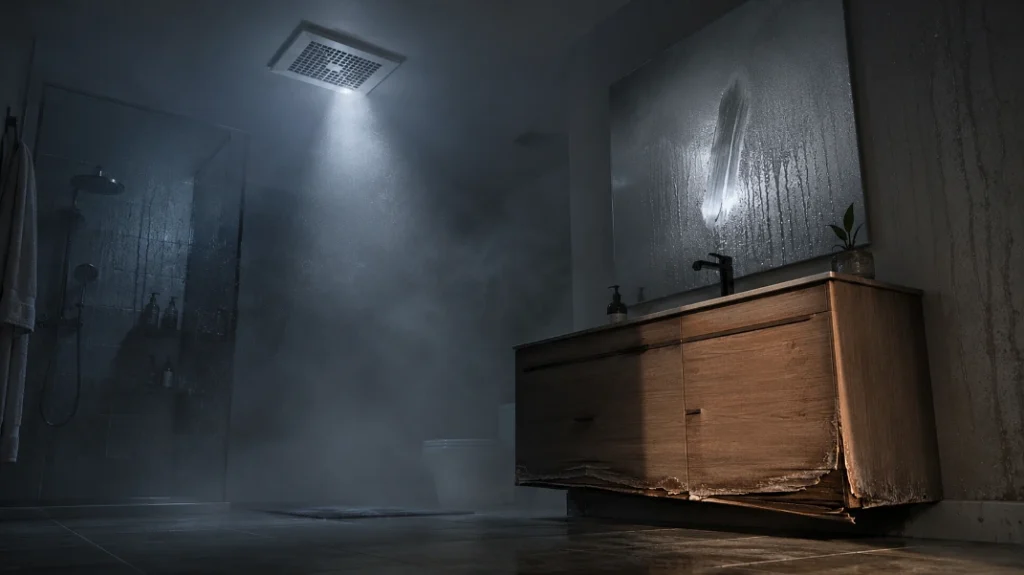
Quick answer: the exhaust fan is the only thing standing between your shower steam and every surface in the bathroom, and almost everyone runs it wrong. The Home Ventilating Institute says the fan should keep running for 20 minutes after you leave. Most people shut it off in two.
That 18 minute gap is where the moisture that swells vanities, peels paint, and feeds mold does its work.
The fan has a reputation problem. People treat it as an odor gadget, a courtesy switch, the thing you flip for guests. Its actual job is water removal. A 10 minute shower puts roughly half a pint of water into the air of a small room, and that water doesn’t vanish when you towel off. It hangs there, then it settles. Onto the mirror, the paint, the grout, and straight into the one piece of furniture in the room, the vanity.
And this is the part that stings. When a vanity swells at the bottom edges, people blame the vanity. They replace it, spend real money on a nicer one, and eighteen months later the new one’s doing the same thing, because the problem was never the cabinet. The culprit was on the ceiling the whole time, shut off eighteen minutes early, every single day.
Half a Pint Per Shower, and Nowhere to Go

Older, draftier houses used to get away with weak ventilation because the building leaked. Humid air found its own way out through the gaps. Modern homes are sealed tight, which is great for the heating bill and terrible for the bathroom, because now that half pint of airborne water has exactly one exit, and it’s the fan.
The Home Ventilating Institute, the industry body that certifies these things, is blunt about what happens when the exit stays closed. Their published damage list from uncontrolled bathroom humidity runs: cracked and peeling paint and wallpaper, ruined wallboard, warped doors, rusted cabinets and fixtures, and eventually deterioration of the joists and framing above the bathroom. Read that again. The authority on ventilation lists your cabinets and the structure of your house as what’s at stake. Not fogged mirrors. Framing.
Which is why the fan pairs directly with the furniture decision. A vanity built from materials that survive humidity buys you resilience, but even solid plywood is fighting uphill in a room that never dries out. The fan decides what kind of room the vanity lives in.
The Three Ways a Fan Fails at Its Job


Most bathroom fans are failing right now, quietly, in one of three specific ways. All three are checkable this weekend.
- It runs 18 minutes too short. HVI’s recommendation is 20 minutes of runtime after the bathroom is used, because the moisture load takes that long to clear. Shutting it off when you leave means the fan handled the shower and skipped the steam. If the mirror is still fogged when the fan goes off, the job isn’t done.
- It’s too small for the room. The sizing rule is simple: 1 CFM of fan capacity per square foot of floor, roughly eight full air changes an hour, for any bathroom up to 100 square feet. A 60 square foot bathroom needs a 60 CFM fan, minimum 50 no matter how small the room. Bigger than 100 square feet and you size by fixtures instead, 50 CFM each for the shower, the tub, and an enclosed toilet. Plenty of builder installed fans miss these numbers, and an undersized fan running the full 20 minutes still loses.
- It’s venting into the attic. This one’s worse than no fan at all. Code requires bathroom exhaust to terminate outdoors, and dumping it into the attic instead is a violation for a very physical reason: you’re relocating the mold problem to the roof framing and the insulation, where you won’t see it until it’s expensive. If you don’t know where your fan’s duct ends, that’s worth finding out this month, not eventually.
The Honest Reason the Fan Stays Off

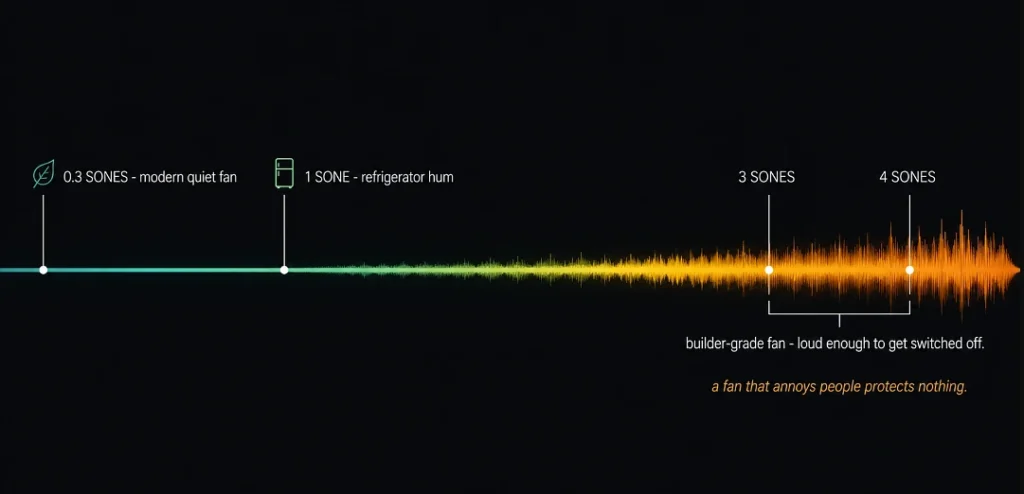
Noise. That’s it. Builder grade fans run at 3 to 4 sones, loud enough that people instinctively shut them off to get some peace, and every one of those shutoffs donates another few minutes of humidity to the room. Modern quiet fans run 0.3 to 1 sone, quieter than a refrigerator, and the difference in how often a household actually uses the fan is dramatic. A fan that annoys people protects nothing, because it’s never on.
Does the room feel dry ten minutes after a shower?

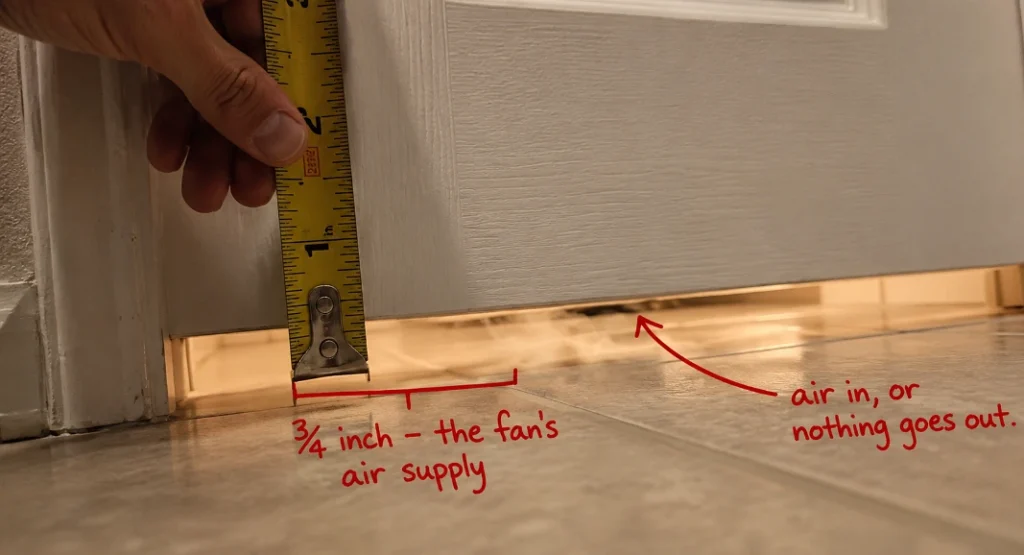
Then the system’s working. Still damp after twenty? The fan’s undersized, the duct’s restricted, or the air has no way in. That last one surprises people: a fan can only push air out if replacement air can get in, which is why the bathroom door needs about three quarters of an inch of clearance under it. A sealed room defeats its own fan.
Two Cheap Fixes That Make the Whole Thing Automatic
The 20 minute rule fails because it depends on humans remembering it, so stop depending on them.
A timer switch costs $15 to $30, replaces the existing wall switch, and lets you hit it on the way out while the fan finishes the job alone. A humidity sensing fan goes further, switching itself on when the room passes about 60% humidity and off again below 50%, no human input at all, for somewhere between $100 and $180. Against the price of one replacement vanity, either option is a rounding error. One more note if you’ve got a steam shower: HVI’s guidance is a separate dedicated fan for the steam enclosure itself, because a standard bath fan isn’t sized for what a steam session releases.
My honest take, having looked at what the humidity actually costs: the exhaust fan is the cheapest piece of equipment in the bathroom and it’s protecting the most expensive ones, and it’s the only upgrade in the room where thirty dollars of timer switch can outperform a thousand dollars of furniture. Fix the fan before you replace anything the moisture has already ruined, because otherwise you’re buying the humidity a nicer meal.