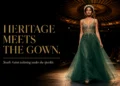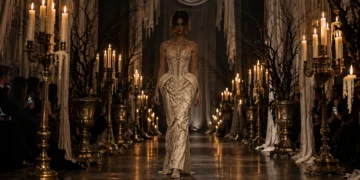
Tang Chi Couture Spring/Summer 2027: New York Debut in a Room Dressed for a Wake
The candelabras were the tell. Before a single look walked The Georgia Room on September 11, the runway had been...
Read moreDetails

She published it in October 2025 and the industry took five months to prove her right.
Daria Nazarova is a working plus-size model — editorial credits at Harper’s Bazaar and L’Officiel, judging panels for international pageants, the kind of career that puts you in enough rooms to notice patterns. In an essay for Marie Claire Nigeria she described a specific mechanism rather than a feeling, which is what separated it from most writing on the subject.
One plus-size model walks. The collection still stops at size L. Perhaps a handful of larger pieces exist somewhere if you go hunting for them. Anyone who has sat through a casting recognized it immediately.
Then the AW26 season happened.
More than a hundred shows across New York, London, Milan and Paris. Over 7,000 looks. Straight sizes, meaning US 0 through 4, took 97.6 percent of them. Mid-size — US 6 to 12 — landed at 2.1 percent. Plus-size, US 14 and above, finished at 0.3 percent.
The season before, that last figure was 0.9. Cut by two-thirds in six months. Mid-size went up by a tenth of a point over the same stretch and there’s something instructive in that pairing about what gets counted as diversity when a casting director has one slot to fill and no appetite for a conversation.
| Straight size | Mid-size | Plus-size | |
|---|---|---|---|
| New York | 97.7% | — | — |
| London | 92.7% | 6.5% | 0.8% |
| Milan | 97.3% | — | — |
London reads better because London has Karoline Vitto and a NewGen pipeline that has kept two or three size-committed names on the schedule. Pull those names and the column matches the others. Vitto has said as much herself, which comes later.
Nazarova’s framing was that inclusivity is a system of actions, not a slogan — that it has to run through design, casting, production teams, creative direction. AW26 is what the alternative looks like: one layer of that system gets touched, briefly, when someone is watching.
Two things in her essay do most of the work and both are about how the industry hedges.
The first is a casting preference nobody announces. Brands reach for models sitting between sample size and plus size — safe diversity, as she called it. Wide enough appeal, no real challenge to the norm. Set that against the 2.1 percent mid-size figure and the 0.3 percent plus-size figure and you can watch the preference operating across four cities at once.
The second is harder. She has been added to campaigns purely to satisfy diversity metrics and she describes the moment of understanding that you were selected to symbolize inclusion rather than to contribute as a professional. That is a different job than the one on the call sheet.
Her position on marketing itself is more generous than the headline suggests. Marketing spreads awareness and sustains creative work — her objection is narrower, that it shouldn’t replace meaning and that a brand claiming inclusion has to back it with transparent casting and genuine diversity behind the camera as well as in front of it.
Whether that argument moves anyone when it comes from a model rather than an analyst is it’s own question. Probably not. The spreadsheet tends to get the meeting.
Her essay names Renee Cafaro directly — as someone treating inclusion as a mission rather than a seasonal theme, casting varied shapes, heights and ages.
Cafaro showed “Out of Scale” at NYFW in September 2025, a Chelsea gallery, couture built specifically for larger bodies up to 5X, made in the Garment District by BIPOC artisans using materials sourced in the city. She came to fashion from a social justice background and the collection carried both registers — candy motifs and vinyl records in places, something considerably more confrontational in others. Jazzmine Carthon, who walked it, described it as showing up for herself in an industry that tells her she should be erased.
One number frames why that show mattered. A Vogue Business inclusivity report from March 2025 found that of 8,703 runway looks, 24 would have fit the average American woman.
Vitto works from London, sizes XS to 3XL and her AW26 show did something no dataset can: models from XS through curvy in the same draped dresses and sculpted jersey, identical silhouettes, the construction holding across all of it. Zipped gussets down the sides of trousers, part detail and part on-the-go adjustment. Elastic structure built into a tailored waistband. A Pull&Bear collaboration landing the morning of the show, extended to 2XL at retail — evidence it scales when a company decides to make it scale.
Her show notes said curve casting had all but frozen over. And then the line that should have settled the question of whether this is fixed: the weight of body diversity should not rest on a handful of designers. If she and her few peers skip a season, nobody picks it up and the numbers fall off a cliff.
Between SS26 and AW26, roughly that happened.
New York Fashion Week for spring/summer 2027 runs September 10 to 15, 2026. Seventy shows and presentations on the CFDA’s preliminary schedule. Diane von Furstenberg opens with Henry Zankov’s debut as artistic director, Thom Browne closes, Ralph Lauren shows off-calendar the night before.
The first-timer list is long and worth attention — Conner Ives, Magda Butrym, Sabyasachi, Zaldy, Benjamin Seidler, High Sport. CFDA/Vogue Fashion Fund finalists throughout. First NYFW under the fully fur-free official-schedule policy.
No name on that preliminary schedule is publicly positioned on extended sizing.
Preliminary matters there. Schedules shift, names get added and off-calendar presentations don’t appear on it at all — which is exactly where Cafaro’s kind of show tends to sit. So this is not a forecast. It’s what the official list currently signals, seven weeks out, in a season following a 0.3 percent measurement.
The distance between what a calendar promises and what actually walks is Nazarova’s entire argument, restated as a scheduling document.
Plus-size apparel is a market in the hundreds of billions depending on whose methodology you accept and McKinsey found in 2023 that body-diverse marketing produced a 32 percent lift in customer engagement against conventional casting.
The runway figure went up, then down and now sits below where it was in 2020.
Nazarova closed more hopefully than I would. Seven years of catwalks growing more diverse, inclusion moving from buzzword toward movement, designers and PR teams increasingly treating it as a value rather than a tactic. She has been in the rooms and I have not, so her read may be the better one.
Her experience covers her own bookings, though. The data covers 7,000 looks. Right now those two things point in opposite directions.

The candelabras were the tell. Before a single look walked The Georgia Room on September 11, the runway had been...
Read moreDetails
Copyright © 2024 NoodleMagazine - All Right Reserved