Open-Box Electronics: The Smartest Way to Buy Tech in Canada Right Now
Canadian tech buyers are in a squeeze. Prices on monitors, peripherals, and smart home gear keep climbing, the dollar isn't...
Read moreDetails

A 17-year-old junior in Maryland gets docked a grade for writing about music she loves. A Liberty University student is told to apologize for using AI on a paper about her own cancer diagnosis. A University of Michigan student with documented disabilities is slapped with a “no record” grade because a graduate assistant decided her writing style “felt artificial.” None of them used AI.
This is not a hypothetical. This is what’s happening right now in classrooms across the United States, the UK, and beyond. AI detection tools — the ones your professors trust like gospel — are accusing honest students of cheating, and the fallout is destroying academic careers. The worst part? Students have almost zero ability to defend themselves before the damage is done.
That’s the problem. Reilaa is the fix. A free, unlimited AI detector built for students that lets you check your own work before submission, estimate your Turnitin score, and protect yourself from false accusations before they ever happen. No paywall. No sign-up. No catch.
But before we get into how it works, you need to understand exactly how broken the system is — and why it’s only getting worse.
In February 2026, a YouGov survey commissioned by Studiosity polled 2,373 university students. The findings were bleak:
The irony is suffocating. The people with the least to hide are the most afraid.
This survey didn’t come out of nowhere. It followed a full year of escalating incidents. In December 2025, NPR published an investigation documenting how more than 40% of surveyed 6th-to-12th-grade teachers used AI detection tools during the last school year — despite “numerous research studies showing that AI detection tools are far from reliable.” A month later, NBC News spoke to ten students and faculty caught in the middle of what they described as “an escalating war of AI tools.”
Students described dumbing down their own work, recording themselves writing, and running every assignment through multiple detectors — just to prove they’re human. One student left her university entirely because she couldn’t handle the stress of repeated false accusations.
Here’s what the AI detection industry doesn’t want you to know: the technology isn’t reliable enough to accuse anyone of anything. It never was.
A landmark 2023 study published in the International Journal for Educational Integrity by Weber-Wulff et al. tested 14 of the most popular AI detection tools, including Turnitin, GPTZero, and Copyleaks. With over 695 academic citations, it remains the most comprehensive independent analysis of AI detection accuracy to date. The conclusion was devastating. Not a single tool achieved 80% accuracy. The researchers stated plainly: “the available detection tools are neither accurate nor reliable.”
Here’s what they found:
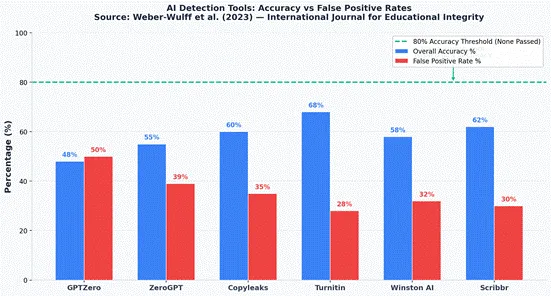
Not a single major AI detection tool passed the 80% accuracy threshold. GPTZero led with a 50% false positive rate — meaning every other flag could be an innocent student. Data sourced from Weber-Wulff et al. (2023).
So if you’re an international student who writes in your native language and translates to English, these tools are already biased against you. The system treats your multilingual ability as evidence of cheating. That’s not a flaw in the student. That’s a flaw in the technology.
The stories aren’t abstract. They’re documented, named and getting worse.
Ailsa Ostovitz, a 17-year-old junior at Eleanor Roosevelt High School in Maryland, was accused of using AI on three assignments in two classes during a single school year. One accusation was based on a writing assignment about music she listens to. “I write about music. I love music. Why would I use AI to write something that I like talking about?” she told NPR. Her teacher didn’t respond to her appeal. Her grade was docked.
Leigh Burrell, a computer science major at the University of Houston-Downtown, received a zero on an assignment worth 15% of her final grade after Turnitin flagged her mock cover letter. According to Google Docs editing history reviewed by The New York Times, she had drafted and revised the assignment over two days. She had to send a 15-page PDF of timestamped screenshots to get her grade restored.
Brittany Carr, a long-distance student at Liberty University, received failing grades on three assignments flagged by AI detectors. She showed revision history and even handwritten notes. One assignment was about her own cancer diagnosis and battle with depression. The university told her to take a “writing with integrity” class and sign an apology. She eventually dropped out.
In February 2026, a student sued the University of Michigan, claiming the school wrongly accused her of using AI to write class papers. The student has documented generalized anxiety disorder and obsessive-compulsive disorder. The lawsuit argues that traits associated with her disabilities — “formal tone, meticulous structure, stylistic consistency” — were misinterpreted as signs of AI use.
Here’s the pattern:
The common thread isn’t cheating. It’s writing with clarity, structure, and effort — exactly what education is supposed to teach you.
Here’s the structural problem that makes all of this so much worse: professors have access to AI detection tools, and students don’t.
Turnitin, the dominant player in academic integrity, is only available to institutions. Students cannot run their own papers through Turnitin before submitting. They can’t see what the algorithm thinks of their writing. They can’t identify which sentences might trigger a flag. They submit blind, and if the machine decides they’re guilty, the burden of proof falls entirely on them.
As Erin Ramirez, an associate professor of education at Cal State Monterey Bay, told NBC News: “Students now are trying to prove that they’re human, even though they might have never touched AI ever.” She also put her own academic papers through AI detectors. The result? “It flags me at like 98% every time, and I didn’t use AI in any capacity.”
A high school teacher in Cleveland, Carrie Cofer, ran a chapter of her Ph.D. dissertation through GPTZero. It came back as “89% to 91% AI-written.” She wrote every word herself. The tools don’t work reliably for professors. They definitely don’t work reliably for students. But students are the only ones being punished.
The result of this broken system is predictable. Students are turning to AI humanizer tools — software that scans ai text and suggests changes to make it appear less machine-generated. Some students use these tools to humanize the text they wrote themselves, simply to avoid getting falsely flagged.
According to NBC News reporting, Joseph Thibault, founder of academic integrity software company Cursive, tracked 43 humanizer tools that received a combined 33.9 million website visits in a single month. That demand tells you everything. Students aren’t flocking to tools that convert ai to human-readable patterns because they all cheated. Many are running there because they’re terrified of a system that punishes them for writing clearly.
The detection companies responded exactly how you’d expect:
So now the detection companies are trying to catch students for using tools to protect themselves from the detection companies’ own false positives. And Grammarly wants students to voluntarily record their entire writing process and hand it over as proof of innocence. Five million Authorship reports were created in the past year. Most were never submitted.
The system has turned students into suspects who must monitor and record themselves writing homework just to prove they’re innocent. That is not education. That is surveillance theater.
So here’s where we stand:
The solution is obvious: give students the same information professors have. Let them check their work before they submit it. Let them see what the algorithms think — and fix anything that might trigger a false positive — before their academic record is on the line.
That’s what Reilaa does.
It is a free AI detector built specifically for students. No monthly subscription. No scan limits. No sign-up required. You paste your text, get your AI detection score, get an estimated Turnitin score, and you’re done. Check it once. Check it ten times. Check every draft of every assignment all semester. It costs nothing.
This matters because the existing options are useless for students on a budget:
None of them offer a free Turnitin estimation. None of them are designed for the student experience. None of them let you scan unlimited text without pulling out a credit card.
It provides genuinely unlimited free AI detection with Turnitin score estimation included. That means you can see an approximation of what your professor’s Turnitin report will show — before you hit submit. If a section scores high, you can rework it. Add more personal voice. Vary your sentence structure. Include specific examples. Change AI language to human language — not because you cheated, but because the algorithm can’t tell the difference between clean writing and machine output.
The tool also deletes your text immediately after analysis. No storage. No database. No adding your essay to a plagiarism repository. Your work stays yours. Compare that to Turnitin, which stores every submission and has faced years of criticism for profiting off student work without consent.
Most free AI detectors are free for a reason — they barely function. Here’s what separates Reilaa from the rest:
| Feature | Reilaa | GPTZero | Copyleaks | ZeroGPT | Turnitin | Scribbr |
| Free Unlimited Scans | ✅ Yes | ❌ Capped monthly | ❌ Paid plans only | ⚠️ Limited | ❌ Institution only | ❌ Paywalled |
| Turnitin Score Estimation | ✅ Yes | ❌ No | ❌ No | ❌ No | ✅ Native (no student access) | ❌ No |
| Sign-Up Required | ❌ None | ✅ Required | ✅ Required | ⚠️ Optional but limited | ✅ Institutional login | ✅ Required |
| Word Count Cap | ❌ Unlimited | ⚠️ 5,000 free | ❌ Pay per word | ⚠️ Limited | N/A | ⚠️ Limited |
| Text Stored After Scan | ❌ Deleted immediately | ⚠️ Unclear | ⚠️ Stored | ⚠️ Unclear | ✅ Stored permanently | ⚠️ Unclear |
| Built for Students | ✅ Yes | ⚠️ Partially | ❌ Enterprise focus | ⚠️ Generic | ❌ Institution only | ⚠️ Partially |
| False Positive Rate (Weber-Wulff) | N/A (estimation tool) | 🔴 50% | 🟡 35% | 🟡 39% | 🟡 28% | 🟡 30% |
| Price | Free | $10+/mo | $30+/mo | Free (limited) | Institutional license | $20+/mo |
The result? Students who use Reilaa before submitting aren’t surprised by their professor’s AI report. They aren’t scrambling to compile 15-page PDFs of screenshots. They aren’t sitting in an academic integrity hearing trying to explain why they write in formal sentences.
They already know their score. They already fixed anything suspicious. They submit with confidence.
This issue goes far beyond a bad grade on one assignment. False AI accusations carry consequences that can follow students for years:
The Studiosity/YouGov survey found that 60% of students experienced stress while using any AI tools for study, and international students were disproportionately affected. The report explicitly recommended that university leaders “reconsider detection tools that give false positives” and “establish pathways to protect students from wrongful cheating accusations.”
Vivienne Stern, chief executive of Universities UK, wrote in the report’s foreword: “It is important that students have confidence in using AI to enhance, rather than replace, genuine learning… This report shows we still have some way to go in this regard.”
She’s right. And while institutions slowly figure out their policies over the next several years, students need protection right now. Today. Before the next assignment is due.
If you’re a student writing essays, research papers, dissertations, or any academic work, here’s the play:
Before you submit anything, paste your text into Reilaa. Get your AI detection score and your Turnitin estimation. If any section flags high, rework it:
Do this for every draft. Do this for every class. It gives you unlimited scans for free, so there’s zero reason not to check. The five minutes it takes to scan your paper could save you from weeks of academic integrity hearings, thousands in legal fees, and permanent damage to your transcript.
Your professors didn’t create this mess. The detection companies did. They sold universities on undetectable AI detection technology that doesn’t work, pocketed the licensing fees, and left students to deal with the fallout. And until the technology actually works — if it ever does — the responsibility falls on you to defend yourself.
Reilaa gives you the tools to do that, at no cost, with no compromise on your privacy.
The system is broken. Stop hoping someone will fix it for you. Check your work. Know your score. Submit with proof that you’re human.

Canadian tech buyers are in a squeeze. Prices on monitors, peripherals, and smart home gear keep climbing, the dollar isn't...
Read moreDetails
Copyright © 2024 NoodleMagazine - All Right Reserved