
Peter White’s Net Worth: An In-Depth Look
I came to Peter White backwards. Most people find him through the smooth-jazz radio staples, but the first thing I...
Read moreDetails

The format is the easy part of the decision. Vial, nasal spray, capsule, that’s mostly about convenience. What actually determines whether a product is worth buying is the documentation behind it, and that documentation should look the same no matter which format you’re holding. A convenient capsule with no paperwork is a worse buy than a well documented vial, every time. Here are the six things worth checking on any product at peptides.com, applied with the same eye regardless of format.
One note before the list: this is written for laboratory research. Everything below is for research use only, not for human or animal consumption.
Purity is the headline number, so start there. High-quality research peptides generally run 99 percent or higher, and the good suppliers put that figure in writing rather than gesturing at it with words like “premium” or “lab grade.” The percentage tells you how much of the material is the compound you wanted versus synthesis leftovers.
Packaging changes nothing here. A vial, a spray and a capsule should each carry a clear number, because the container has no effect on what fraction of the contents is real. A missing purity figure is the first red flag, and it doesn’t matter how slick the format is.
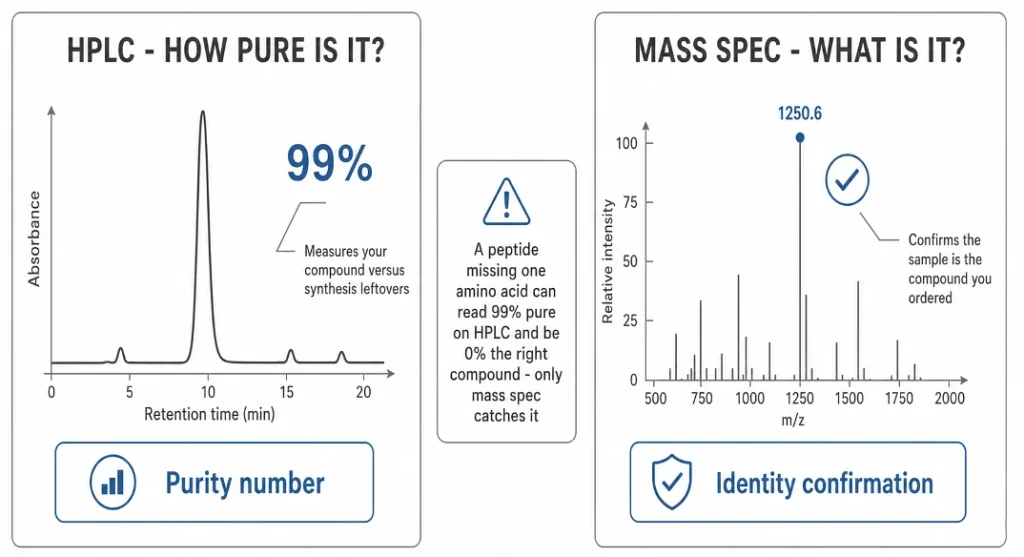
A purity number with no evidence behind it is just a claim. The evidence is the certificate of analysis, the lab report for one specific batch. Two words matter most: published and batch-specific. You want a document you can open, tied to the exact lot you’re buying, not a generic PDF that could describe any batch the supplier ever made.
And here’s the part the marketing rarely explains: a strong COA carries two different tests, because they answer two different questions. HPLC measures how pure the sample is. Mass spectrometry confirms what the sample actually is. That distinction is not academic. A peptide missing a single amino acid can read as 99 percent pure on HPLC while being zero percent the compound you ordered, and only the mass spec result would catch it. A COA showing HPLC purity alongside a molecular weight confirmation is the real thing. One without the other is half the picture.
peptides.com keeps lab reports across its catalog, which is the transparency this signal is about. No COA, no confidence.
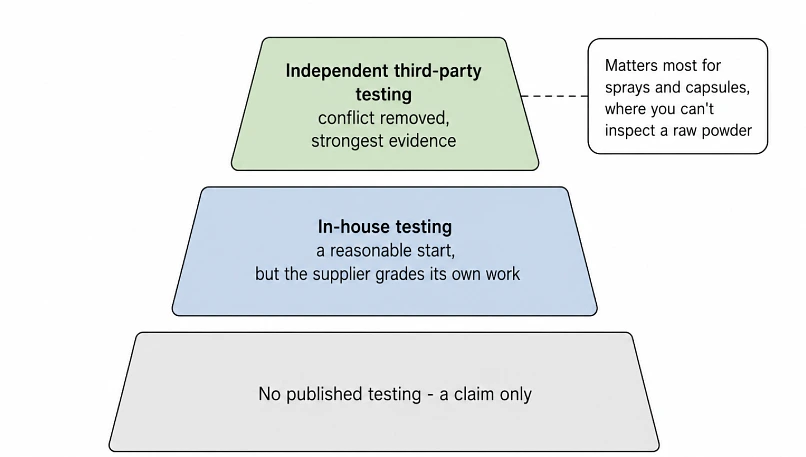
In-house testing is a reasonable start, but a supplier grading its own work has an obvious conflict of interest. Third-party testing, where the vendor sends samples to an outside accredited lab, removes that conflict, which is why it carries more weight.
It matters more, not less, for pre-formulated products. With a raw powder you can at least see what you have. With a nasal spray or a capsule you’re trusting that the finished product contains what the label says, so an independent result on those formats is worth more, not less. When a supplier layers third-party data on top of its own, you’re looking at the strongest evidence the category offers.
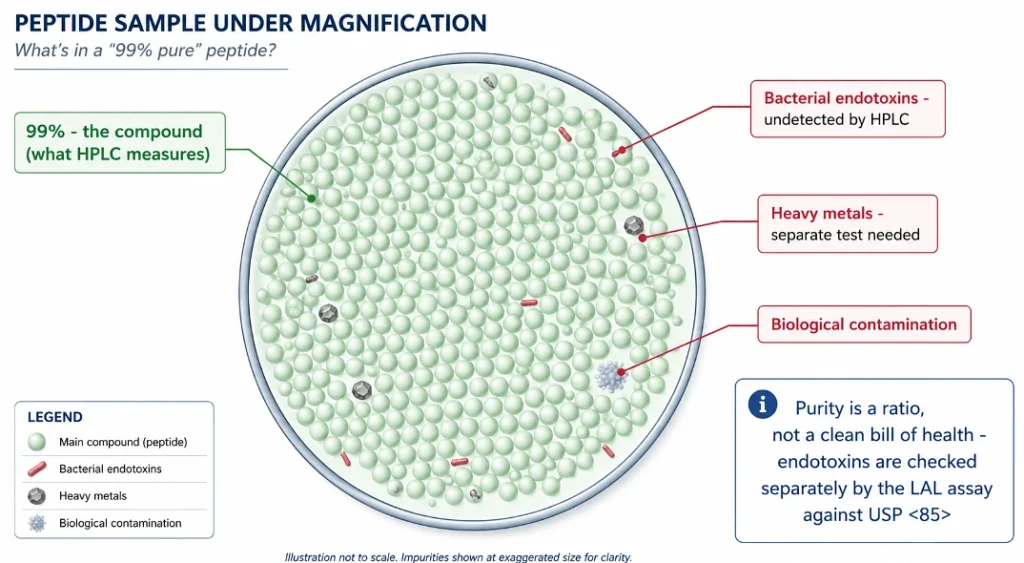
Worth pausing here, because it’s the single most common misunderstanding in this market. A high purity figure is not a clean bill of health. HPLC is designed to measure the ratio of your compound to related impurities. It does not detect bacterial endotoxins, heavy metals, or other biological contamination, and a sample can post 99 percent purity while still carrying endotoxins that would ruin sensitive work. Labs check for these separately, using the LAL assay against the USP <85> standard.
For a lot of routine research this extra layer may be more than you need, but knowing the limit of the purity number is what separates a careful buyer from one who reads a single percentage and stops thinking. Ask what the figure does and doesn’t cover.
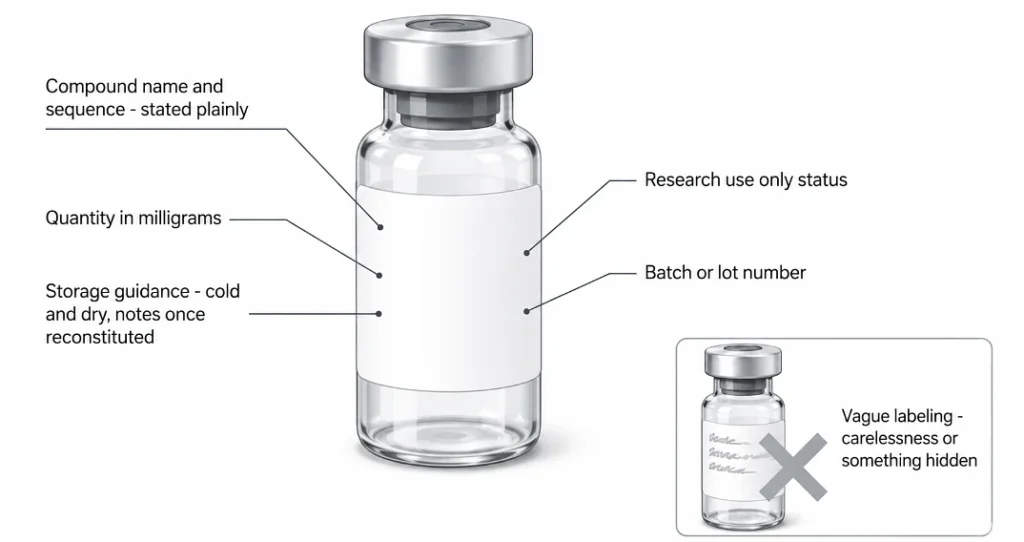
Labeling is a quiet tell. A serious product states the compound name and sequence, the quantity in milligrams, storage guidance and its research-use-only status, all plainly. Vague or half-finished labeling points to either carelessness or something being hidden, and neither belongs in research material.
Storage guidance should fit the format, and its presence is itself a signal that the supplier understands their own product. A lyophilized vial needs direction to stay cold and dry, with care taken once reconstituted. A liquid spray needs handling notes and a usable window. A capsule needs protection from heat and moisture. A product sold with no meaningful storage direction leaves you guessing, and guessing is how good material degrades before it’s ever used.
The last signal is how the product is framed. A legitimate supplier describes compounds in chemical and research terms, labels everything research use only, and steers clear of claims about treating conditions or human use. That restraint isn’t just box-ticking. It tells you the operation runs the way the category is supposed to run.
peptides.com presents itself this way across its vials, sprays and capsules, with purity data, published reports and consistent research framing. A seller that blurs the line between research chemical and product-for-use is one to treat with caution, whatever format they’re selling.
None of these six needs a lab of your own. Confirm a stated purity figure, open a batch-specific COA that carries both HPLC and mass spec, look for independent third-party testing, read the label and storage guidance, understand what the purity number leaves out, and check that the positioning stays honestly research use only. A product that clears all six is a sound buy in any format. One that misses several is a poor buy no matter how good the format looks.
A stated purity figure, a published batch-specific COA, and independent third-party testing are the core three. Clear labeling, format-appropriate storage guidance, and honest research-use-only positioning round it out. All six apply equally to vials, sprays and capsules.
No. HPLC measures how pure the sample is relative to synthesis impurities, but it does not detect endotoxins or heavy metals, and it can’t confirm identity on its own. That’s why a mass spec result and, for sensitive work, separate endotoxin testing matter alongside the purity figure.
It removes the conflict of interest in a supplier assessing its own product, giving independent confirmation of purity and identity. It’s especially valuable for sprays and capsules, where you can’t inspect a raw powder yourself.
This article is for educational purposes and describes how to evaluate research peptide products. All products referenced are for research use only and are not intended for human or animal consumption, or to diagnose, treat, cure, or prevent any disease.

I came to Peter White backwards. Most people find him through the smooth-jazz radio staples, but the first thing I...
Read moreDetails
Copyright © 2024 NoodleMagazine - All Right Reserved

