
The Last Breath of Käämyäjä
Stumbled across this old legend while digging through some dusty archives last week—Käämyäjä, that mythical serpent from ancient tales in...
Read moreDetails

A sleeping wooden goddess the length of a bus now lies on a grass bank in Sheffield, hair of woven willow streaming behind her, face turned up toward one of the most famous concrete buildings in Britain. The pairing should not work. It works better than almost anything either the garden world or Park Hill has staged in years.
The figure is Gaia, the centerpiece of Sarah Eberle‘s garden On the Edge, which took both a Gold Medal and Garden of the Year at the RHS Chelsea Flower Show in May 2026. Chelsea gardens usually live for one week, then vanish into skips and salvage. This one was taken apart, driven north and rebuilt at Park Hill, the vast 1960s streets-in-the-sky estate above Sheffield’s train station, where it opened to the public this summer as a permanent piece of the grounds.
The sculpture reads as one flowing thing. It is actually several trades meeting in the middle.
Chainsaw artist Chris Wood carved the body from fallen mature trees, with carver Heather Crompton, who grew up in Sheffield, working alongside him. Tom Hare wove the hair from willow branches, a mane that pours off the figure’s head and dissolves into the landscape. Then the hair does something quietly brilliant: it flows into a dry-stone wall that snakes away through the grass, built by Lydia and Cuthbert Noble, fifth-generation stonewallers from West Yorkshire. Wood becomes willow becomes stone, one material handing off to the next, so the goddess seems less placed on the site than grown out of it.
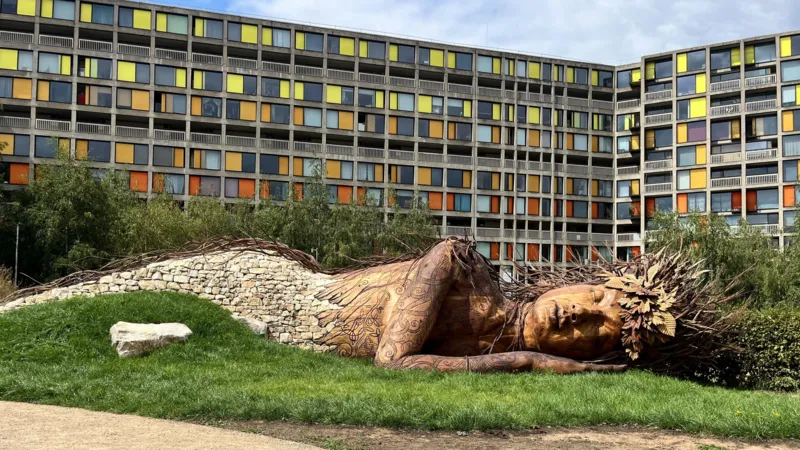
Up close the carving carries swirling engraved patterns across the shoulders and arms, the kind of surface detail built for visitors standing a foot away rather than judges viewing from a rope line. That matters now, because at Park Hill the rope line is gone. Residents walk past her on the way to the tram.
Eberle’s record has no real comparison. The 2026 win brought her to 14 Chelsea gold medals with four category best-in wins, more than any designer in the show’s history, achieved across a career of roughly five decades. She is one of only three women ever handed Garden of the Year. She had also, at 71, considered herself retired from Chelsea before the commission pulled her back.
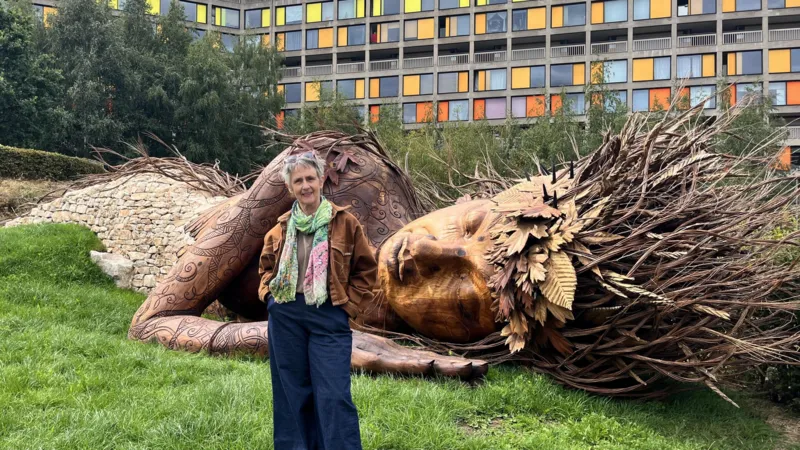
Her connection to the site is not a press-release invention. Eberle first visited Park Hill in the 1970s as a landscape architecture student, when the estate was still council housing rather than the Grade II* listed, part-renovated landmark it has become. Speaking to Sheffield’s Exposed Magazine about placing Gaia against the concrete, she described the appeal directly: There’s something about the balance between her spirituality and her softness” set against buildings she called brutal, a contrast she found more exciting than the Chelsea showground itself. On receiving the award she told the RHS she was thrilled to bits.
On the Edge was commissioned for the centenary of CPRE, the countryside charity, with sponsorship from Project Giving Back. The subject is edgelands, the fringes where towns blur into fields, the dog-walking strips and scrubby margins that give most urban people their only daily contact with nature while sitting first in line for development.
The Chelsea planting made the argument with a straight face and a sly grin at once: naturalized garden plants of the sort that arrive through fly-tipped garden waste, UK natives usually dismissed as weeds, all presented as abundance rather than neglect. Eberle grew up on the edge of a town herself and has said that fringe of land shaped who she became.
Sheffield deepens the fit. CPRE traces some of the earliest Green Belt campaigning to the city through Ethel Haythornthwaite, the Sheffield conservationist whose work helped birth the organization a century ago. Moving the centenary garden here is less relocation than homecoming.
The Park Hill version is deliberately simpler than the show garden. The dense Chelsea planting gave way to wildflower turf that ties the sculpture into the existing banks, on the logic that the surrounding green space now does the work the borders once did. At Chelsea, Gaia’s hand touched water from a shallow pool; at Park Hill she settles into a living hillside that will shift with the seasons around her.
Eberle has framed the piece as belonging to the residents above all, something to be touched, sat beside and owned rather than admired from a distance. The estate has spent fifteen years being written about as an architecture story. It now has a resident older than any tenant, made of trees, holding the ground floor.
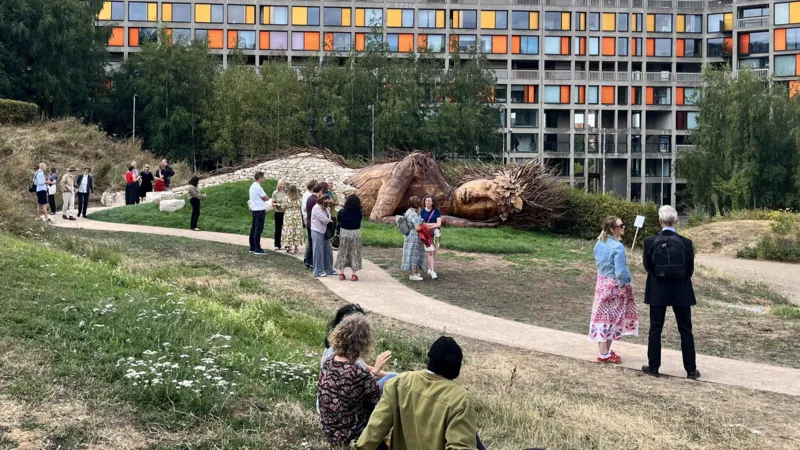
The opening drew the crowd in the photo above, a mix of garden press, estate residents plus people who plainly wandered over to find out why a goddess was asleep on the lawn. Which is roughly the audience the garden was always arguing for. Chelsea tickets sell out months ahead at prices to match. The tram to Park Hill runs every few minutes.

Stumbled across this old legend while digging through some dusty archives last week—Käämyäjä, that mythical serpent from ancient tales in...
Read moreDetails
Copyright © 2024 NoodleMagazine - All Right Reserved