
Podiatrists And Barefoot Shoe Fans Do The Same Shoe Test And Want Opposite Answers
Pick up a shoe in any store and try to wring it out like a wet towel. A podiatrist watching...
Read moreDetails
The crypto trading bot market is crowded. Dozens of platforms offer automated trading, each with it’s own angle on strategy, pricing and security. When users write reviews comparing Botty to alternatives, they rarely focus on which platform has the slickest interface or the most aggressive marketing. They focus on four things that actually matter when real money is involved: where their funds are held, how much the platform takes when things go well, whether the strategy has a verifiable track record and which assets they can actually trade. This article walks through each of those comparisons in the order users raise them.
Most “best crypto bot” articles compare platforms on surface features: number of supported exchanges, dashboard design, the presence of a mobile app. These factors have their place, but they tell you very little about what matters most in practice.
Users who have moved between platforms and their reviews make this clear, tend to compare on fundamentals. Did I ever feel my funds were at risk from the platform itself, not just the market? Did I pay fees even during losing months?
Was there any way to verify the strategy’s results before committing capital? Did the supported assets match my actual needs? These are the questions that separate a useful comparison from a marketing checklist.
What follows is an honest look at how Botty stands on each of these dimensions, not against a specific named competitor, but against the patterns that dominate the broader bot market.

The most fundamental split in the crypto bot market is between platforms that hold your funds and platforms that don’t. This distinction matters more than any other feature.
Custodial platforms ask users to deposit funds into the platform’s own wallet or account. The platform controls the assets while the bot runs. This model simplifies the user experience, one account, one interface, but it introduces a category of risk that has nothing to do with trading: platform risk. If the platform is hacked, mismanaged or simply shuts down, users can lose their funds entirely. This has happened repeatedly across the industry.
Botty is non-custodial. User funds remain on the user’s exchange account at all times. The platform connects via API key configured with trade-only permissions, no withdrawal access is possible through this key.
The platform cannot move funds out of the user’s account regardless of circumstances. If Botty ceased to exist tomorrow, every user’s assets would remain exactly where they were, accessible through their exchange login.
In user reviews that specifically mention switching from custodial platforms, this is consistently the first point raised. Several users reference industry incidents where custodial platforms failed and funds were lost, not through bad trades, but through platform failure. The non-custodial architecture eliminates that specific risk category entirely. It doesn’t eliminate market risk, but it means the bot’s performance, good or bad, is the only variable that affects the trading outcome. Platform survival is not a factor.
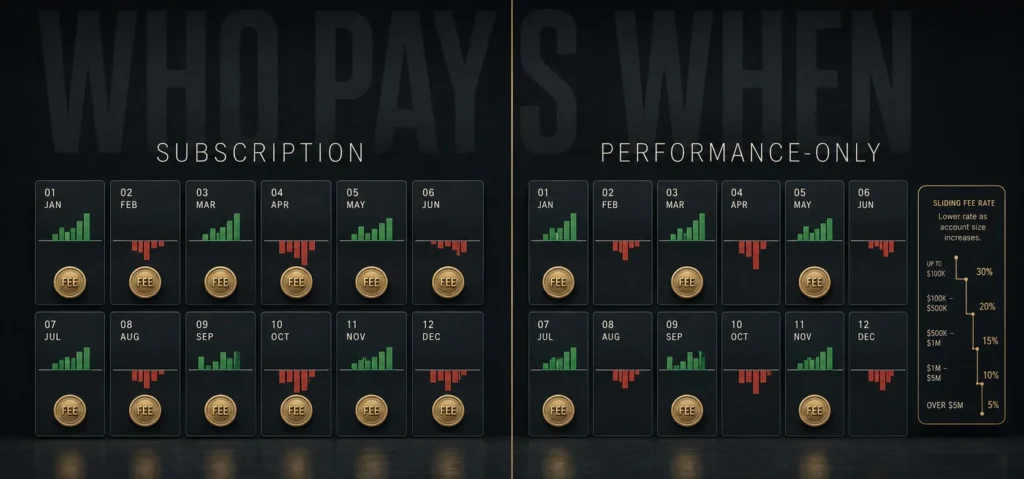
The second major comparison point in user reviews is pricing. Two dominant models exist in the market and they have meaningfully different implications for the user.
Subscription-based platforms charge a fixed monthly or annual fee regardless of trading results. The user pays the same amount whether the bot generated strong returns, broke even or lost money. From the platform’s perspective, this is a stable revenue model. From the user’s perspective, it means the platform’s interests and the user’s interests are structurally misaligned: the platform earns whether or not you do.
Botty charges no subscription fee. Instead, it takes a percentage of realized profits only, between 5% and 20% depending on account size, with smaller accounts paying the higher rate and larger accounts paying the lower. The exact tiers: 20% for accounts under $2,500, scaling down to 5% for accounts above $20 million. If no profit is generated, no fee is charged.
This model is structurally aligned: Botty earns only when users earn. The platform has a direct financial incentive to ensure the underlying algorithms actually generate consistent profits, because without those profits, there’s no revenue. Users in reviews frequently cite this as the reason they trust the platform’s commitment to algorithmic quality in a way they don’t trust subscription-based competitors.
The practical effect in down months is significant. On a subscription platform, a difficult month with minimal bot activity costs the user the same monthly fee as a strong month. On Botty, a month with no closed profitable cycles costs the user nothing. Over time, this difference compounds, particularly in sideways or bear market periods when strategy performance is naturally lower.

Every crypto bot platform presents performance data. The critical question in user reviews is: what kind of performance data?
Backtests, simulations run on historical price data, are the most common form of performance evidence in the industry. They’re also the most easily manipulated. A backtest can be run over cherry-picked time periods, with parameters optimized specifically for those periods, producing results that look compelling on paper but have no meaningful relationship to future live-market performance. The industry has a well-documented history of platforms showing extraordinary backtest results that translated into poor actual returns.
The algorithms underlying Botty’s templates have a verified live-market history. These are not simulated results, they are real trades, on real exchanges, with real capital, executed over an extended period before the platform launched publicly. The peak monthly trading volume processed through the platform exceeded $1.5 billion, representing genuine market activity across thousands of simultaneously running bots.
A specific, verifiable reference point: on October 10, 2025, a market-wide crash liquidated $20 billion in positions across the industry and affected 1.3 million traders. On that same day, Botty’s bots running on BTC, ETH and SOL generated a combined profit of $23,896. This was not a backtest result, it was the outcome of live bots operating in real market conditions during one of the most volatile days in recent crypto history. Users in reviews consistently cite this event as evidence that the strategy’s behavior is predictable under stress, not just under favorable conditions.
When comparing platforms, users who ask about track records find a consistent pattern: competitors can often show backtests with impressive figures, but far fewer can demonstrate verified live-market performance data covering both favorable and adverse market conditions. This distinction carries significant weight in the decision-making process.
Most bot platforms compete on the breadth of supported trading pairs, offering access to hundreds of assets. Botty takes the opposite approach: ready-made, backtested templates are available only for BTC, ETH and SOL.
In user reviews, this limitation is mentioned in two very different tones depending on what the user was looking for. Those who wanted to trade a wide range of altcoins cite it as a genuine constraint, a reason to look elsewhere. Those who were primarily interested in the major, most liquid assets view it as a feature rather than a bug.
The reasoning behind the narrow focus is directly related to the strategy’s track record. The algorithms have been validated on BTC, ETH and SOL, assets with sufficient liquidity, trading history and market depth to support the grid-plus-averaging approach reliably. Extending the same claims to illiquid altcoins with limited price history would undermine the validity of the backtest data and expose users to risks that haven’t been studied with the same rigor.
Users can technically configure the bot on other trading pairs manually, but the platform makes clear that doing so means operating outside the tested templates. The verified performance data does not apply to custom configurations. For users who understand this distinction, the narrow focus is a mark of intellectual honesty, the platform only claims to have validated what it has actually validated. For users who need broad asset support, Botty is not the right tool.

A detail that appears in more experienced user reviews is the platform’s approach to capital management rules. Botty specifies recommended guidelines that, while not technically enforced, significantly affect outcomes.
For futures bots, the recommendation is to keep 50% of the allocated budget as reserve capital that is not actively deployed in bot positions. This reserve functions as a buffer against sustained price drops, it’s what keeps the bot operational during deep drawdowns rather than facing liquidation. For portfolio allocation, the recommended split is 80% in spot bots and 20% in futures bots.
Platforms that take no position on capital management, allowing users to deploy 100% of their capital in futures positions with maximum leverage, are platforms where the worst-case scenarios are significantly worse. The difference between a liquidation at 34% below the BTC entry price (with proper reserve) and a liquidation much earlier (without reserve) is entirely a function of whether these capital rules are followed.
In user reviews, the correlation is clear: users who followed the capital management guidelines consistently report different experiences than those who didn’t. The negative reviews that cite liquidation almost universally come from users who either didn’t understand or ignored the reserve requirement.
One consistent theme across positive Botty user reviews is transparency. Every order the bot opens or closes is visible in real time on the user’s exchange account, not in a proprietary dashboard that could show anything, but in the actual exchange interface where the trades physically occur. There is no intermediary layer between the bot’s actions and what the user can verify independently.
This stands in contrast to platforms where performance is reported through an internal dashboard that may or may not accurately reflect actual trade history on the connected exchange. Users who have verified Botty’s reported activity against their exchange history note the exact match, what the platform shows and what the exchange shows are the same, because they’re reading from the same source.
Control is equally direct: users can stop the bot at any time, adjust settings or switch templates without going through approval processes or waiting periods. The bot is a tool in the user’s hands, not a managed service where someone else controls the activity.
Reading through comparative user reviews, a clear picture of the right and wrong Botty user emerges.
Botty makes sense for users who: want their funds to stay on their own exchange account; prefer paying for performance rather than access; are focused on BTC, ETH or SOL; want a strategy with a documented live-market track record rather than a backtest; are willing to follow capital management guidelines; and have a multi-month time horizon for evaluating results.
Botty is not the right choice for users who: need to trade a wide range of altcoins; want a flat-rate subscription with predictable fixed costs regardless of performance; are looking for a fully managed service that doesn’t require any user involvement or understanding; or expect consistent monthly returns regardless of market conditions.
Neither list is a value judgment. They’re descriptions of different use cases and different risk profiles. The right bot for any user is the one that matches their actual situation, not the one with the most features or the most aggressive performance claims.
The recurring theme in user reviews that compare Botty to alternatives is that the comparison isn’t really between platforms, it’s between fundamentally different approaches to automated trading. Custodial vs non-custodial. Subscription vs performance-based. Backtest vs live track record. Broad catalog vs focused depth.
Botty makes specific choices on each of these dimensions. Non-custodial architecture. Performance-only fees. Verified live-market history on a focused set of assets. Capital management requirements that protect against worst-case outcomes. These choices aren’t universal advantages, they’re trade-offs that make Botty the right tool for some users and the wrong tool for others.
For the users it’s designed for, the reviews are consistent: the architecture holds up, the strategy performs as described when conditions are right and the transparency makes it possible to understand exactly what’s happening at every step. That’s the honest summary of what Botty user reviews say when you read them systematically rather than selectively.
Cryptocurrency trading involves significant risk. Past performance data does not guarantee similar results in the future. Potential returns depend on market conditions, selected settings and capital management practices.

Pick up a shoe in any store and try to wring it out like a wet towel. A podiatrist watching...
Read moreDetails
Copyright © 2024 NoodleMagazine - All Right Reserved