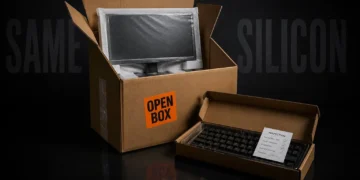
Open-Box Electronics: The Smartest Way to Buy Tech in Canada Right Now
Canadian tech buyers are in a squeeze. Prices on monitors, peripherals, and smart home gear keep climbing, the dollar isn't...
Read moreDetails

More than half of U.S. teens now use AI chatbots for schoolwork. Nearly 9 out of 10 UK undergraduates use generative AI for assessments. And Turnitin’s own data confirms that 15% of all English-language essay submissions now exceed 80% AI-generated content — up from 3% when its detector first launched in 2023.
The numbers are not slowing down. They are accelerating. And the tools most students rely on — ChatGPT, Grammarly, QuillBot — were never built to handle what happens after you generate AI text. They leave students exposed, flagged, and accused. That is the gap Ryne AI was built to close.
This is not a puff piece. This is a breakdown of where student AI tools actually stand in February 2026, where the biggest players fall short, and why Ryne AI has quietly become the most complete platform for students who need to study, write, and humanize content without getting caught in a system that punishes them for using the same technology their professors use daily.
To understand what Ryne AI is doing differently, you first need to see the landscape it entered.
The latest surveys across the U.S. and UK paint a consistent picture. Student AI adoption has gone mainstream — not at the margins, but at the center of academic life. Here is what the data shows:
These are not fringe users. This is the mainstream. And the single biggest barrier is not ethics or desire — it is the fear of a detection system that cannot tell the difference between a student who used AI responsibly and one who did not use it at all.
ChatGPT is good at generating text. Everyone knows that. But generating AI text is only step one. What happens when that text hits a detector? What happens when a student submits an essay and Turnitin flags 74% of it as AI-generated?
ChatGPT does nothing about that. OpenAI shut down its own AI detection tool in 2023 because it was too inaccurate. MIT’s own Teaching & Learning Technologies team has stated plainly that AI detection software is “far from foolproof” with “high error rates” that can lead instructors to falsely accuse students of misconduct.
So ChatGPT gives you the text, but it does not help you convert AI to human writing. It does not help you humanize the text. It does not tell you whether your output will survive a detection scan. It does not offer a study assistant, a note-taker, or an essay composer.
Here is what ChatGPT actually gives students:
It is a single-use tool in a world that demands a full workflow. And ChatGPT is not the only one guilty of it.
Grammarly has been the go-to grammar checker for over a decade. QuillBot became popular as a paraphrasing tool. Both are fine at what they were originally designed to do. Neither was designed for 2026.
Grammarly catches typos, suggests clearer phrasing, and flags passive voice. Useful, sure. But it does not generate original content. It does not humanize AI text. It does not help you bypass AI detection. And here is the part nobody talks about — if you run your AI-generated essay through Grammarly’s corrections, you might actually increase your AI detection score. Well-polished, grammatically consistent text is exactly what detectors flag as machine-like.
QuillBot is worse. Its paraphrasing engine swaps words with predictable synonyms and keeps sentence structure largely intact. To a modern AI detector, that looks identical to AI rewriting behavior. A 2025 narrative review published in MDPI’s Societies journal specifically called out tools like QuillBot for enabling “surface-level changes that lack meaningful engagement with the original ideas,” noting that such practices “could still be considered plagiarism.”
Here is how both tools stack up against what students actually need in 2026:
They charge premium prices for features that still leave students one Turnitin scan away from an academic integrity hearing.
Here is the part that should make every student angry.
A landmark 2023 study published in Patterns (Cell Press) by researchers at Stanford University — Liang et al., “GPT detectors are biased against non-native English writers” — found that GPT detectors frequently misclassify non-native English writing as AI-generated. The study has been cited nearly 700 times and remains one of the most referenced papers on AI detection bias in academic literature.
That means if English is your second language, you are statistically more likely to be falsely accused of using AI. Not because you used it, but because your natural writing patterns resemble AI output. The system punishes you for how you write, not what you did.
Turnitin’s own detection model analyzes “statistical writing behavior” — word predictability, sentence rhythm, token probability. Well-edited academic writing, ESL writing, and heavily structured essays can all trigger higher AI scores. Turnitin themselves acknowledge that their tool measures probability, not authorship.
And yet, universities treat these probability scores as if they are proof. Students are being hauled into academic integrity panels based on a percentage generated by a system that the research has proven to be flawed.
The problems with current AI detection are not small or theoretical:
This is the broken system. And the tools most students use — ChatGPT, Grammarly, QuillBot — do absolutely nothing to protect them from it.
This is where the conversation shifts from what is wrong to what actually works.
Ryne AI was not built as a chatbot that got popular and then bolted on extra features. It was designed from the ground up as a complete academic platform — study, write, humanize — in one place. That matters because the problems students face in 2026 are not isolated. You do not just need to generate text. You need to study material, compose essays, take notes, and then humanize your AI text so it reads as genuinely human before you submit it.
Here is how Ryne AI handles each layer of that workflow.
Ryne Chat gives students access to over 15 AI models, including GPT-4o, Claude, and Gemini. That is not a gimmick — it is a practical advantage. Different models have different strengths. Claude handles nuanced reasoning well. GPT-4o is fast and versatile. Gemini excels at multimodal input.
Students can submit questions via text, image, or PDF. That means you can photograph a problem set, upload a textbook page, or type a question and get an answer from the model best suited to the task. No other student-focused tool offers this level of model selection. ChatGPT locks you into one model. Grammarly and QuillBot do not offer a chat assistant at all.
Ryne AI includes a built-in essay composer and note-taker. The essay composer helps students draft structured essays from scratch, while the note-taker processes lecture material and readings into organized, digestible notes.
This is not the same as pasting a prompt into ChatGPT and hoping for the best. Ryne’s essay tool is built to produce academic-quality output that can be further refined and personalized. The note-taker converts dense material into concise study resources — a task that Grammarly and QuillBot cannot even attempt.
This is where Ryne AI separates itself from every competitor on the market.
Ryne’s AI humanizer takes AI text — whether generated by ChatGPT, Claude, Gemini, or any other model — and rewrites it to read as authentically human. The goal is not just to change AI language to human language by swapping a few words. It is to fundamentally alter the statistical writing patterns that detectors use to flag content.
The humanizer works by disrupting the predictability signals, sentence rhythm patterns, and token probability sequences that tools like Turnitin and GPTZero rely on. The result is output that reads naturally, maintains the original meaning, and passes AI detection consistently.
Other tools claim to do this. Most of them fail. Here is where the so-called competition stands:
Ryne’s humanizer has been tested head-to-head against Turnitin, GPTZero, Originality.ai, and Copyleaks. It consistently produces the highest bypass rates with the cleanest output quality. The free AI tier gives every student access to 250 words per use and 100 Ryne coins — no credit card required. For students who need more, paid plans unlock unlimited humanization, all languages, and full AI report generation.
The real advantage of Ryne AI is not any single feature. It is a fact that every feature connects.
A student using separate tools has to juggle a mess of disconnected steps:
That is five tools, five tabs, and zero guarantee that the final output passes detection.
A student using Ryne AI opens one platform, generates a draft with Ryne Chat (choosing the best AI model for the task), refines it with the essay composer, and humanizes the entire thing with the built-in AI humanizer. One workflow. One login. One result is ready to submit.
That is not a minor difference. That is the difference between a scattered process that takes hours and a unified system that takes minutes. For students juggling multiple courses, part-time jobs, and deadlines, that time savings is not a luxury. It is a necessity.
Ryne AI reports that over 2.3 million students are using the platform. That number did not come from a massive ad budget or celebrity endorsements. It came from results.
In academic AI tools, the only marketing that matters is word of mouth. One student gets a clean Turnitin scan. They tell a friend. That friend tries the free AI humanizer. They get the same result. The cycle repeats. That is how platforms grow when they actually deliver on what they promise.
Compare that to the competition:
The market is full of tools that promise undetectable AI writing. Ryne is full of students who actually got it.
Every article about AI humanizers dances around the ethics. Here is the direct take.
Over half of peer reviewers in academic publishing use AI. 88% of undergraduates use AI for assessments. Professors use AI to draft syllabi, generate exam questions, and write feedback. The technology is embedded in every layer of education. Only students get punished.
That is not an ethical framework. That is a double standard. And Ryne AI is not designed to help students cheat. It is designed to help students use AI in the way the entire professional world already uses it — and then humanize the text so a flawed detection system does not destroy their academic record over a false positive.
The Stanford study by Liang et al. proved that AI detectors are biased against non-native speakers. Turnitin’s own data shows that polished human writing regularly triggers AI flags. In this environment, humanizing your output is not dishonest. It is self-defense.
Consider the reality students face:
The rules are not applied equally. The tools that claim to enforce “academic integrity” cannot even measure it accurately. Ryne AI gives students a way to navigate this broken system without becoming its victim.
Ryne AI is not sitting still. The platform has expanded from a standalone AI humanizer into a full academic suite in under two years. New features — including deeper AI report generation, multilingual humanization across all languages, and advanced model selection — continue to roll out.
The broader trend in edtech is clear. Single-purpose tools are dying. Students do not want to pay for five subscriptions, learn five interfaces, and manage five workflows. They want one platform that handles study, writing, and humanizing in one place.
Grammarly is stuck correcting commas. QuillBot is stuck swapping synonyms. ChatGPT is stuck generating text with no awareness of what happens after. And students are stuck in the middle, trying to duct-tape a workflow together from tools that were never designed to work as one.
Ryne AI removed the duct tape. That is why it is winning.
The data is not ambiguous. Over 9 in 10 students use AI tools. 15% of all essays submitted to Turnitin are heavily AI-generated. AI detectors are biased, unreliable, and still treated as gospel by institutions. And the tools most students rely on — ChatGPT, Grammarly, QuillBot — leave them completely unprotected from the consequences.
Ryne AI is the first platform built to address the full student workflow: study with multi-model AI chat, write with integrated essay and note tools, and humanize AI text so it reads from AI to human naturally. The free AI tier means every student can try it without risk. The results speak for themselves.
The old way of doing things — copying from ChatGPT, running it through QuillBot, crossing your fingers, and submitting — is a joke. And in 2026, the punchline is an academic integrity violation on your permanent record.
Stop gambling. Start using the tool that was built for how students actually work today.

Canadian tech buyers are in a squeeze. Prices on monitors, peripherals, and smart home gear keep climbing, the dollar isn't...
Read moreDetails
Copyright © 2024 NoodleMagazine - All Right Reserved