
Best Spots for a Work Dinner That Doesn’t Feel Like a Work Dinner
If you're trying to impress a client or honestly just want your own team to have a decent time for...
Read moreDetails

It’s the kind of thing that most people choose based on how it tastes or because someone told them it’s good for you. Nothing wrong with that. But the science supporting individual teas is much more precise than the general “antioxidants are good for you” messaging on the packaging implies. Scientists have quantified precise concentrations of a compound at precise temperatures, performed randomised controlled trials with specific health outcomes and made the numbers available. Whether your morning cup provides those compounds is almost entirely determined by what you’re brewing and how.
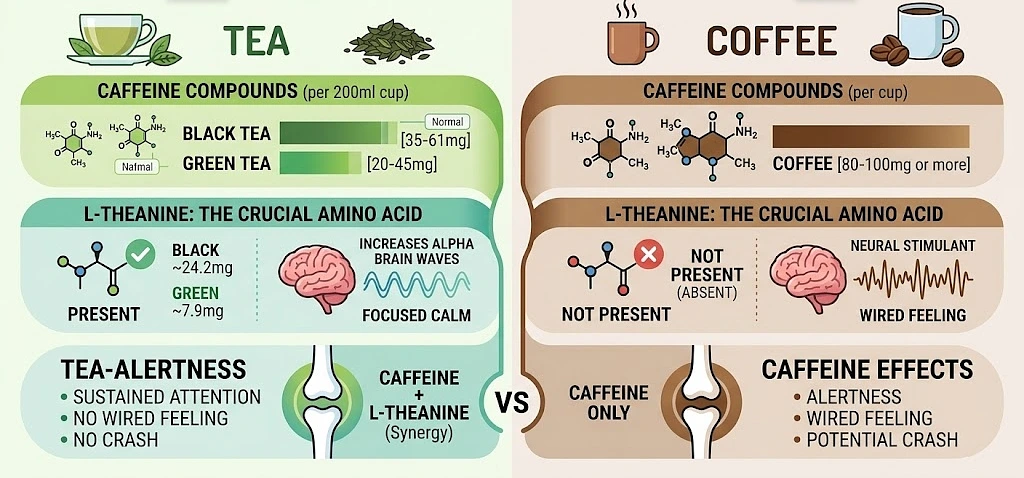
Both have caffeine. Black tea runs about 35-61mg per 200ml cup. Green tea sits lower, roughly 20-45mg. Coffee pushes 80-100mg or more. If caffeine were the whole story, tea would just be diluted coffee.
Tea contains L-theanine. Coffee doesn’t. That single difference changes everything about how the two beverages affect your brain.
L-theanine is an amino acid that crosses the blood-brain barrier and increases alpha brain wave activity, the pattern your brain produces during focused calm. A standard cup of black tea delivers about 24.2mg of it, green tea around 7.9mg per 200ml, though brewing method and leaf quality shift those numbers considerably. A double-blind, placebo-controlled study found that just 50mg of L-theanine combined with 75mg of caffeine about one to two cups of tea improved attention task performance compared to placebo. Neither compound performed as well on its own.
A separate randomised trial tested L-theanine on Japanese adults aged 50-69. A single dose reduced reaction time on attention tasks and increased correct answers on working memory tests. The researchers noted something interesting: caffeine acts as a neural stimulant while L-theanine acts as a depressant, and both naturally coexist in the same leaf. That combination produces the particular quality of tea-alertness that coffee drinkers don’t get focus without the wired feeling, sustained attention without the crash two hours later.
Matcha outperforms regular green tea in every antioxidant measure researchers have tested, and the margin isn’t small.
Jakubczyk et al. at Pomeranian Medical University published a study in Foods (2020) testing Traditional and Daily Matcha at four water temperatures. At 90°C, the peak values were: flavonoids at 1968.8 mg/L, total polyphenols at 1765.1 mg/L, vitamin C at 44.8 mg/L, and antioxidant potential (DPPH) at 41.2%. At 25°C room temperature those numbers dropped roughly in half across every measured category. Same powder, dramatically different output, entirely because of water temperature.
Rutin content tells a similar story. Matcha ranges from 1222.6 to 1968.8 mg/L. Standard green tea? About 37.13 mg/L. That’s close to a 50× difference. Buckwheat, which is considered one of the better dietary sources of rutin, contains 62.30 mg per 100g of fresh weight, still nowhere near matcha.
A 2020 review addressed this problem in Molecules (Kochman et al.), broader chemical profiling and reported a chlorogenic acid concentration of 4800 μg/g, with chlorophyll levels of 5.65 mg/g in tencha leaves (the starting material for matcha) compared to standard green tea at 4.33 mg/g. It’s the shade-growing process that tencha goes through before being ground into matcha powder that drives that spike in chlorophyll more shade means the plant makes more chlorophyll to make up for lack of sunlight, and that extra bit contributes its own antioxidant potential outside of catechins.
This one has serious clinical evidence behind it, not just traditional use claims.
A USDA-backed trial at Tufts University (McKay et al.) recruited 65 adults aged 30-70 with pre-hypertension or mild hypertension. Half drank three cups of hibiscus tea daily for six weeks. The other half got a placebo beverage with artificial hibiscus flavouring and colour. Systolic blood pressure dropped 7.2 mmHg in the hibiscus group versus 1.3 mmHg in the placebo group. Participants with higher baseline blood pressure showed even stronger responses.
The results of that trial were published in 2010. Larger analyses over time have observed the pattern. A meta-analysis in Nutrition Reviews from 2022 pooled 12 randomised controlled trials across 819 participants and found hibiscus decreased systolic BP by −7.10 mmHg compared to placebo. A 2025 dose-response meta-analysis on ScienceDirect with 26 trials involving a total of 1797 participants reported that these reductions were dose-dependent and more pronounced in individuals over the age of 50 years and in studies lasting more than four weeks.
The blood pressure effects of hibiscus compared to actual pharmaceutical medications showed no statistically significant difference in some analyses. That’s a remarkable finding for a dried flower steeped in hot water, though it comes with obvious caveats, these are complementary dietary effects, not replacements for prescribed medication. Anyone on blood pressure drugs shouldn’t swap them for hibiscus tea without talking to their doctor.
The matcha data made this clear: the same product brewed at different temperatures delivers vastly different compound concentrations. This applies across all tea types, though the specifics vary.
Green tea leaves used are unoxidised and thus retain heat-sensitive catechins. Water over 80°C begins to destroy those compounds and leaches out astringent tannins, leaving the brew bitter and less nutritionally useful. Fully oxidised during processing, black tea needs hotter water 95-100°C for the extraction to take place appropriately. White tea, which is minimally processed, The In-Between. Dried roots and flowers generally require the highest temperatures and longest steep times, because the cellular structure of roots and other tough botanicals is more difficult to break down into the particles that yield flavour.
Steep time matters just as much. Too short, and you leave polyphenols and water-soluble vitamins locked in the leaf. Too long and tannin extraction increases bitter taste, and tannins can inhibit iron absorption.
| Tea | Water Temperature | Steep Time |
|---|---|---|
| Green | 70-80°C | 2-3 min |
| Black | 95-100°C | 3-5 min |
| White | 70-75°C | 4-5 min |
| Matcha | 80-90°C | Whisked |
| Herbal/tisane | 95-100°C | 5-10 min |
Herbal infusions, technically tisanes since they aren’t from the Camellia sinensis plant, contain no caffeine. They each have a distinct active compound, and a different mechanism.
Ginger’s primary bioactive is gingerol. The anti-inflammatory and anti-nausea properties are well documented in a large body of peer-reviewed literature. Chamomile has a flavonoid called apigenin, which binds to GABA-A receptors in the brain, the same class of receptor that benzodiazepines target, only much more weakly with apigenin’s binding. That’s the chemical basis for chamomile’s reputation as a relaxant. Menthol is found in peppermint and it relaxes smooth muscle of the GI tract. Multiple global pharmacopoeias acknowledge its usage for digestive discomfort.
None of these are medicines. They’re dietary aids that are most effective as part of a steady regimen, not occasional treatments.
Jakubczyk et al. published a second study in Foods (2024) analysing eleven matcha samples from different origins and growing conditions. Antioxidant capacity ranged from 7.26 to 9.54 mM Trolox equivalent/L, a 31% gap between the weakest and strongest samples. Vitamin C content spread from 38.92 to 70.15 mg/100mL. Caffeine ranged from 823.23 to 7313.22 mg/L.
Same product label. Wildly different compound delivery inside the packet. Origin, harvest timing, cultivation method (conventional vs organic), and post-harvest processing all drive that variation. A matcha from a first-harvest spring picking grown under proper shade conditions in Japan and a matcha from a third-harvest late-season picking grown under minimal shade in a different country will share a name and almost nothing else analytically.
This is where sourcing stops being a marketing conversation and becomes a measurable one. Whole-leaf, minimally processed teas from transparent supply chains, the kind Tea Vision specialises in retain the cellular structure and natural oils that determine how much of those researched compounds actually end up in your cup. Teabag dust, by comparison, has a vastly higher surface-area-to-volume ratio, oxidises faster in storage, and degrades before you ever brew it.
The difference between a carefully sourced tea and a commodity one isn’t taste preference. Based on the analytical data, it’s the difference between drinking what the research measured and drinking hot flavoured water.

If you're trying to impress a client or honestly just want your own team to have a decent time for...
Read moreDetails
Copyright © 2024 NoodleMagazine - All Right Reserved