
Glaucoma Takes Your Sight Without Telling You, And Your Own Brain Helps It Hide
You trust your eyes to complain when something is wrong. Something gets in, they water. Too bright, you squint. That...
Read moreDetails

I cut out dairy six months ago. Then gluten. Then onions, garlic, beans, lentils, the whole FODMAP list.
The first couple of weeks of each round felt like I’d finally figured it out. Then within a month the afternoon bloat was back. Now I’m down to about ten foods and still puffing up by 3pm, basically negotiating with my stomach every day about what’s safe today.
The reason none of it stuck is that I was working on the wrong variable the whole time. It’s not the food. It’s what my bacteria do with the food once it reaches them, and food restriction doesn’t change the bacterial make-up producing the gas.
That’s the part most people figuring this out on their own never get told. The bloating you feel after lunch is fermentation happening in your colon, and fermentation is the byproduct of which bacteria are present and in what amounts. Change the food, and you change what they have to work with for a few weeks. But the bacterial community itself — who’s overgrown and who’s depleted — doesn’t shift just because the menu shifted.
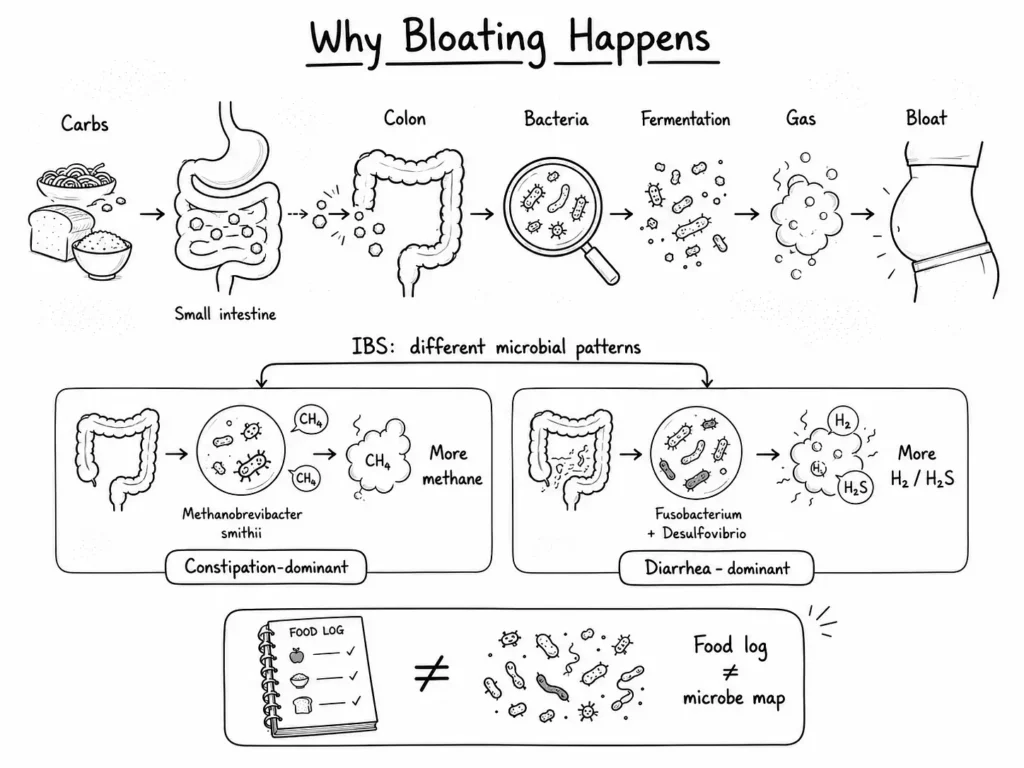
Most chronic bloating comes down to gas, and most of that gas comes from bacterial fermentation in the colon. Carbohydrates that didn’t get absorbed in the small intestine hit the colon, the bacteria living there break them down for energy, and out comes gas as a byproduct. Hydrogen, methane, carbon dioxide, sometimes hydrogen sulfide.
In a balanced gut this happens at levels the body handles without much fuss. When the bacterial mix is off, it stops being manageable. Specific strains overgrow, hydrogen and methane production climbs, and gas builds up faster than the gut can clear it. So the bloating you see isn’t the food itself. It’s the metabolic activity of bacteria reacting to the food.
There’s a 2022 Cedars-Sinai study in Clinical Gastroenterology and Hepatology that mapped this in real detail. IBS patients on the constipation-dominant side had higher breath methane and a lot more Methanobrevibacter smithii — a methane-producing archaeon — in their stool. The diarrhea-dominant patients ran higher on hydrogen and hydrogen sulfide, with bacterial signatures dominated by Fusobacterium and Desulfovibrio. Same waiting room, same clinical-looking problem, two completely different bacterial pictures underneath, needing two completely different treatments.
A food journal logs what went in. It can’t tell you which bacteria multiplied because of it.
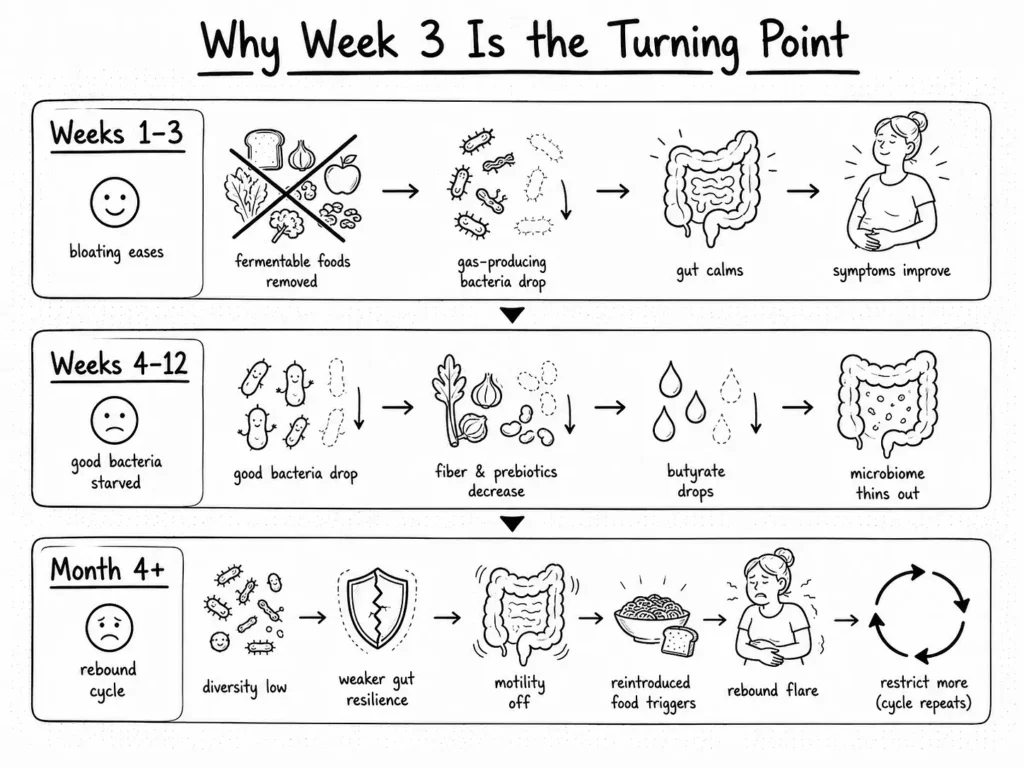
The first two to three weeks of an elimination diet usually do bring relief. That mechanism is real. The gas-producing bacteria get starved of the substrate they were fermenting, so fermentation drops and the bloating eases. That’s exactly why low-FODMAP works as a short-term symptom intervention.
What happens after week three is the part most people aren’t warned about.
A 2025 systematic review and meta-analysis in the Journal of Food Science looked at the long-term effects of low-FODMAP diets on gut microbiota and found a consistent reduction in Bifidobacteria across multiple studies. Bifidobacteria are one of the main groups responsible for short-chain fatty acid production, particularly butyrate — the thing that feeds the colon lining and helps regulate inflammation and motility. And a 2026 StatPearls entry on the diet in clinical practice flagged the same pattern: prolonged restriction lowers Bifidobacterium and Faecalibacterium prausnitzii, cuts fiber and prebiotic intake, and is now something all the major clinical guidelines advise against doing long-term.
So the timeline runs roughly like this:
Then you reintroduce something — maybe something that was never even a trigger — and the now-thinned-out gut overreacts. Bloating’s back. Most people read that as “missed a trigger food” and restrict further, and round it goes. The diet that worked beautifully in week two is quietly making things worse by month four.
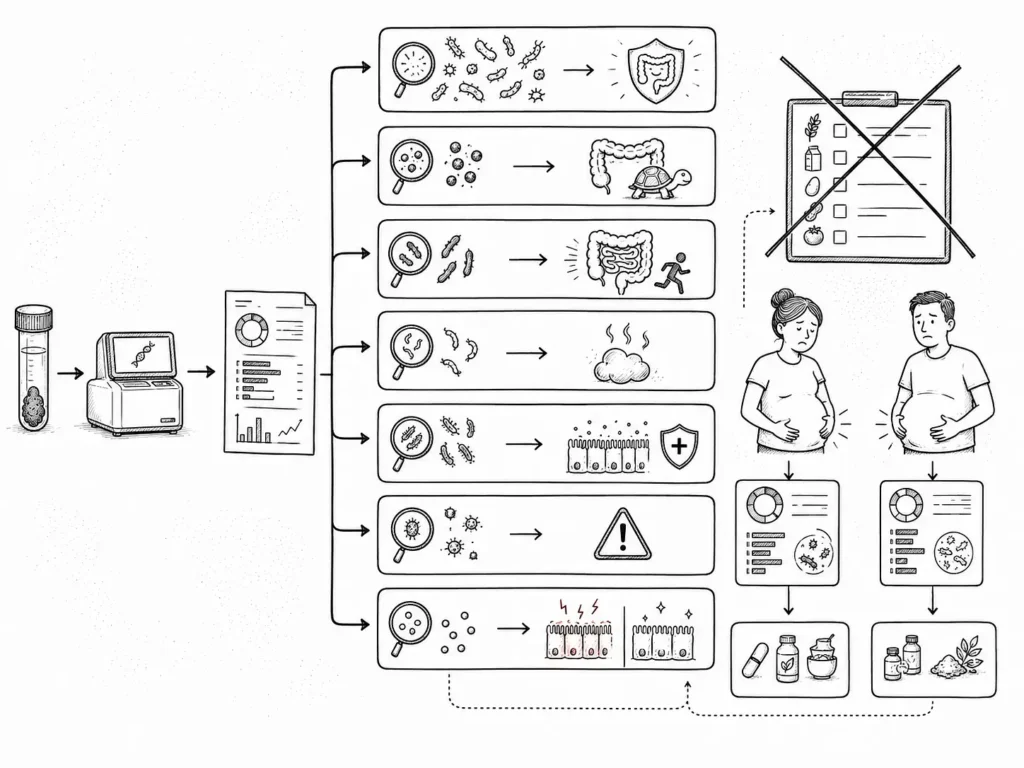
A stool-based microbiome analysis sequences the DNA of the bacteria in your gut and gives you a picture of what’s actually present, in what amounts, and what those bacteria can metabolically do. That’s a completely different kind of information than a food tracker, an elimination diet, or even a standard endoscopy can hand you.
A typical report comes back with things like:
The whole point is that the report tells you what’s specifically wrong in your gut, not what’s generally wrong with people who bloat. Two people with identical symptoms can come back with reports that look nothing alike and need entirely different treatments. A gut microbiome test is the only way to see that directly, and working from the result lands you a lot closer to the right intervention than guessing your way through one diet after another.
Once you know which bacteria are doing what, the intervention stops being a guessing game.
Butyrate producers depleted — the priority becomes feeding them. Resistant starch from cooled and reheated rice, green bananas, cooled potatoes, properly prepared legumes. Specific prebiotic fibers. Sometimes butyrate supplemented directly, though feeding the bacteria that make it is usually the better long-term play.
Methane producers overgrown — now the strategy targets them. Prescription antimicrobials like rifaximin combined with neomycin in some protocols, herbal protocols using oregano oil, berberine, or allicin in others. The choice depends on the case, but the target is the specific organism, not just the food it was eating.
Hydrogen producers overgrown — different protocols, different antimicrobials, different food strategies. Hydrogen sulfide producers, different again. And low overall diversity with no specific overgrowth is a different job entirely — there the work shifts to rebuilding the ecosystem through fermented foods, prebiotic fiber rotation, and probiotic strains matched to what’s actually missing.
This is the gap elimination diets cannot bridge. They can quiet symptoms by removing the substrate the bacteria were fermenting, but they cannot rebalance the bacterial composition itself. To do that you have to know what the composition is, which means measuring it.
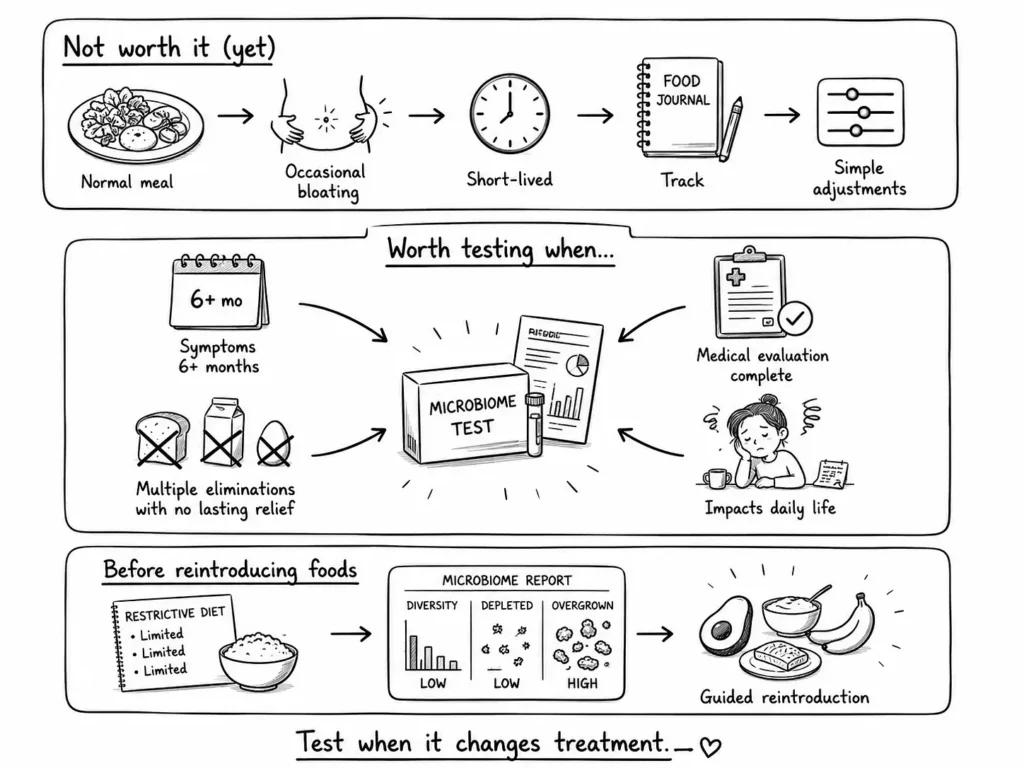
A microbiome test isn’t the right move for everyone with occasional bloating.
If the bloating shows up after specific identifiable meals and clears within a few hours, that’s just normal digestion dealing with a heavy or fermentable meal. Food journaling and a few basic adjustments are plenty.
It earns its place somewhere else: when the bloating has been a daily thing for more than six months, when several elimination diets have come and gone without lasting relief, when the standard gastroenterology workup came back clean, and when the symptoms are genuinely wrecking your quality of life. At that point the result is specific enough to actually change the direction of treatment, instead of kicking off yet another generic round of restriction.
It’s also worth it for anyone who’s been deep in a restrictive diet for over six months and wants to know the state of their microbiome before they start reintroducing foods. Knowing what your diversity looks like, what’s depleted, what’s overgrown — having that before the rebuild starts changes the order you do things in and the supports you lean on along the way.
The shift is from asking “what food is causing this” to asking “what’s the bacterial state of my gut, and how do I move it toward something healthier.” Not the same question. Doesn’t lead to the same actions either.
Food still matters here, it just stops being the enemy. Instead of a list of triggers you’re scared of, it turns into the actual tool for shaping the bacterial community over time. Fermentable fibers feed the good bacteria. Polyphenol-rich stuff backs certain protective species. The more different plants you eat, the more diverse the microbiome tends to be — that correlation is one of the strongest in the literature. And fermented foods throw live cultures and their byproducts into the mix, which helps the whole thing settle.
So for most people who actually do this properly, the food list grows. It doesn’t keep shrinking.
That afternoon bloat isn’t a permanent condition. It’s the symptom of something specific happening underneath, something elimination diets were never built to fix. The fix is down at the bacterial level, and step one is just seeing what’s actually going on down there. Once you can see it, the work gets targeted instead of guessed, and that grind of eliminate-feel-better-relapse-restrict-further finally breaks.

You trust your eyes to complain when something is wrong. Something gets in, they water. Too bright, you squint. That...
Read moreDetails
Copyright © 2024 NoodleMagazine - All Right Reserved