
Budgeting an Interstate Move: The Numbers to Sort Before the Boxes
Moving states costs most Australian households somewhere between $2,000 and $6,000 for the transport alone, before stamp duty, storage or any of...
Read moreDetails

So you’re running out of room, and the first thing that comes to mind is a bigger office, which feels like progress until you actually stop and look at what’s taking up the space. If a chunk of your office is boxes and stock and shipping supplies and returns you haven’t processed yet, you’re paying office rent on square footage that’s doing warehouse work, and the cost difference between those two things is a lot bigger than most people realize.
Office space in the US is averaging about thirty-three dollars a square foot annually right now, according to CommercialCafe’s most recent numbers. Warehouse space is sitting at around nine dollars. That’s a 3.6x gap on every square foot you’re using for storage instead of desks. Run that across five hundred square feet of office floor that’s basically functioning as a stock room, and you’re spending around sixteen thousand a year on space that could cost you forty-five hundred. In coastal cities where office rents push into the seventy-five to a hundred dollar range, the math gets even worse.
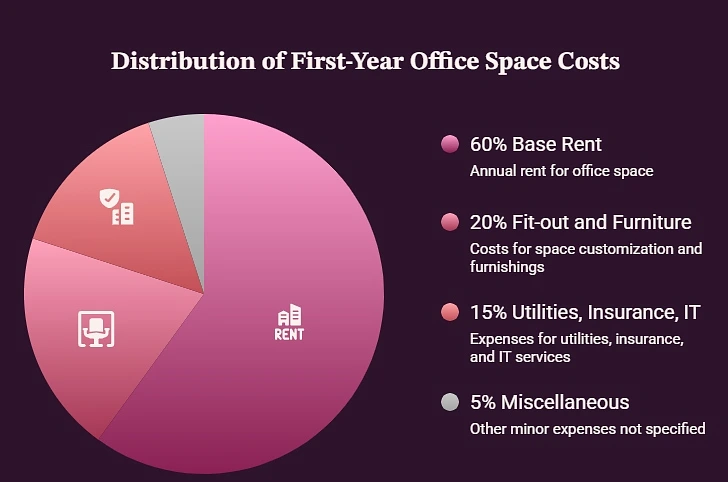
Most people look at the rent number and think that’s the cost, but the rent is maybe sixty percent of what you’ll actually spend in the first year. Take a thousand square feet in a mid-tier market like Dallas, Denver, or Chicago, where office rents run thirty-five to fifty-five dollars a square foot, and then start adding the stuff that shows up after you sign:
So the real first-year number for a thousand square feet of additional office space in a mid-tier market is more like fifty to seventy thousand dollars, and what did that buy you operationally? More desks, a bigger break room, maybe, a meeting room you’ll book twice a week. None of it touches revenue.
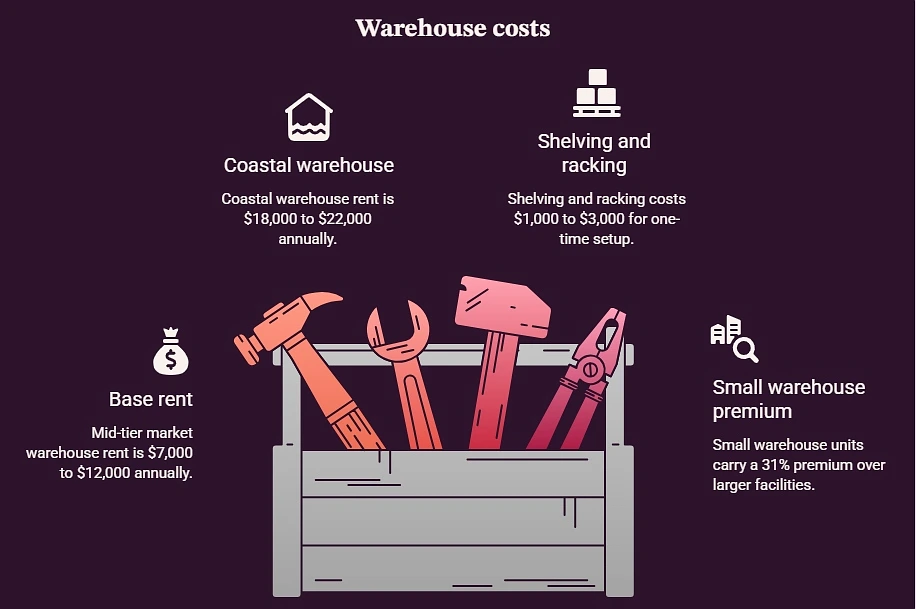
A thousand square feet of warehouse in the same kind of mid-tier market runs seven to twelve dollars a square foot, so you’re looking at seven to twelve thousand a year in base rent. Fit-out is basically nothing because warehouses come as they are, and shelving costs a couple thousand at most. Utilities run lower because you’re not cooling the space to office comfort levels all day.
And unlike the office expansion, this space is directly connected to things that make you money.
Everyone mentions the bulk purchasing advantage of having warehouse space but nobody seems to sit down and work it through, so here’s roughly what it looks like for a small e-commerce operation.
Say your product costs twelve dollars a unit when you order two hundred at a time, which is what you’ve been doing because that’s all you can fit anywhere. Your supplier has been telling you for months that the price drops to eight-forty at five hundred units, which is a thirty percent reduction, but you keep ordering the smaller batch because there’s physically nowhere to put five hundred of anything.
That’s three dollars and sixty cents per unit in margin you’re not capturing. Across a year of ordering, you’re leaving something like eleven to twelve thousand dollars on the table. The warehouse that would have unlocked that volume discount might have cost you $5,000 to $8,000 for the whole year in a secondary market. So the warehouse literally pays for itself just on the purchasing side, before you even count the operational improvements.
The operational side is harder to put a dollar figure on but it’s real. Running inventory out of office space means packing orders off a folding table in the break room, product stacked behind people’s desks, returns sitting in bags because there’s no space to process them, and the whole fulfillment operation running slower than it should. Move the same work into a dedicated space with actual shelving and a proper packing station, and everything speeds up, errors drop, and customers get their stuff faster. That’s revenue you can’t see on the warehouse lease but you can definitely see on the sales report.
Office leases in the US tend to lock you in for three to seven years and the penalties for breaking early can run into tens of thousands. Warehouse leases, particularly on smaller units, are generally shorter and more flexible.
The market right now actually favors tenants. National warehouse vacancy has settled at about 7.1%, which is the highest it’s been in over a decade, and landlords are offering concessions and free-rent periods to get spaces filled. Rent growth has cooled to roughly two percent a year after running at eight to twelve percent during the pandemic years. So if you’ve been putting off the warehouse decision, the timing is about as good as it’s been in a while.
This applies to a specific slice of businesses, but it’s worth covering because the cash flow impact can be significant. If you’re importing products from Thailand, Vietnam, or the Philippines, you’re probably shipping everything in one big container to US warehouse space where it sits for months until you sell through it. You’re paying US rates on inventory that isn’t generating revenue yet.
Some businesses are starting to hold a portion of that inventory closer to the factory instead. A ให้เช่าโกดังขนาดเล็ก, which is basically a small warehouse rental in Thailand, works as a staging point where finished goods sit at Thai rates until they’re actually needed, then ship in smaller batches as demand requires rather than one massive container every quarter. The economics work when your products are batch-manufactured but continuously sold, because you’re not tying up capital in months of unsold stock sitting in expensive American storage.
Not a fit for every business. Works best with a reliable manufacturing partner, non-perishable products, and enough volume to justify the second location. But for those it does fit, the difference in holding costs is meaningful.
When the pressure is people, not stuff. Professional services, consultancies, design agencies, law practices, anything where the work is done at desks and the only things stored are laptops and files, those businesses need more office space and a warehouse would be pointless.
Most growing businesses have some of both going on though, people needing desks and stuff needing storage, and the move that makes the most financial sense is almost always separating those two problems. Keep the office the size your team actually needs and move everything else into warehouse space at a third of the cost per square foot. It’s not a complicated idea and it’s not a new one, but it’s the one most businesses skip because getting a bigger office feels like growth, and renting a warehouse just feels like logistics.

Moving states costs most Australian households somewhere between $2,000 and $6,000 for the transport alone, before stamp duty, storage or any of...
Read moreDetails
Copyright © 2024 NoodleMagazine - All Right Reserved