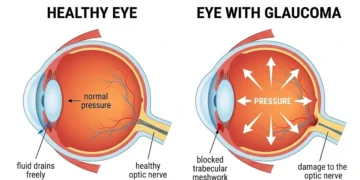
Glaucoma Takes Your Sight Without Telling You, And Your Own Brain Helps It Hide
You trust your eyes to complain when something is wrong. Something gets in, they water. Too bright, you squint. That...
Read moreDetails

Every wellness article aimed at business owners makes the same promise. Book a massage, melt the stress away, come back cured. It’s a comforting pitch, and it’s not quite what the research says. The gap between the two is worth understanding before you spend the money, because there’s a better reason to go than the one you’re being sold.
Start with how bad it actually is. In a 2025 study of entrepreneurs, 87% reported experiencing either anxiety, depression, or burnout, or all three at once. Founders are roughly 50% more likely than the general population to report a mental health condition, and clinical depression shows up in about 30% of them, against 7% in everyone else. Here’s the part that makes it a business problem and not just a personal one. The founder is the business, and when the founder breaks, everything breaks. When your judgment goes, the company’s goes with it.
So the stakes are real. The question is whether a spa visit does anything about them.
The honest answer is narrower than the marketing. A single massage session reliably lowers cortisol and heart rate right afterward, and that effect shows up again with each session. That part holds up across the studies. What doesn’t hold up nearly as well is the popular claim that regular massage permanently resets your stress hormones. The rigorous reviews found that cortisol drifts back to its starting point between sessions, even when massage is given in the interim, and a sustained hormonal change is not supported. Reviewers don’t even agree that the cortisol drop is the reason massage helps at all.
Put plainly, a spa treatment is a reset button, not a cure. It drops you into a calmer physiological state for a while. It doesn’t rewire your baseline. Anyone selling you the second thing is overselling.
Which sounds like a reason not to bother, until you look at what founders actually need.
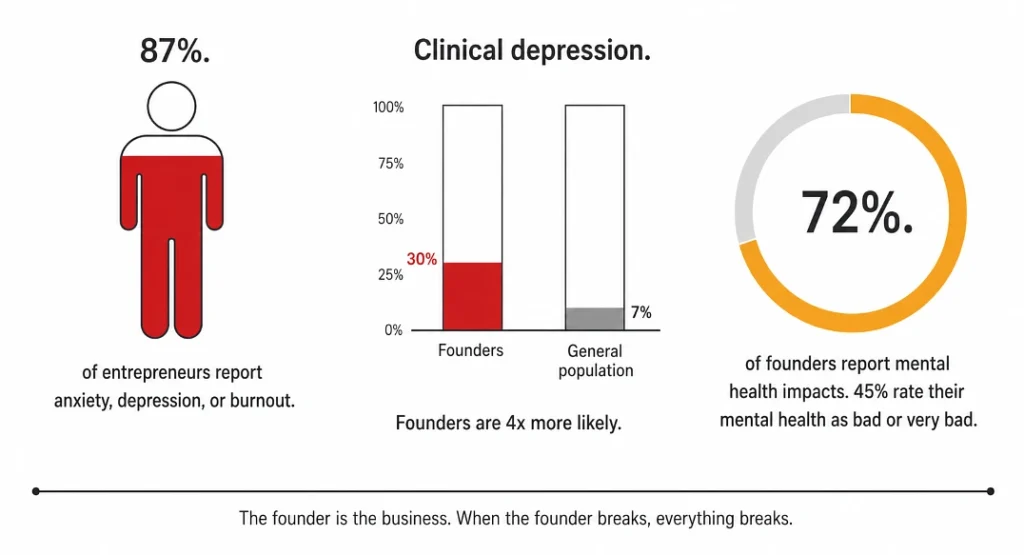
The thing wrecking most business owners isn’t a single bad week. It’s the absence of any real off switch. The 72% of founders reporting mental health impacts, and the 45% rating their mental health as bad or very bad, are not people who need one perfect afternoon. They’re people running at full capacity for months with no recovery built in. Rest never gets scheduled because there’s always one more thing.
That’s where a booked treatment earns its place, and it has nothing to do with hormones. It’s an appointment you’ve paid for, in a room where there is nothing to approve, reply to, or solve, and where you are, for once, genuinely unreachable. For a founder who will cancel on themselves the second a message lands, the fact that it’s on the calendar and already paid for is doing most of the work. The massage is almost incidental. The enforced boundary is the point.
And that lines up with the one piece of founder research that actually points at a fix. The Lehigh-led study of 308 entrepreneurs found that the ones who set clear work life boundaries experienced less burnout, and that higher wellbeing tracked with being more engaged, more productive, and more willing to keep growing the business. Boundaries, not cures. A spa visit is one of the more enforceable boundaries available, because you’ve made the appointment with someone other than yourself.
If you go, go in a way that matches what it’s actually good for:
None of this needs anywhere in particular. It plays out the same in a treatment room in New York or in one of the spa clusters around Nonthaburi just outside Bangkok, สปานนทบุรี in Thai, where the math for a stressed owner is identical. A paid hour of being no one’s problem solver.
The founders who last aren’t the ones who found a way to stop feeling stress. They’re the ones who caught it early and built in the interruptions before it started making their decisions for them. A spa day won’t fix you. Booked regularly and defended like it matters, it’s one of the simpler ways to make yourself put the work down, and given the numbers, that’s not a small thing.

You trust your eyes to complain when something is wrong. Something gets in, they water. Too bright, you squint. That...
Read moreDetails
Copyright © 2024 NoodleMagazine - All Right Reserved