
Glaucoma Takes Your Sight Without Telling You, And Your Own Brain Helps It Hide
You trust your eyes to complain when something is wrong. Something gets in, they water. Too bright, you squint. That...
Read moreDetails

Key Takeaways
Medicare and Medicaid fraud drains billions from public healthcare programs every year, raising costs for taxpayers and putting patient care at risk. The most common schemes are upcoding, kickbacks and billing for services that were never provided or never needed. Patients and insiders are usually the first to notice fraud, often through billing discrepancies, unfamiliar charges or services that were never ordered. Reporting through the right channel matters and reporting it the wrong way can cost you both the case and any award. Whistleblowers who file properly under the False Claims Act are protected from retaliation and can receive up to 30% of what the government recovers.
In April 2012, a former Biogen employee named Michael Bawduniak filed a lawsuit accusing the drugmaker of paying doctors to prescribe it’s multiple sclerosis drugs. The payments were dressed up as speaker fees, consulting fees, training honoraria, the occasional meal. He had already flagged it to Biogen’s own compliance department, which did nothing. So the FBI asked him to start recording conversations with Biogen staff and those recordings backed up what he was saying.
The government looked at the case and decided not to join it. His attorneys litigated it alone for years, millions of documents, dozens of depositions. A decade after he first filed, Biogen agreed to pay $900 million, most of it to the federal government and roughly $56 million split among 15 states. Bawduniak received about 29.6% of the federal share, somewhere near $26.6 million. It’s believed to be the largest whistleblower recovery under the False Claims Act ever secured without the government stepping in to help.
That one case shows almost everything worth knowing about how Medicare and Medicaid fraud actually works and how it gets stopped. So it’s worth understanding what these schemes look like from the inside, because the people who notice them first are almost never the investigators.
Fraud against these programs comes down to deliberately deceiving a government healthcare program to get paid for something you weren’t entitled to. Sometimes that’s a sophisticated corporate scheme like Biogen’s. Sometimes it’s a single provider padding their billing. The damage is the same either way, it pulls money out of programs that millions of people depend on and in the worst cases it pushes patients toward tests, equipment or procedures they never needed.
The scale is the problem. Government estimates put improper payments through Medicare and Medicaid above $130 billion in 2020 alone. Agencies like the Office of Inspector General prosecute these cases, but they can’t review every claim before it gets paid. The system runs on trust, providers submit claims, the government generally pays based on what the provider says happened. That trust is exactly what fraud exploits. Anyone weighing whether what they’re seeing crosses a line can start by learning how a qui tam healthcare fraud case actually proceeds before deciding what to do.
Most schemes are variations on a handful of moves.
Upcoding is billing for something bigger than what was delivered. A provider exaggerates the time spent with a patient, swaps in a code for a more serious diagnosis or bills a more expensive procedure than the one performed. A common tell is reflexive billing, where a provider always selects the highest level of service no matter what the patient actually needed.
Billing for services not rendered is the bluntest version, charging for appointments, treatments or equipment a patient never received. In the worse cases providers go further and perform unnecessary tests or even unnecessary surgery, treating a patient’s insurance like an open checkbook.
Kickbacks are payments or gifts traded for referrals or for prescribing particular drugs and devices. They distort medical decisions, because the referral starts following the money instead of the patient’s needs. The Biogen settlement was a kickback case at it’s core, the speaker programs were the vehicle.
A few others come up often, duplicate billing, misrepresenting a patient’s diagnosis to justify tests that weren’t needed and unbundling, where services meant to be billed together under one payment get split into separate codes to squeeze out multiple payments.
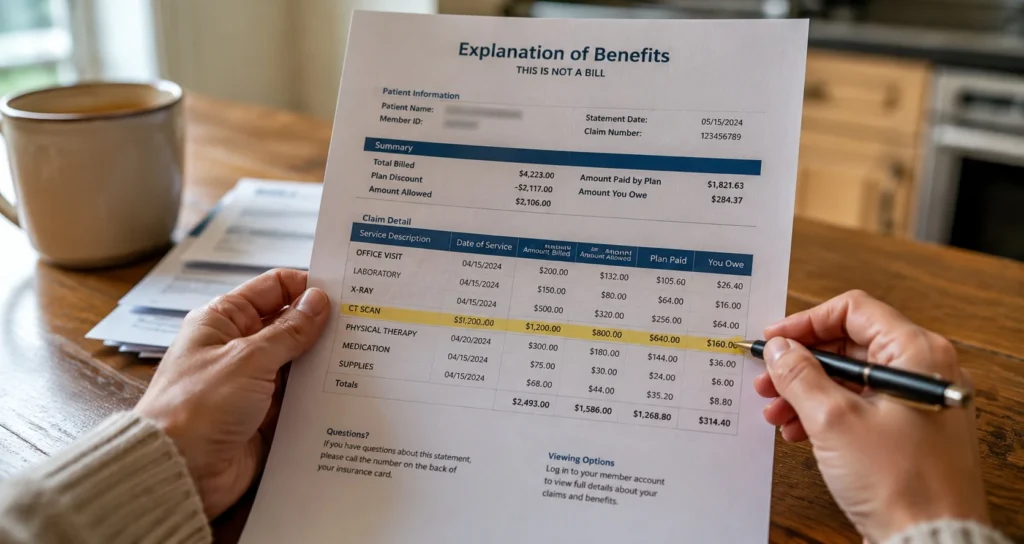
You don’t need to be an investigator to spot the warning signs. Patients catch a lot of this just by reading their own paperwork. Watch for:
Charges on a Medicare Summary Notice or Explanation of Benefits for services you never received. Provider names or facilities on your bill that you don’t recognize. Anyone offering “free” equipment or testing in exchange for your Medicare or Medicaid number. Calls, letters or prescriptions for appointments and services that were never scheduled or ordered.
A single odd line item usually isn’t proof of anything. But a pattern of charges that don’t match the care you actually got is worth questioning and worth raising with your provider before assuming it’s innocent.
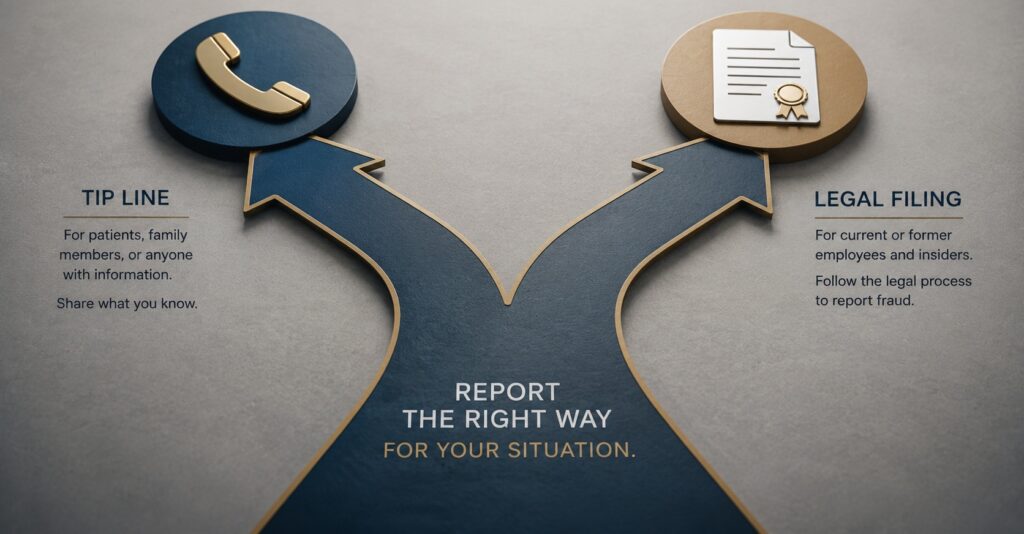
If you suspect fraud and you’re a patient or family member, the direct channels exist for exactly this:
Call 1-800-MEDICARE (1-800-633-4227) for the Medicare fraud tip line. Contact your state’s Medicaid Fraud Control Unit. Report to the Office of Inspector General hotline at 1-800-HHS-TIPS (1-800-447-8477) or file online.
Have the specifics ready, the provider’s name and address, dates of service, the patient details and a short summary of what looked wrong. The more concrete the tip, the better the chance someone can act on it.
There’s a catch worth knowing, though. Reporting fraud directly to a hotline is the right move for a patient, but it generally does not entitle you to a whistleblower award. If you’re an insider with real evidence of a scheme, the path that protects you and preserves a potential award runs through the False Claims Act, not the tip line.
Insiders are how most large fraud cases actually surface. The government relies on people who can see the scheme from inside the building, the billing manager, the sales rep, the nurse who knows the physician was never in the room. The False Claims Act exists to pull those people forward by protecting them and paying them.
File a qui tam case the right way and you can receive between 15% and 30% of what the government recovers. The same law shields you from retaliation under 31 U.S.C. § 3730(h), so termination, demotion or harassment for reporting can itself become a claim, with remedies like double back pay and reinstatement.
Two things tend to trip people up. First, the case is filed under seal, meaning it stays secret while the government investigates and your identity usually stays protected for a few years before it becomes public. That window gives you time to plan. Second, the False Claims Act runs on a strict first-to-file rule. Only the first person to properly file on a particular scheme is eligible for the award. Because these cases are sealed, you may have no idea someone already filed ahead of you, which is why waiting can quietly cost you everything.
The Biogen case is the clearest argument for both points. Bawduniak filed early, stayed the course through a decade of litigation and the government’s decision not to intervene didn’t sink him because the case was built properly from the start.
Most prevention is just attention. Read your statements the way you’d read a credit card bill, line by line and question anything that doesn’t match. Guard your Medicare and Medicaid numbers the same way, never handing them to anyone offering free gifts or unsolicited equipment. Be skeptical of any deal that needs your insurance information to unlock something free.
For someone watching fraud happen from inside a practice or company, the calculus is different and heavier. Staying and saying nothing carries it”s own risk and gathering evidence the wrong way, especially protected health information, can expose you to liability instead of protecting you. That’s the point where a conversation with an experienced whistleblower firm stops being optional.
The cases that recover the most money almost always start the same way, with one person who noticed something and decided not to let it slide. Bawduniak spent more than ten years on his. Most won’t take that long and most insiders never imagine the numbers will reach nine figures. But the structure of the law is built around that single decision to come forward and built to make it worth doing. Spotting the fraud is the first part. Reporting it the right way, early and with the right help, is what turns noticing into something that actually stops it.

You trust your eyes to complain when something is wrong. Something gets in, they water. Too bright, you squint. That...
Read moreDetails
Copyright © 2024 NoodleMagazine - All Right Reserved