Your Bathroom Fan Is Why the Vanity Is Swelling
Quick answer: the exhaust fan is the only thing standing between your shower steam and every surface in the bathroom,...
Read moreDetails

A hardwood deck can pass every number on the spec sheet and still go grey, cup, and split within a couple of summers. The timber isn’t the problem when that happens. The detailing is. That gap, between a timber that’s rated to last forty years and a deck that actually does, is where most backyard projects quietly go wrong and it’s worth understanding before you spend on the boards.
In Australia the backyard does real work. For a lot of families it’s the second living room, used most of the year, which is exactly why a good alfresco or deck sits among the higher-return home improvements going around, with resale estimates landing somewhere in the 75 to 83 percent range. Buyers like walking into a finished outdoor space they don’t have to build themselves. But the return only holds if the thing lasts and lasting is more about choices than about the price of the timber.
A deck that still looks good in ten years starts on paper, not at the timber yard. The current design lean is away from the plastic-looking composites and back toward natural materials with real grain and earthy tone, which suits the local hardwoods well. When you’re pricing the build, sourcing quality hardwood in Brisbane that’s cut for local conditions matters more than chasing the cheapest lineal metre, because the wrong board in this climate fails fast.
Whether you’re after a spot for summer barbecues or just somewhere to sit with a coffee before work, the layout does most of the heavy lifting on how the space feels. If you want to map your own before committing, browsing ideas on outdoor entertaining and landscaping helps you settle the layout while it’s still cheap to change your mind. The aim is a space that reads as part of the house, not a structure bolted onto the back of it.
Brisbane throws humidity, hard UV and termites at anything you put outside, so the timber choice is doing more than looking good. Dense native hardwoods are the local default over imported composites, and the density is the whole point, it’s what gives you the toughness, the bug resistance, and the fire performance in one species.
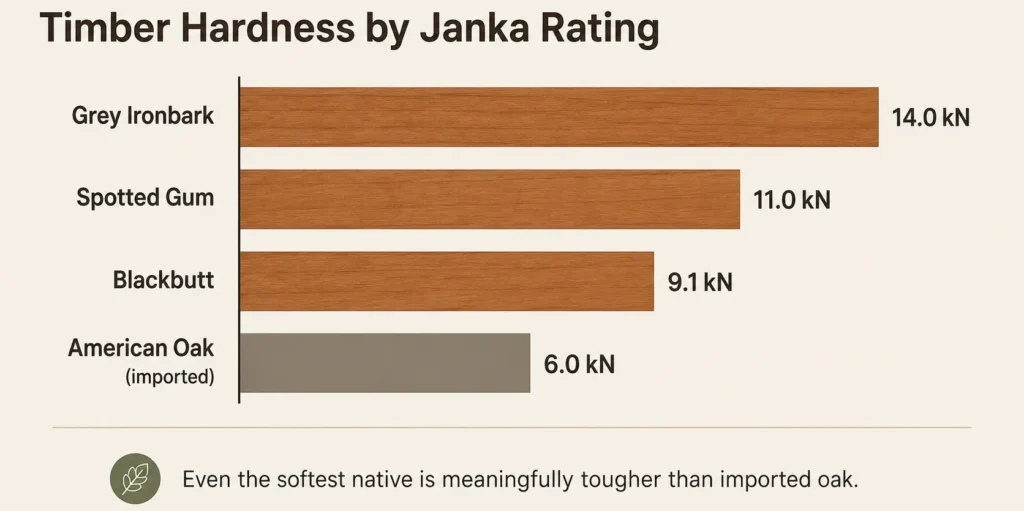
The hardness story is easy to see in the Janka numbers, which measure how well a timber resists denting:
Grey Ironbark sits around 14.0 kN. It’s one of the hardest commercial timbers on earth, dense enough that it won’t float in water. Brutal underfoot durability, but it’s hard on tools and harder on your install budget. Spotted Gum runs about 11.0 kN, the popular middle ground, the wavy grain and colour range from pale grey through to chocolate is why architects keep reaching for it. Blackbutt comes in near 9.1 kN, a touch softer, easier to work, more uniform in colour, and its heartwood isn’t prone to lyctid borer the way Spotted Gum’s is.
For comparison, imported American Oak sits around 6.0 kN, so even the softest of these natives is meaningfully tougher than the timber a lot of people assume is premium.
Class 1 hardwoods like Spotted Gum and Ironbark carry an above-ground life expectancy past 40 years in WoodSolution’s durability ratings, and that density brings natural termite and decay resistance without chemical treatment. It also handles fire. Under the bushfire construction standard, dense natives like Spotted Gum, Blackbutt and Ironbark meet BAL-29 requirements on their own, because they char rather than catch, so there’s no need for the toxic fire-retardant treatments lower-density timbers need.
Here’s the part the spec sheets leave off, and it’s the thing that actually decides whether your deck lasts.
Durability class measures resistance to rot and insects. It says nothing about weather. A Class 1 Ironbark deck will silver off to grey just as fast as the cheapest pine if you don’t put a UV-protective finish on it and keep it up. The forty-year figure assumes the deck is detailed and maintained properly, and WoodSolutions is blunt about this: poor ventilation, trapped moisture, or concealed joints will rot even a Class 1 hardwood early.
Two more things builders know and brochures skip. Only the heartwood is durable, the sapwood rots even in a Class 1 species, so what you’re actually buying matters as much as which tree it came from. And Spotted Gum and Blackbutt heartwood can’t be brought up to a treated standard with pressure treatment, so with these timbers you’re relying on natural durability and good detailing, full stop. Spotted Gum in particular will surface-check if the end grain isn’t sealed, and it wants regular oiling to hold its colour. None of that is a reason to avoid it. It’s the reason to detail the deck right and budget for upkeep instead of assuming the rating does the work for you.
If sustainability factors into the build, Australia runs two independent certification bodies, FSC Australia and Responsible Wood, covering more than 11.4 million hectares of native and plantation forest between them. Buying timber certified under either means the boards came out of forests managed to a real ecological and ethical standard, which is worth confirming at the yard rather than assuming.
Once the deck or pergola frame is up, a few choices stretch its life and cut how much you fuss over it later:
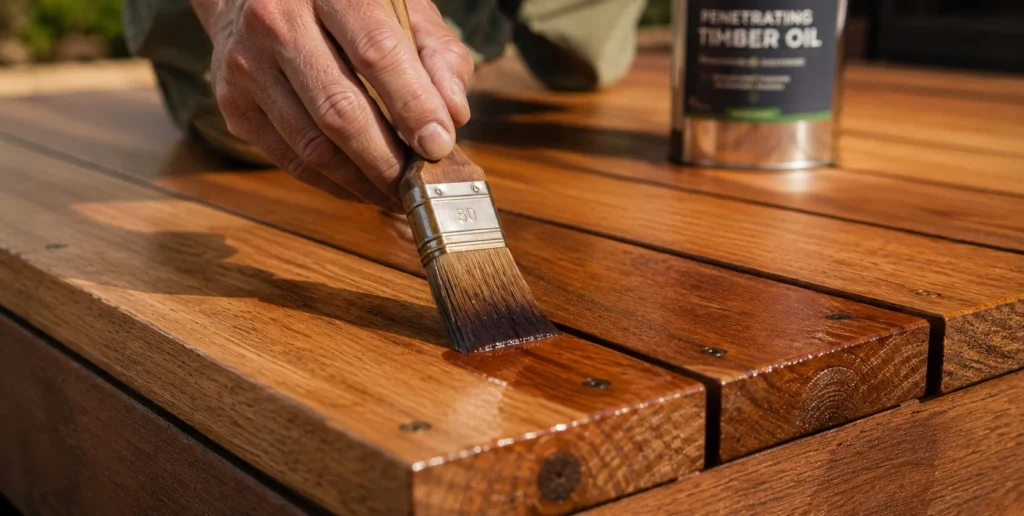
A penetrating oil finish, kept up rather than applied once and forgotten, protects the boards from UV and holds the grain colour instead of letting it grey off. Drought-tolerant native planting around the deck suits the earthy timber tones and survives a Brisbane summer without constant watering. Timber seating, storage benches or planter boxes built into the deck save floor space and read as a single custom build rather than furniture parked on top. Furniture in rust-proof aluminium, treated teak, or UV-stable fabrics, so the styling survives the storms instead of needing replacing every couple of seasons.
Pair a dense native timber with detailing that respects how it actually behaves in this climate, and the deck holds its value and its looks for decades. Get the species right and the detailing wrong and you’ve bought a forty-year board that lasts five. The timber was never the hard part.

Quick answer: the exhaust fan is the only thing standing between your shower steam and every surface in the bathroom,...
Read moreDetails
Copyright © 2024 NoodleMagazine - All Right Reserved