
Your Bathroom Fan Is Why the Vanity Is Swelling
Quick answer: the exhaust fan is the only thing standing between your shower steam and every surface in the bathroom,...
Read moreDetails

The blue tile color is among the best tile colors of 2024. Not only in a single format – in ceramic, glass, and porcelain, in various shades of light and dark – they have been gathering strength in the market, particularly in kitchens and bathrooms. That’s not a coincidence.
The reason most people feel blue interiors is because it is a real study. In 2018, scientists at the University of Bologna experimented on 443 students who lived in a residence hall consisting of six buildings – the same in terms of all architectural elements, and the only distinction being the wall color. The findings reported in the article in the journal Frontiers in Psychology revealed that blue was the favorite interior color, and there was a statistically significant correlation between a blue environment and a relaxed mood. Students in the blue building also gave it the highest rating in the facilitation of studying, as compared to warmer colors such as orange and red.
On the spatial side, cool tones push walls outward visually. A blue-tiled wall in a narrow bathroom reads as more open than the same wall in a warm or neutral color.
Blue ceramic tile adds calm, depth, and style to kitchens and bathrooms. Learn where to use it, how to choose shades, and what pairs best.
The backsplash is the visual center of most kitchens — it’s what you’re looking at while cooking. A blue ceramic tile here changes the room’s character without touching cabinets or countertops.
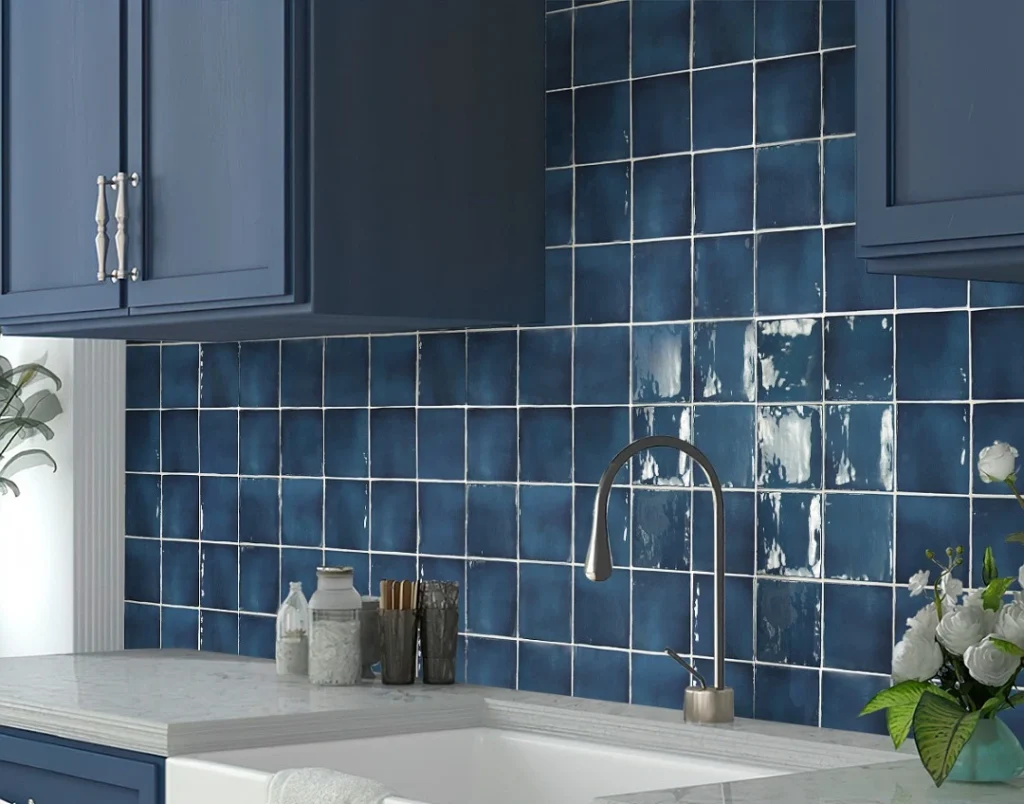
Why ceramic specifically for a backsplash:
That’s according to the Tile Council of North America, which also notes that non-ceramic surfaces can trap residual moisture behind the wall material — a breeding ground for mold — while properly installed ceramic prevents this.
Blue in a bathroom is the most obvious fit. The color already reads as water-adjacent, and the research on calm moods cited above backs up what most people sense when they walk into a well-tiled blue bathroom.
Tile drenching — running the same tile across walls, floor, and features like a vanity surround — is a growing approach in 2025, with bathrooms as the primary space where designers are applying it, according to Homes & Gardens’ 2025 tile trends report. In a small bathroom, carrying one tile across all surfaces makes the space feel considered rather than assembled from separate parts.
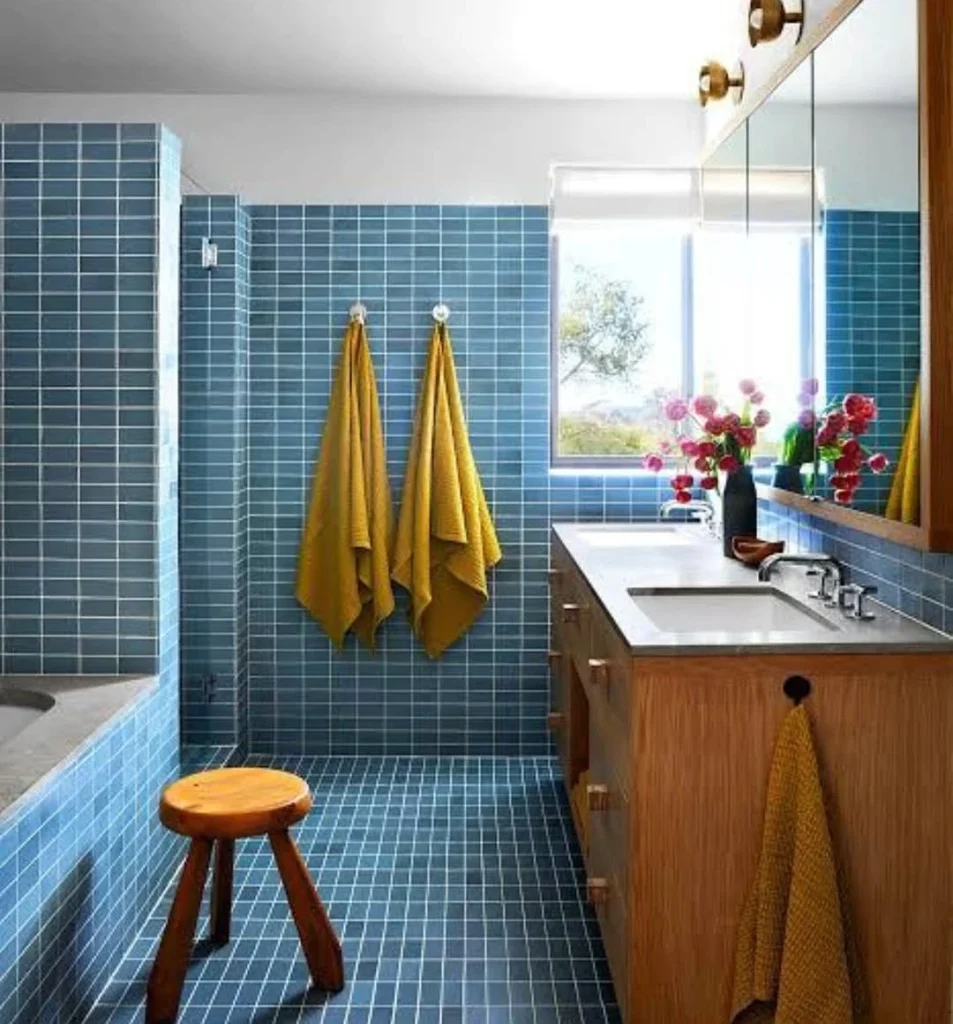
Not all blues behave the same way in a room:
| Shade | Best for | Light condition |
|---|---|---|
| Sky blue, pale aqua | Smaller rooms, softer look | Works in low natural light |
| Cobalt, navy | Statement walls, larger spaces | Needs strong natural light to balance |
| Dusty blue, slate | Neutral feel, pairs with warm wood | Flexible across light conditions |
North-facing rooms and those which receive minimal sunlight should not be overloaded with deep blue on all four walls of the room – it does not translate into cozy in such situations.
Finish:
Grout:

Quick answer: the exhaust fan is the only thing standing between your shower steam and every surface in the bathroom,...
Read moreDetails
Copyright © 2024 NoodleMagazine - All Right Reserved