Watch New York Fashion Week Shows From Home, February 10 To 14, 2027
Runway 7 is bringing it's New York Fashion Week shows back to Sony Hall from Wednesday, February 10 to Sunday,...
Read moreDetails

Every few months another report announces that shoppers have had a moral awakening and turned on fast fashion. It makes a clean headline. The waste behind it is real enough: the fashion industry throws off around 92 million tonnes of textile waste a year, a number the UN expects to hit 134 million tonnes by 2030 on current trends, and close to 73% of that gets burned or buried instead of reused or recycled. Polyester, which sheds microplastic every wash, is now more than 60% of the fiber the world makes. None of that is in dispute.
What’s shakier is the story stitched on top of it. The idea that consumers are quietly abandoning cheap clothing out of conscience, and that this is what’s powering the shift toward slower, better-made goods. The spending data doesn’t back the tidy version of that.
Look at who actually holds the money. Bain & Company projects that by 2030, more than 70% of global luxury spending will come from Millennials and Gen Z, the two groups everyone points to as the ethical ones. But Bain’s own recent numbers tell a more awkward story about how they behave right now. That younger share has been slipping, not climbing. The luxury customer base shrank by roughly 20 million people in a single recent year as shoppers cut frequency, traded down, or moved to secondhand. And Gen Z in particular reads as less loyal and more price-sensitive than the generation before it, not more willing to pay up for virtue.
So the picture isn’t “people got principled and started spending accordingly.” It’s closer to the opposite: a generation that says the right things about sustainability while shopping harder on price and bailing to resale. If you’re selling the clean morality-tale version of slow fashion, that’s a problem. The behavior doesn’t match the branding.
There is one corner of this, though, where the shift is genuinely measurable and genuinely sticky. And it has almost nothing to do with ethics.
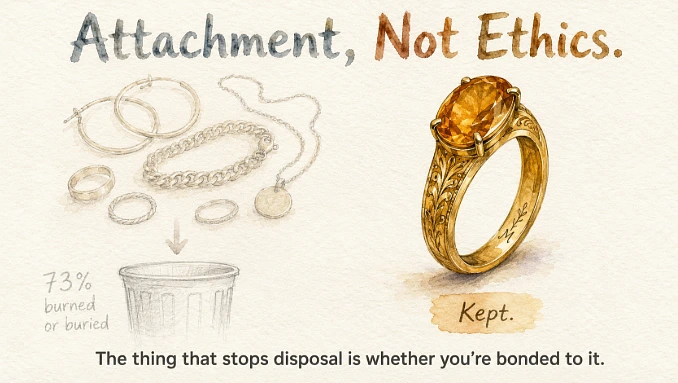
The thing that actually keeps an object out of a landfill isn’t a sustainability pledge on the label. It’s whether you’re attached to it. And customization manufactures that attachment better than any recycled-cotton claim.
When you sit in on the design of a piece, pick the stone, choose the engraving, decide what it commemorates, you’ve done something a bulk purchase never asks of you. You’ve made it specific to you, which quietly rules out the disposal reflex that governs everything else in the wardrobe. Nobody bins the ring they helped draw. This is the real engine under the custom accessories trend, and it’s why a growing share of buyers are commissioning personalized jewelry rather than adding another interchangeable piece to the pile. The point isn’t that it’s ethically sourced, though it often is. The point is that it’s yours in a way mass product can’t be, so it survives.
That’s a much smaller and more honest claim than “conscious consumption is reshaping fashion.” It’s also the one the numbers actually support.
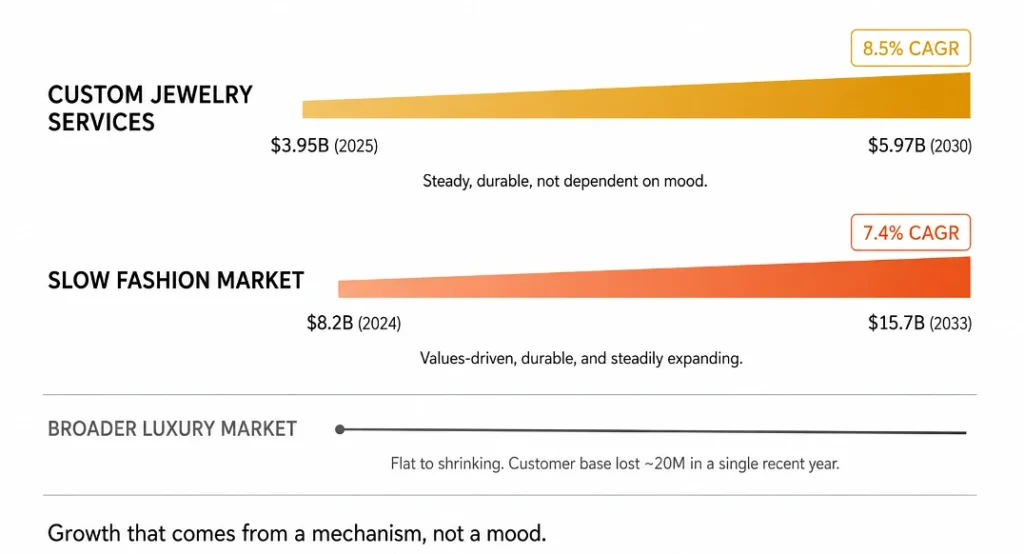
The custom jewelry services market was worth about $3.95 billion in 2025 and is on track for $5.97 billion by 2030, growing at 8.5% a year, according to The Business Research Company. The wider slow fashion market runs on a similar quiet slope, roughly $8.2 billion in 2024 heading toward $15.7 billion by 2033 at 7.4%. Steady. Not explosive, not a revolution, but durable in a way the broader luxury market, which has been flat to shrinking, hasn’t managed.
Growth like that doesn’t come from a mood. It comes from a mechanism that keeps working regardless of how people feel about the planet on a given week.
The big houses have noticed, and most now offer engraving, monogramming, made to order lines as revenue drivers. But this is one area where scale is a disadvantage. Bespoke depends on the buyer feeling like a participant, and a monogramming station bolted onto a global supply chain doesn’t deliver that. A small studio taking one commission at a time does. The intimacy is the product, and intimacy is exactly what large-scale manufacturing strips out.
So here’s the part the trend pieces won’t say. If you actually care about those waste figures, buying things labeled sustainable is close to useless, because the label doesn’t stop the disposal cycle. Buying fewer things you’re genuinely bonded to does. Customization isn’t valuable because it’s virtuous. It’s valuable because attachment is the only thing that reliably keeps an object out of the bin, and a piece you helped make is one you’re far less likely to throw away.

Runway 7 is bringing it's New York Fashion Week shows back to Sony Hall from Wednesday, February 10 to Sunday,...
Read moreDetails
Copyright © 2024 NoodleMagazine - All Right Reserved