
Your Bathroom Fan Is Why the Vanity Is Swelling
Quick answer: the exhaust fan is the only thing standing between your shower steam and every surface in the bathroom,...
Read moreDetails

A 2024 survey by My Home Move Conveyancing found that 77% of people experienced heightened stress during their last home move — ranking it above having a baby, getting married, and yes, even the pandemic. That’s not a small number. And yet 84% of those same people said they’d move again.
So the stress is real, clearly documented, and apparently not enough to put people off. Which means the question isn’t whether moving is hard. It’s whether you come out of it feeling like it was worth it.
Two weeks out, go room by room — not to pack, just to decide. What’s coming? What’s going to a charity shop? What’s been sitting somewhere for three years because throwing it away feels wasteful, but you’ll never actually use it again? That last category is larger than anyone admits.
The average Brit moves four times in their life, according to Legal & General research. Most of those moves involve carting the same half-used things from one place to the next without ever questioning them. Clearing first means the boxes are lighter, the van space is smaller, and you’re not unpacking clutter into a space you were hoping would feel different.
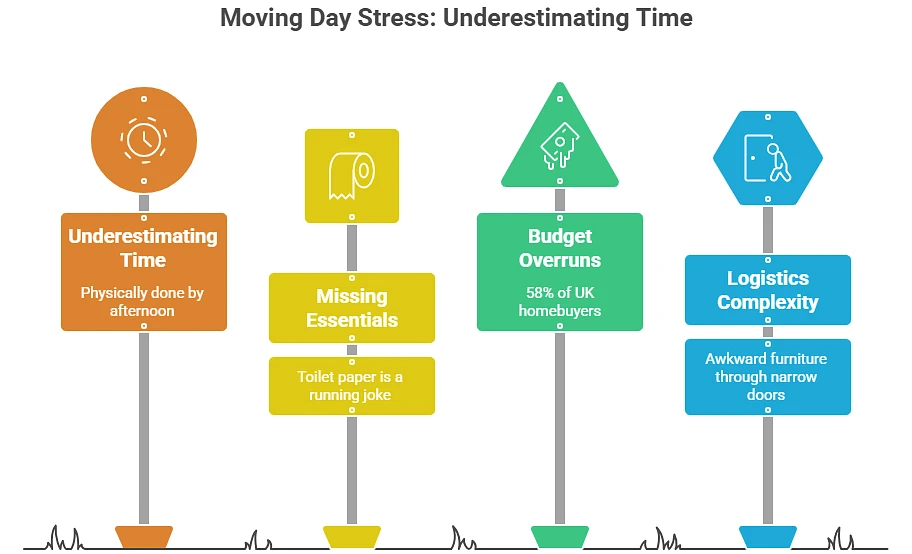
Moving day itself ranks as the single most stress-inducing part of the entire process — not the paperwork, not the mortgage, the actual day. Most of that comes down to underestimating time.
Start at 8am if you can. It sounds punishing, but it means you’re physically done by early afternoon with daylight left to actually set things up rather than fumbling around in a half-assembled bedroom at 10 pm.
Food, water, chargers — in a bag you carry personally, not packed somewhere in box fourteen. Toilet paper, too. The number of people who discover this missing on their first night in a new place is a running joke among removal crews for a reason.
58% of UK homebuyers said their move ended up costing more than they’d budgeted for, with 70% of Londoners going over budget — so factor in a buffer, and use that buffer to get the transport right. Finest Van offers van removal services in London that handle the actual logistics — loading order, staircase furniture, and timing. A good removal crew has done the awkward sofa-through-a-narrow-doorway problem hundreds of times. You haven’t.
41% of adults who moved reported anxiety, 31% experienced sleep deprivation, and 25% had more arguments with their partner during the process. None of that is really about heavy boxes. It’s decision fatigue. By hour six you’re deciding where to put things you’ll probably move again within a week, and your brain is just done.
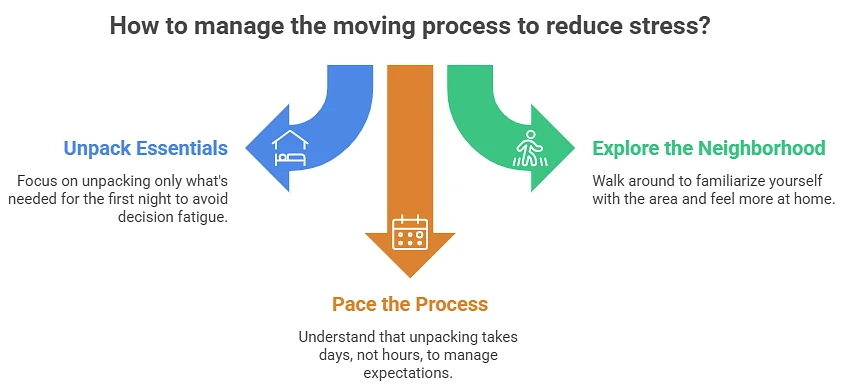
Stop before that point. Unpack what you need for tonight — bed, basic kitchen, bathroom. Everything else is fine in boxes until tomorrow, when you can think straight. The rest of the place will come together over days, not hours, and that’s completely normal.
Walking around the neighborhood that first evening, even just to find somewhere to eat, does something useful. It starts the shift from “new place” to “where I live.” Small observations — the coffee shop nearby, the shortcut through the park — accumulate faster than you’d expect.
Moving forces a kind of inventory that ordinary life doesn’t. You physically handle everything you own. You make decisions about your space and routines concretely, not in the abstract.
Some people recreate their old setup exactly. Same furniture positions, same systems. Nothing wrong with it. Others treat the blank space as a reason to try something different — a desk near the window, kitchen actually organized around how they cook. Neither approach is the point. The point is you get to choose, and moving day is probably the only time that choice is genuinely easy to make.

Quick answer: the exhaust fan is the only thing standing between your shower steam and every surface in the bathroom,...
Read moreDetails
Copyright © 2024 NoodleMagazine - All Right Reserved