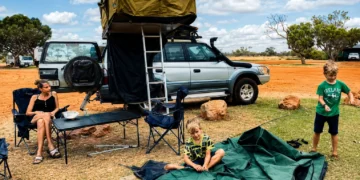
Australian Families Are Taking More Outback Trips Than Ever, Just Not the Way the Glossy Ads Show It
The brochure version is a family parked beside a gorge a thousand kilometres from anywhere, an espresso machine humming off...
Read moreDetails

I’ve been to Japan twice in spring, and the answer to this question depends on what you actually want out of the trip. The honest version is that the city has roughly five neighborhoods worth booking during sakura week, and picking the wrong one can mean an extra hour each day on the Midosuji line when you’d rather be standing under a cherry tree with a beer.
The 2026 forecast from the Japan Meteorological Corporation puts the first bloom around March 23 and the full bloom (mankai) around April 2. The window is about a week, give or take a hard rain. So whatever neighborhood you pick has to deliver you to the trees fast, because by the time you’ve figured out the trains, half the petals are already on the ground.
Here are the five areas I’d actually recommend, ranked by how I’d weigh them against each other, with the trade-offs spelled out. Many travellers researching where to stay in Osaka — referred to in Thai as โอซาก้า พักแถวไหนดี — end up oscillating between Namba and Umeda, but the real answer depends on which version of spring you’re trying to catch.
If this is your first trip to Osaka, this is probably where you should sleep. Namba sits right on top of Dotonbori, the Glico sign, the Kuromon Ichiba market, and the Shinsaibashi shopping arcade — the food and shopping spine of the city. The Nankai Rapid train from Kansai International Airport (KIX) drops you directly into Nankai Namba Station in 34 minutes, non-stop, which during cherry blossom season — when KIX is operating at peak congestion — is a real mercy.
What makes Namba work for Sakura specifically:
What does not work about Namba:
Best fit: First-time visitors, food-led travellers, anyone arriving on the Nankai line from KIX, and wanting zero transfer headaches.
Umeda is where Osaka’s serious transport hub lives. JR Osaka Station, Hankyu Umeda, Hanshin Umeda, and the Osaka Metro all converge here. From Osaka Station, the JR Kyoto Line gets you to Kyoto Station in about 30 minutes, the JR Kobe Line gets you to Sannomiya in roughly 25, and the Kintetsu line out of Namba (which is also reachable in two stops via Midosuji) gets you to Nara in about 40.
For cherry blossom season specifically, Umeda has one underrated advantage: it sits at the northern edge of central Osaka, which means it’s the closest of the five areas to Kema Sakuranomiya Park. The JR Loop Line from Osaka Station puts you at Sakuranomiya Station in two stops, roughly 6 minutes. The park itself runs 4.2 kilometers along the Okawa River with about 4,700 cherry trees — locals call it the most spectacular cherry stretch in the city, and they’re not wrong. Most foreign tourists default to Osaka Castle Park instead, which means Sakuranomiya is genuinely less mobbed, especially on weekday mornings.
The other Umeda call: it’s a few minutes’ walk to Nakanoshima, the long, thin island in the middle of central Osaka with the Central Public Hall, the rose gardens, and a quieter strip of cherry trees that almost no foreign guidebook covers. Walk along the river there at 7am with a coffee from one of the konbini, and it feels like the city is on loan to you.
What gives some travellers pause about Umeda:
Best fit: Multi-city travellers using Osaka as a Kansai base, anyone whose itinerary includes day trips to Kyoto/Nara/Kobe, light sleepers who want a calmer evening atmosphere.
This is the call for travellers whose entire reason for the trip is the cherry blossoms.
Osaka Castle Park has about 3,000–4,000 cherry trees spread across roughly 261 acres, with the Nishinomaru Garden specifically holding about 300 Somei Yoshino trees and a paid entry of 350 yen during sakura season. The Nishinomaru illumination for 2026 runs from March 20 to April 12, 6pm to 9pm (last entry 8:30pm). About a 15-minute walk away, the Japan Mint Bureau opens its private garden for one week each spring — the “Sakura Tunnel,” a 560-metre one-way path through 340 cherry trees of 140 varieties, mostly the late-blooming yaezakura. The 2026 dates are April 9–15, and reservations are required in advance.
Staying in this area means rolling out of bed at 7 am, walking 10 minutes to Osaka Castle Park before the tour buses arrive, getting your photos in soft morning light with maybe twenty other people in the frame instead of two thousand. That alone is worth the trade-off of being slightly off the main entertainment circuit.
The trade-off is real, though. The immediate area around Osaka Castle is heavy on government buildings, hotels, and parks — light on restaurants, light on nightlife, and at night it gets quiet quickly. Most travellers who stay here end up taking the train to Honmachi or Namba for dinner anyway. That’s a 10–15 minute ride, not a tragedy, but it’s real friction.
The Tenmabashi side is more practical. Tenmabashi Station sits on the Keihan Main Line and the Osaka Metro Tanimachi Line — from here you can walk to Osaka Castle Park, walk to Kema Sakuranomiya, walk to the Mint Bureau, and you’re 10 minutes by train from Yodoyabashi for the rest of the city. Hotel Noum, Hotel New Otani Osaka, and several mid-range business hotels concentrate here.
Best fit: Sakura purists, photographers, early risers, travellers on a 2–3 day Osaka stop who want every morning to start with cherry trees.
Shinsaibashi has become my personal default. It’s the strip just north of Namba — same Midosuji subway line, same walking distance to Dotonbori, but several decibels quieter at night and a better hotel-value-per-yen ratio in the mid-range. The Shinsaibashi-suji shopping arcade runs straight through it. The W Osaka, the St Regis Osaka, and a long line of mid-range hotels (HOTEL THE LEBEN OSAKA, Bespoke Hotel Shinsaibashi, the boutique scene) all sit within a few minutes of Shinsaibashi Station.
For sakura, the Shinsaibashi position is essentially a discount on Namba — same access to the major cherry blossom spots via Midosuji, but typically 10–20% cheaper and meaningfully less noisy. Walk south for ten minutes and you’re in Dotonbori; walk north for ten minutes, and you’ll hit the calmer dining districts; jump on the metro, and you’ll be at any of the three big sakura parks within half an hour.
What you give up: direct airport rail access (you have to walk or take a one-stop ride to Namba to catch the Nankai Rapi:t), and the slight prestige of being “right in the middle of it.” Most travellers won’t miss either.
Best fit: Repeat visitors, mid-range budgets that still want walkable central access, light-sleeper couples who want Namba’s amenities without Namba’s volume.
Tennoji used to be the budget recommendation that nobody would actually take seriously. That has shifted in the last few years — partly because Namba has gotten genuinely overcrowded, partly because Tennoji has cleaned up significantly, and partly because Abeno Harukas (Japan’s tallest skyscraper at the time of construction) anchored the area with proper restaurants, shopping, and one of the city’s better sky bars.
Tennoji Park itself has cherry blossoms — not in the league of Osaka Castle, but pleasant — and the eight-minute walk to Shitennoji Temple delivers you to the Honbo Garden with about 100 cherry trees of multiple varieties (Somei Yoshino, Yaezakura, Edohigan, Yamazakura) and the temple’s iconic Five-story Pagoda framing them. It’s a quieter hanami than the Castle Park crush, and entry to the inner garden is 300 yen.
The transport is solid: JR Tennoji Station, Osaka-Abenobashi Station (Kintetsu — direct to Nara), and the Midosuji subway line all hub here. From Tennoji, you can be at Osaka Castle Park in about 15 minutes, Namba in 5, Umeda in 15, and KIX in 35.
The downsides: hotel selection is less varied at the high end. The Osaka Marriott Miyako inside Abeno Harukas is the standout, but books fast; below that, the options are mostly business hotels. Some of the streets immediately west of Tennoji Station (around Shin-Imamiya and Tsutenkaku) have a grittier feel after dark — fine during the day, less appealing late at night for some travellers.
Best fit: Repeat visitors, budget-conscious travellers who still want central access, anyone planning a Nara day trip via the Kintetsu line, light sleepers who genuinely cannot tolerate Namba.
Book early. This is the cliché advice, but during sakura week, it’s not optional. Hotels in central Osaka run at near-capacity from late March through mid-April, and the rates roughly double versus low season. Six months ahead is normal; nine months for the better-rated places.
Weekday mornings are the actual hack. Most of the cherry blossom photos you’ve seen on Instagram were taken between 6:30am and 8am on a weekday. Osakans are at work, the tour groups haven’t arrived yet, and the light is soft. By 11 am on a Saturday at Osaka Castle Park, you cannot move.
Carry cash for konbini and food stalls. Cherry blossom parks during peak bloom fill up with yatai food stalls — takoyaki, okonomiyaki, yakisoba, sakura mochi — and many are cash-only. The 7-Eleven and Lawson at Sakuranomiya and Tenmabashi stations are the easiest restock points.
The Mint Bureau Sakura Tunnel for 2026 runs April 9–15 with mandatory reservations. If your trip is early in the season (late March), you may miss this specifically because the yaezakura at the Mint bloom about 10 days later than the Somei Yoshino at the rest of the city. Check the dates against your travel window before you commit.
The honest summary: Namba is the right answer for most first-time visitors, Umeda is right if Kyoto is also on the itinerary, the Castle/Tenmabashi corridor is right for serious cherry blossom photographers, Shinsaibashi is the underrated middle option, and Tennoji is what you book the second or third time when you’ve decided the noise of central Osaka isn’t actually adding to the trip. Pick based on what you’re optimising for, book six months out, and the city will deliver more sakura than a single week can comfortably absorb.

The brochure version is a family parked beside a gorge a thousand kilometres from anywhere, an espresso machine humming off...
Read moreDetails
Copyright © 2024 NoodleMagazine - All Right Reserved