
Budgeting an Interstate Move: The Numbers to Sort Before the Boxes
Moving states costs most Australian households somewhere between $2,000 and $6,000 for the transport alone, before stamp duty, storage or any of...
Read moreDetails

So you’ve got the Destination Thailand Visa figured out. Five-year validity, multiple entries, 180 days per stay with a possible 180-day extension, all for a base 10,000 THB application fee (some embassies charge the equivalent in local currency, often 400 to 500 USD). You’ve shown the bank balance, you’ve got your remote income sorted, and you’re picturing yourself in a Chiang Mai cafe with decent wifi and a 65-baht pad thai. The financial planning part feels done.
It isn’t. The bit that catches most people comes later, and it’s the collision between two numbers that nobody puts in the same sentence: the 500,000 THB you needed to qualify for the visa, and the elevated rate at which Thai private medical costs continue to climb, double digits in recent years, though the latest forecasts show some moderation. One hospital admission at a Bangkok private facility can run 200,000 to 800,000+ THB, depending on what’s wrong with you, and that’s before the surgeon’s fee or an extended stay. If you’re relying on your visa savings as your emergency fund, a single medical event can wipe it clean.
This is the financial planning that actually matters for DTV holders, and most of it happens before you pack.
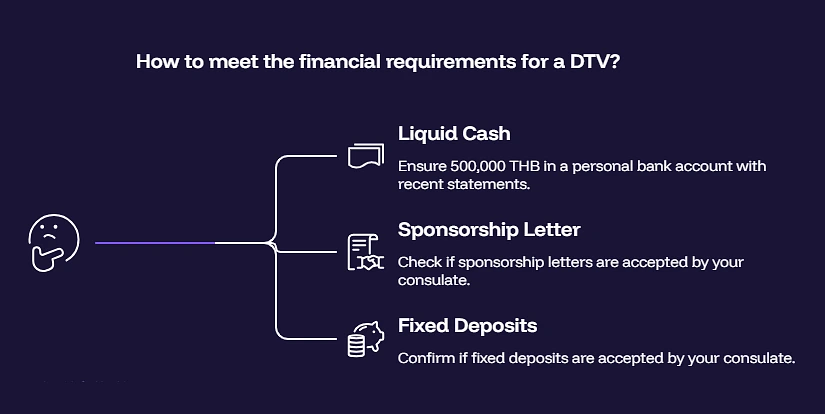
The DTV’s financial requirement is straightforward on paper. You need 500,000 THB (roughly $15,250 USD at current rates of about 32.7 to 32.8 THB per dollar) sitting in a personal bank account. Embassies generally require recent statements, a baseline for the last three months, showing an ending balance of at least 500,000 THB. Some are stricter on seasoning or request six months. Crypto, investment portfolios, and PayPal balances do not count. It has to be liquid cash, or equivalent in major currencies at some posts, in a bank account in your name. Fixed deposits are accepted at certain embassies, and sponsorship letters are accepted at some but not all, so always confirm with your specific consulate before assuming.
What trips people up is what happens after approval. The 500,000 THB is technically an application requirement, not a permanent obligation; you’re free to spend it once you’re in Thailand. But if you want to extend your stay beyond 180 days, immigration may ask you to demonstrate funds again under what’s known as the “snapshot” rule. So the money has to exist at the application and potentially again at the extension.
The practical effect is that most DTV holders end up ring-fencing that 500,000 THB as untouchable savings, which means it’s sitting there while their actual living expenses come from somewhere else entirely. And if the savings run thin somewhere else, the visa savings become the emergency fund by default, the worst possible use for money you might need to show immigration in six months.
A few things worth understanding about the requirement:
Here’s where the commodity version of this article would list Thailand’s lovely hospitals and move on. The non-commodity version asks you to do some math.
Willis Towers Watson’s Global Medical Trends surveys have shown Thailand running high single- to low double-digit medical cost inflation in recent years, with earlier projections reaching about 14.2% for 2025 in some WTW data. The latest WTW 2026 Global Medical Trends Survey, published in December 2025, projects 10.8% for Thailand in 2026, still elevated and among the higher rates in the region, though the Asia-Pacific region overall is projected at 14%. Meanwhile, Thailand’s general consumer price inflation was near zero or slightly negative through parts of 2025 and is running around 2 to 3% in mid-2026, still far below the rate at which medical costs are moving.
Put differently, a procedure costing 300,000 baht today could cost substantially more in five years if these elevated trends persist. Why does it keep climbing? Three structural reasons:
Private hospitals competing aggressively for talent and technology. Over 92% of Thai private hospitals are actively investing in equipment upgrades and specialist recruitment, and that arms race gets passed to patients through billing.
The public system is overburdened. Government hospitals are stretched, particularly in border regions and tourist areas, and waiting times have pushed anyone who can afford it into private care, which further inflates private pricing.
Foreigners pay more by design. Thailand’s public hospitals operate official dual-pricing tiers where foreigners pay premiums over Thai national rates. Private international hospitals like Bumrungrad, MedPark, and Bangkok Hospital Group have premium international patient rates and often require substantial upfront deposits or guarantees before major treatment begins.
The practical consequence for a DTV holder is this: you’re largely excluded from subsidized public rates, you’re paying private-hospital rates that have been rising faster than general inflation, and a single serious medical event at a premium Bangkok hospital can generate a bill that approaches or exceeds your entire visa savings.
Bumrungrad alone treated over 604,000 international medical episodes from more than 180 countries in 2025. It’s excellent care. It’s also care that frequently requires significant upfront financial commitments, often hundreds of thousands of baht, before major surgery or complex treatment begins.
This is the bit most relocating remote workers treat as a box to tick rather than a financial decision to think about properly.
Some Thai embassies require health insurance as part of the DTV application. Others recommend it. Either way, the question isn’t only whether immigration demands it. The question is whether you can absorb a 500,000+ baht hospital bill out of pocket without destroying your financial position in Thailand.
For most DTV holders the answer is no, which is why securing proper DTV insurance before arriving is a financial planning decision, not an admin task. The right cover transfers the risk of catastrophic medical billing away from your personal savings and onto an insurer, which means your visa funds stay intact, your monthly budget stays on track, and you actually have access to the private hospital network without panic about payment.
A few things to check when comparing policies:
Reputable providers and brokers active in Thailand for long-stay and DTV needs include Pacific Cross and Pacific Prime, both of which are frequently referenced by the expat community for this specific visa category.
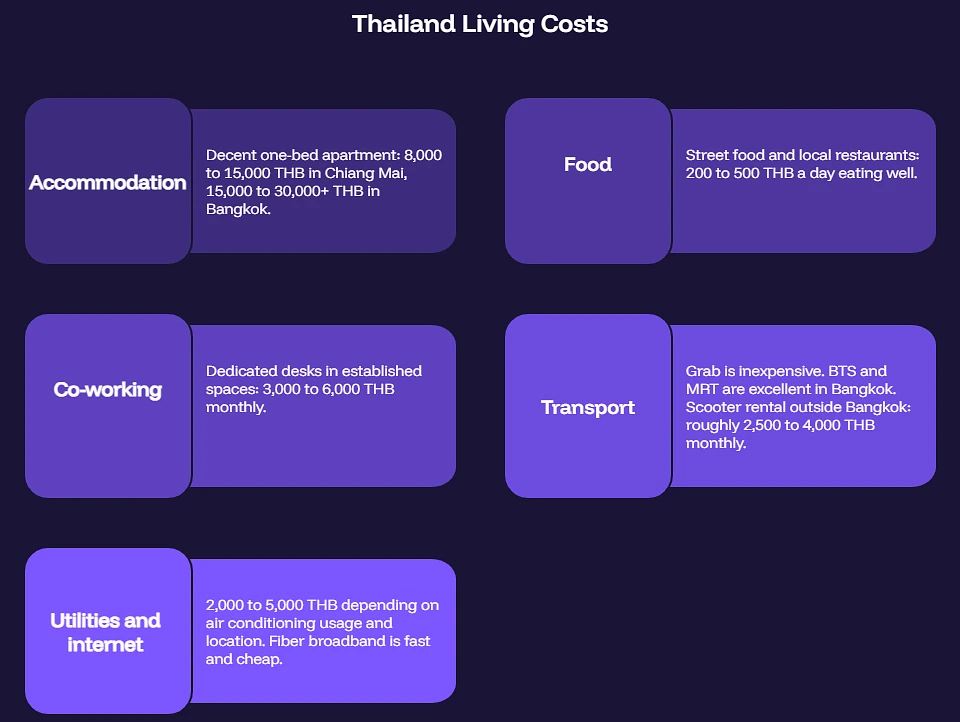
Once visa logistics and health cover are sorted, the living-cost picture in Thailand remains genuinely favorable compared to most Western countries, the main reason many consider relocating.
Research from digital nomad tracking platforms consistently puts a comfortable monthly expenditure for a remote worker in Thailand at around 65,000 THB (roughly $1,900 to $2,000 USD at current rates), split roughly in half between accommodation and everything else. That “everything else” covers food, transport, co-working space, activities and the daily rhythm of actually living somewhere rather than visiting.
How that breaks down practically, with Chiang Mai generally cheaper than central Bangkok:
First-month costs are front-loaded because Thai landlords typically want two months’ deposit plus one month’s rent upfront, and you’ll have visa application fees, initial flights, and potentially a few weeks in temporary accommodation while you find somewhere permanent.
Your income is almost certainly in dollars, euros, pounds or another home currency. Your expenses are in Thai baht. The exchange rate is not stable, and a 10% swing in USD-THB (which has happened multiple times in the last five years) changes your effective monthly budget by roughly 6,000 to 7,000 THB overnight.
Most DTV holders don’t hedge this because they don’t think of themselves as having currency exposure. But if your income is in one currency and your rent is in baht, you absolutely do. Multi-currency accounts like Wise and Revolut let you convert in batches when the rate is favorable rather than at whatever rate your bank offers on the day the direct debit hits. That’s not sophisticated financial planning, it’s a ten-minute setup that can save you several hundred dollars a year.
Keep emergency funds in at least two currencies. If the baht strengthens suddenly against the dollar, having baht-denominated savings means you’re not forced to convert at the worst possible moment. If the baht weakens, your home-currency income stretches further, and the problem solves itself.
Most DTV relocation advice stops at “show the bank balance, book the flight.” The actual financial planning for a remote worker relocating to Thailand has three layers, and skipping any one of them creates a gap that compounds over time.
Layer one: the visa capital. 500,000 THB, properly seasoned per your embassy’s rules, in liquid cash. Ring-fenced. Not your emergency fund, not your living expenses. This is entry money and extension money, and it stays where immigration can see it.
Layer two: the health cover. Proper DTV-compliant or long-stay insurance that transfers catastrophic medical risk away from your savings. Not travel insurance. Not a “we’ll figure it out” approach. Elevated medical cost growth means the cost of being uninsured gets worse over time.
Layer three: the operating budget. A realistic monthly plan that accounts for accommodation deposits, ongoing living costs, co-working, currency fluctuation, and a genuine emergency reserve that exists separately from your visa savings.
Get all three right and Thailand remains one of the best places in the world to work remotely, with a high quality of life at a fraction of Western costs, with world-class private healthcare infrastructure. Get any one of them wrong, and you’re either scrambling for funds, facing a medical bill that reshapes your finances, or explaining to immigration why the bank balance they asked for isn’t where it should be.

Moving states costs most Australian households somewhere between $2,000 and $6,000 for the transport alone, before stamp duty, storage or any of...
Read moreDetails
Copyright © 2024 NoodleMagazine - All Right Reserved