Your Bathroom Fan Is Why the Vanity Is Swelling
Quick answer: the exhaust fan is the only thing standing between your shower steam and every surface in the bathroom,...
Read moreDetails

Key things covered in this article:
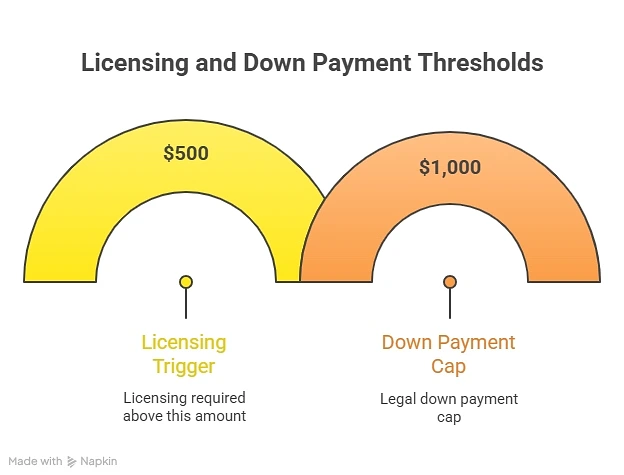
The State of California has a certain licensing threshold which defines when a plumber must have a state-issued license and when he/she can safely operate without the license. According to California Business and professions code 7048, any plumbing that is priced at 500 dollars or more (labor and materials included) must be done by a C-36 plumbing Contractor license that is active with the Contractors State license board.
The implication of this in practice is that small tasks such as replacing a faucet or a running toilet can technically be performed by an individual without a license but beyond that point it is a slippery slope. Replacement of a water heater, sewer line, repipe, rough-in of a bathroom, all of these will cost more than 500 dollars and all of them will demand a licensed C-36 contractor.
The significant point here is that it is unlawful to divide a bigger employment into smaller units in order to circumvent the 500 limit. When the overall project is 1200 dollars, a contractor cannot divide it into three invoices of 400 dollars to evade the licensing policy. This is one violation that is specifically reported by the CSLB.
You can verify any contractor’s license for free through the California State License Board online lookup tool. Type in the license number or the business name and you’ll see whether the license is active, whether there are any complaints on file, whether the contractor’s insurance is current, and whether they hold the specific C-36 classification. This takes about two minutes and it’s the single most useful thing you can do before hiring anyone.
You’re looking at a plumbing issue in your San Fernando home and wondering whether it’s a one-time fix or the beginning of something bigger. The answer often depends on when your house was built and what pipe materials were used during construction.
A large number of homes across the San Fernando Valley were built between the 1940s and 1970s, and these homes typically have galvanized steel supply pipes and clay sewer lines. Both of these materials have known lifespans and known failure patterns.
The inside corrosion of galvanized steel becomes narrower with time and limits the water flow. You feel it initially in the form of low water pressure, water becoming discolored after turning on the tap first, and finally in the form of pinhole leaks which initially begin appearing on the walls or ceilings. The clay sewer lines are fragile and susceptible at the junctions, soil movement, encroachment root of trees, and natural settling may crack them or form holes through which debris gets trapped and causes reoccurring clogs.
These issues are aggravated by the soil conditions of the Valley. The Los Angeles County is composed of a large portion of clay soil which contracts during dry seasons and expands during wet seasons by up to 30 percent of its volume. This continuous stretching and compressing causes pressure on the pipes that were not even intended to have such motion over decades.
The question to ask any local plumber in San Fernando: If a plumber shows up and gives you a quote without asking about the age of your home, the type of pipes in the system, or whether the original plumbing has ever been replaced — that’s a red flag. The common problems in this area are so specific to the construction era and pipe materials that any experienced local plumber should be asking those questions before they even pull out a wrench. A mid-century home with original galvanized supply lines is a fundamentally different job than a 1990s home with copper, and pricing them the same way means someone isn’t doing their homework.
The Contractors State License Board doesn’t just process paperwork. They actively run undercover sting operations across California to catch unlicensed contractors, and the results give you a good picture of how common the problem is.
In April 2025, a two-day sting operation in Bakersfield caught 10 unlicensed contractors submitting bids between $1,600 and $4,800 for home improvement work. In September 2024, another operation in Riverside County caught 12 unlicensed contractors, six of whom also violated the down payment law by requesting deposits above the legal limit. An earlier July 2024 sting in Santa Clara County cited 14 people, one of whom had a prior grand theft conviction and another who had an outstanding warrant for contracting without a license.
The penalties aren’t minor either. Operating as an unlicensed contractor in California is a misdemeanor under BPC Section 7028, carrying administrative fines up to $15,000 and up to six months in jail. Repeat offenders face mandatory 90-day jail sentences.
Here’s the part that catches most homeowners by surprise. If you hire a licensed plumber and the work is faulty, the CSLB has a complaint and mediation process that can result in the contractor being required to fix the work, pay restitution, or face license suspension. If you hired an unlicensed contractor, you have almost no recourse through the state system. Your only option at that point is civil court, which is slower, more expensive, and comes with no guarantee of collecting anything even if you win.
The California law limits the amount that a contractor may demand to be paid upfront prior to the commencement of work. The maximum is one thousand or ten percent of the whole project cost, whichever is lower. Subsequent progress payments cannot be more than the value of work that has been done.
This is amongst the most breached consumer protection laws in the state. The CSLB sting operation in Fresno had one unlicensed person that asked a down payment of 2,100 on a 4,200 bid that is more than twice what is required under the law. Breach of this is a distinct-type misdemeanor offense that carries a maximum penalty of one year in county jail and a fine of up to 5000.
When a plumber requests you to pay him half the cost of the project before he lays a tool to it, then that is against the California law whether he is licensed or not. This rule is known to any legitimate plumber in California and is being worked within. Those who do not are either unqualified or prepared to break the law and neither of those is a person you would prefer to do work in your home.
This comes up constantly during home inspections and real estate transactions, and a surprising number of homeowners don’t know about it until they’re trying to sell.
California Health and Safety Code Section 19211 requires all residential water heaters, both new and existing, to be braced, anchored, or strapped to resist falling or horizontal displacement during an earthquake. The California Plumbing Code (Section 507.2) specifies that a minimum of two restraint straps must be installed, one in the upper third and one in the lower third of the water heater. Water heaters over 52 gallons require a third strap.
This law has been in effect since 1991, following the Loma Prieta earthquake of 1989 and later reinforced after the 1994 Northridge earthquake. Sellers are legally required to certify water heater strapping compliance to buyers before closing a real estate transaction.
Any plumber doing water heater installation or replacement in California should be strapping the unit to seismic code without you having to ask. If they install a new water heater and skip the earthquake strapping, the installation won’t pass inspection and you’ll fail compliance when you eventually sell the home. A plumber working in the San Fernando Valley who isn’t familiar with seismic strapping requirements is a plumber who doesn’t know California code, and that should concern you regardless of what they’re charging.
You’re comparing quotes from two or three plumbers and trying to figure out who is giving you a fair price versus who is cutting corners on the estimate to get the job. A complete estimate in California should include:
If a plumber hands you a quote that’s just a single total number with no breakdown, you have no way to compare it meaningfully against another bid. The itemized format also protects you if there’s a dispute later, because you can point to exactly what was agreed to rather than arguing over a vague lump sum.
The CSLB’s online license lookup tool is free and takes two minutes. Use it. It tells you whether the license is active, whether the bond is current, whether workers’ comp insurance is on file, and whether there are any complaints or disciplinary actions. That single check eliminates most of the risk in hiring a plumber, and the fact that it’s available at all is one of the things California actually gets right about consumer protection.

Quick answer: the exhaust fan is the only thing standing between your shower steam and every surface in the bathroom,...
Read moreDetails
Copyright © 2024 NoodleMagazine - All Right Reserved