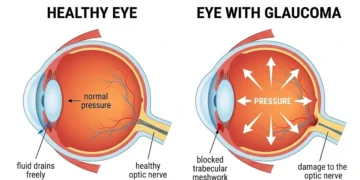
Glaucoma Takes Your Sight Without Telling You, And Your Own Brain Helps It Hide
You trust your eyes to complain when something is wrong. Something gets in, they water. Too bright, you squint. That...
Read moreDetails

Ketamine started as an anesthetic. One is still, used by surgeons as a matter-of-course, since the early 1970s. Antidepressant angle is late and almost an accident, as clinicians began to notice changes in mood in patients who were depressed and received ketamine during their procedures. Streamlined form of the manner in which the research was initiated, yet not an unjust one.
The mechanism is genuinely different from what most people picture when they think of psychiatric medication. SSRIs — Prozac, Zoloft, that whole family — work on serotonin and take weeks to build any noticeable effect, if they work at all. Ketamine hits the glutamate system instead, specifically NMDA receptors. Mood effects can show up within hours. A 2006 trial in Archives of General Psychiatry gave a single intravenous dose to patients with treatment-resistant depression and measured significant antidepressant response within two hours (Zarate et al., 2006). Those patients had already failed multiple standard treatments. Hours versus weeks isn’t just a speed difference — it changes what’s clinically possible entirely.
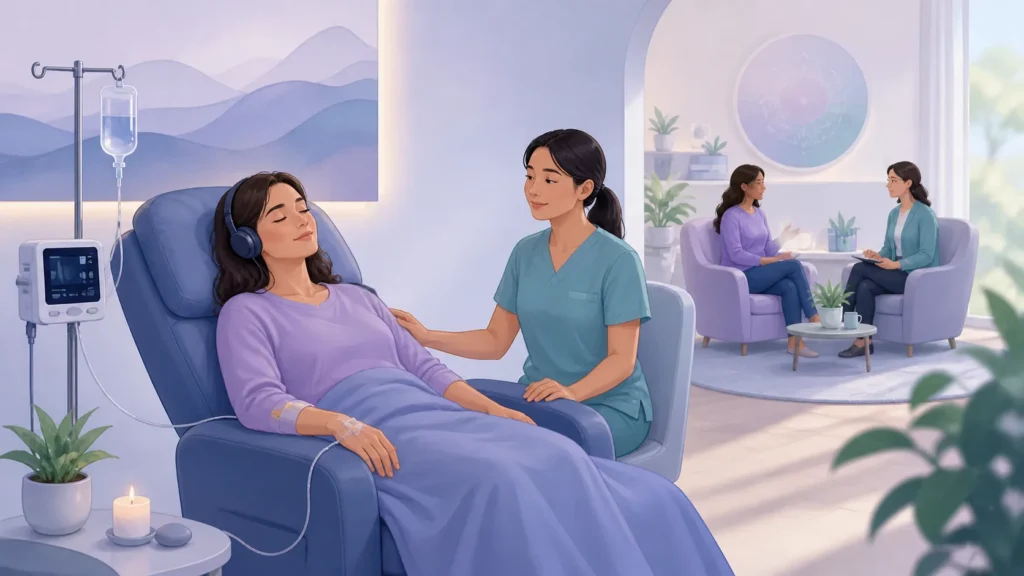
The “assisted” in ketamine-assisted therapy is deliberate. It’s not just the drug administered and done. Three parts to it: evaluation before anything is given, the session itself under monitoring, then integration afterward. That last part is where clinics differ most in approach. Integration means working with a therapist after the session to process what surfaced. During ketamine, patients often experience something dissociative — thoughts and feelings present but observed from a remove, patterns visible that normally aren’t. Some find that disorienting. Others find it clarifying in ways that are hard to articulate afterward. Either way, without structured follow-up, whatever opened during the session tends to close without much having changed.
The sessions are generally shorter than an hour. Ketamine may be administered intravenously, by injection or as a nasal spray. In March 2019, the spray form, which esketamine, brand name Spravato, was specifically approved to treat treatment-resistant depression, marking a literal change in the way psychiatry formally acknowledged this direction in treatment. (U.S. Food and Drug Administration, 2019).
The market size is quite narrow: individuals who have undergone real treatment procedures: numerous medications, even electroconvulsive therapy without receiving satisfactory treatment. The best evidence base is on treatment-resistant depression. PTSD and anxiety disorders are being treated and studied in clinical settings, though the research there is still building compared to the depression data specifically.
Clinics like Daydream MD ketamine depression treatment San Diego run the full process — screening, monitored sessions, integration built into the structure. That sequence matters because the clinical research was built around all three components together, not the drug in isolation.
Screening does rule some people out. Certain cardiac conditions, history of psychosis, active substance use disorders can disqualify someone, and that evaluation exists for exactly those reasons. For patients who’ve run through the standard options without finding what they need, the combination of a distinct mechanism and documented speed of response makes this something meaningfully different — not just another prescription added to an existing pile.

You trust your eyes to complain when something is wrong. Something gets in, they water. Too bright, you squint. That...
Read moreDetails
Copyright © 2024 NoodleMagazine - All Right Reserved