
Your Bathroom Fan Is Why the Vanity Is Swelling
Quick answer: the exhaust fan is the only thing standing between your shower steam and every surface in the bathroom,...
Read moreDetails

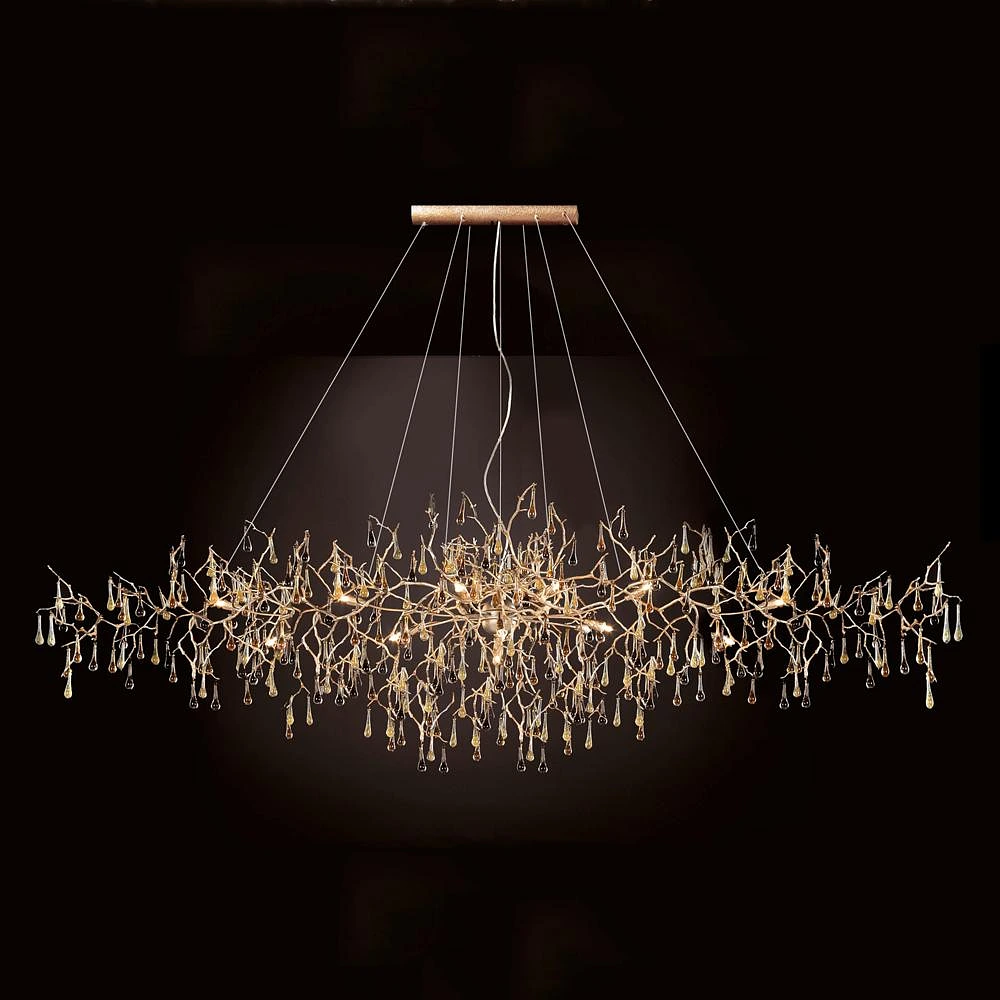
There’s a Portuguese lighting house called Serip that’s been going since the early sixties, and the simplest way to describe what they do is this: every piece is made by hand, and none of them come out the same. Handblown glass drops, hand-shaped bronze branches, each one slightly different because human hands don’t produce factory consistency. That’s the product. The irregularity.
Most people hear “handmade chandelier” and think an expensive version of a normal chandelier. It isn’t. A normal chandelier has identical arms and identical crystals and pushes light in predictable directions. A Serip piece has forty or fifty glass drops all refracting at slightly different angles, and what that does to a room is closer to sunlight coming through actual tree branches than anything engineered. The walls get these moving pockets of brighter and softer light, the ceiling catches shadows that shift through the day, and the whole thing changes character between noon and midnight. You notice it most when you’re sitting under one and realize you keep looking up.
So what does something like this actually cost, because that’s the question everybody asks second (the first one is usually “where do I see one in person”).
Rough picture, because everything is bespoke and the quote depends on what you commission:
None of that includes the part where you fly to a showroom and fall in love with something you hadn’t budgeted for, which is apparently how most of these sales actually happen.
On that point, the reason Singapore keeps coming up when people talk about sourcing European artisan lighting in this part of the world is pretty straightforward. Getting bespoke pieces shipped directly from a Portuguese workshop to, say, Sydney or Jakarta used to be a genuine headache. Unclear timelines, nobody to ask whether the proportions would work in your actual room, and if something arrived wrong, you were back to square one with an international return. Lux & Beyond runs a dedicated Serip showroom on Mohamed Sultan Road in Singapore, and it solves most of that. You walk in, stand under the actual chandeliers in Singapore, work out the scale, and finish with someone who knows the collection and commission from there. That hands-on part matters more for this kind of lighting than for almost anything else you’d buy for a home, because proportions and light quality are things a product photo genuinely cannot communicate.
The finish options run the full range — polished brass reads warm and a bit glamorous, oxidized bronze reads quieter and more natural, matte black works in modern interiors, and silver finishes split the difference. Bronze is the house material, and it’s what most of the signature pieces are built around. Glass ranges from near-clear (scatters more light, more dramatic) to frosted and tinted (warmer, softer, calmer). Configuration is whatever the room needs. Cascading verticals for stairwells and tall entryways. Wide and flat for lower ceilings. Clustered for dining tables. They build it to your dimensions, which is why the lead time runs a few weeks for something simple and a few months for a complex commission.
One thing worth saying about maintenance is that people assume these are fragile and high-maintenance, and they’re really not. Soft cloth, feather duster, cotton gloves if you’re giving the metal a proper clean. That’s it. The glass is tougher than it looks.
The reason these pieces keep turning up in Architectural Digest, Elle Decoration, and Harper’s Bazaar isn’t really about trends. A manufactured chandelier dates. It looks like the year it was designed. Something shaped by hand from natural forms doesn’t date the same way because the reference isn’t a trend; Bazaar is coral and branches and ice, and those haven’t changed since before anyone was keeping track. That’s why the investment framing actually holds for this category in a way it doesn’t for most interior purchases. You’re not buying something fashionable. You’re buying something that doesn’t have a fashion to fall out of.

Quick answer: the exhaust fan is the only thing standing between your shower steam and every surface in the bathroom,...
Read moreDetails
Copyright © 2024 NoodleMagazine - All Right Reserved