
Australian Families Are Taking More Outback Trips Than Ever, Just Not the Way the Glossy Ads Show It
The brochure version is a family parked beside a gorge a thousand kilometres from anywhere, an espresso machine humming off...
Read moreDetails

The first business trip to Bangkok almost always teaches the same lesson, and it has nothing to do with culture, contracts, or the food. It’s about distance. Specifically, the distance between where you sleep and where the meeting actually happens, and how that distance gets measured in this city — not in kilometers, but in the slow death of a Grab ride wedged into Rama IV traffic at 8:15 in the morning.
A returning business traveller knows the drill. The newer one usually doesn’t, and pays for it.
This piece is for anyone in that second camp — flying into BKK with a packed schedule, expected to be sharp on landing, and quietly wondering whether the standard “stay in Sukhumvit, take a Skytrain everywhere” advice still holds when the meetings are in banks and embassies on the other end of town. It does not, mostly. And the wellness piece — the one corporate-travel blogs love to talk about — only works if you build it into the actual geography of the day, not as a vague intention.
Most flights from Europe and the US Eastern seaboard land at Suvarnabhumi between 10pm and midnight Bangkok time. The immigration queue is usually thirty to forty minutes if you’re unlucky. By the time the bag comes off the carousel and a Grab is summoned, it is well past midnight, and Bangkok traffic — even at that hour, even on the toll road — is rarely empty.
If the next morning’s meeting is at 8:30 in Sathorn, that’s fewer than seven hours of horizontal time, minus a shower, minus the unpacking, minus the inevitable jolt awake at 4am because the body still thinks it’s the middle of the afternoon.
A frequent traveller in this lane learns to do two things differently. The first is to fly business class on outbound legs into BKK whenever the trip is short, because the cost gap between economy and the cheapest business fare on a Doha or Dubai routing is often less than the productivity hit of the first wasted day. The second is to handle that first night on arrival deliberately — meaning, not just collapsing into bed at 1am, but actually doing something to flush the flight out of the body before sleeping.
Long-haul travel disrupts the body’s central and peripheral circadian clocks; a study published in The Journal of Physiology indicates that long-haul travel can disrupt the body’s central and peripheral circadian clocks, leading to impaired cognitive function and sleep patterns even after the trip ends. The fatigue is not just psychological. It is a clock-shift problem, and an inflammation-and-stiffness problem, and a cortisol-timing problem, all stacked on top of each other. Coffee solves none of those. Some recovery practices — short hot shower, hydration, ten or fifteen minutes of stretching, a brief massage if available before bed — solve a couple of them at least partially.
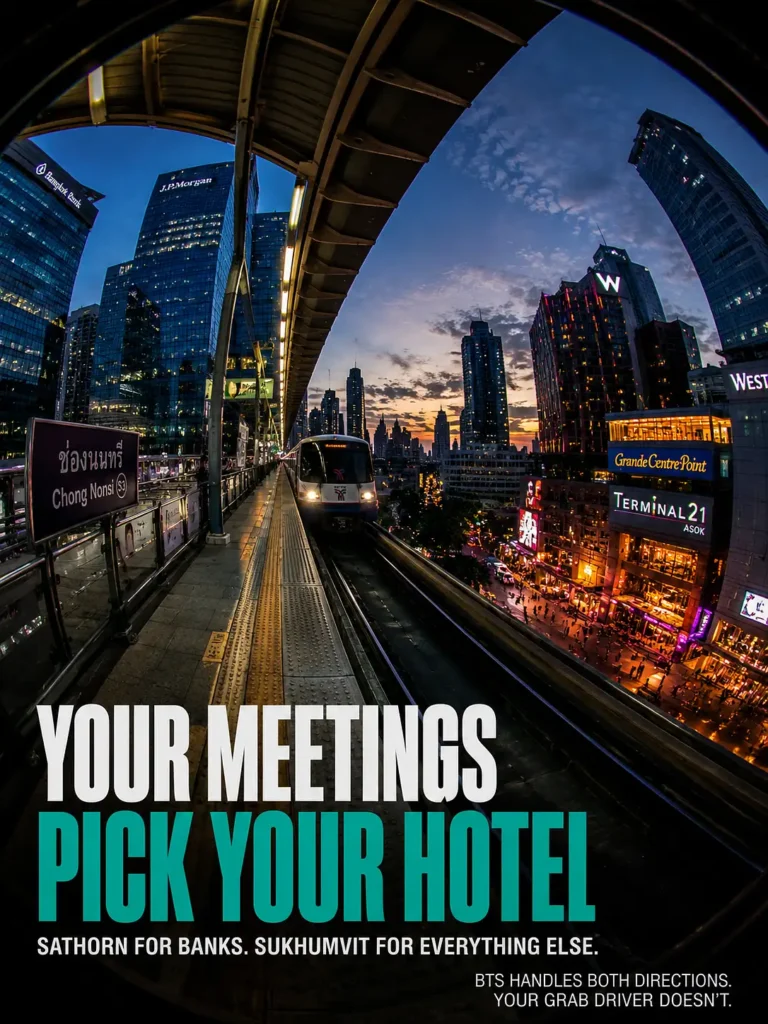
This is the part that takes most first-time business visitors a trip to figure out.
Sukhumvit is the famous strip — the malls, the Soi 11 bars, the rooftop scene, the long line of hotels from Asoke down to Phrom Phong. It is excellent for leisure, dinner, and the after-hours portion of any trip. But the actual financial work in Bangkok happens further west and south. As one of the main business districts of Bangkok, Sathorn (also written as Sathon) is dotted with high-rise offices housing international banks and financial institutions. The Silom and Sathorn areas were the first modern CBD in Bangkok, and they remain where most legal firms, banks, embassies, and multinational regional headquarters sit.
The practical question, then, is not which Bangkok hotel has the best reviews. It is: where is your meeting, and how much of the day are you willing to lose in transit?
A short version of the math:
Sathorn is also a quieter alternative away from the hustle of lower Sukhumvit, which matters when the goal is to sleep well and not be jolted awake by a 3am Soi 11 crowd.
When does it actually go in the schedule? Not in the morning before meetings — that’s a fantasy most schedules don’t survive. Not late at night, either, because by then the body wants sleep, not stimulation. The slot that consistently works for working travellers is the 2pm to 5pm window, the one between a finished morning of meetings and a 7pm dinner. It’s the hour Bangkok itself is at its most useless for outdoor activity anyway, because the heat between two and four is brutal and the air is heavy.
This is the slot where a hotel with an in-house spa stops being a luxury feature and becomes a logistics solution.
The argument for booking a treatment inside your own hotel rather than going off-site is mostly about transit cost. A serious off-site spa in Bangkok could mean another forty-five minutes round-trip in traffic, plus the mental tax of getting back into a Grab in business clothes. An in-house spa means an elevator ride. The recovery starts the moment the elevator door closes.
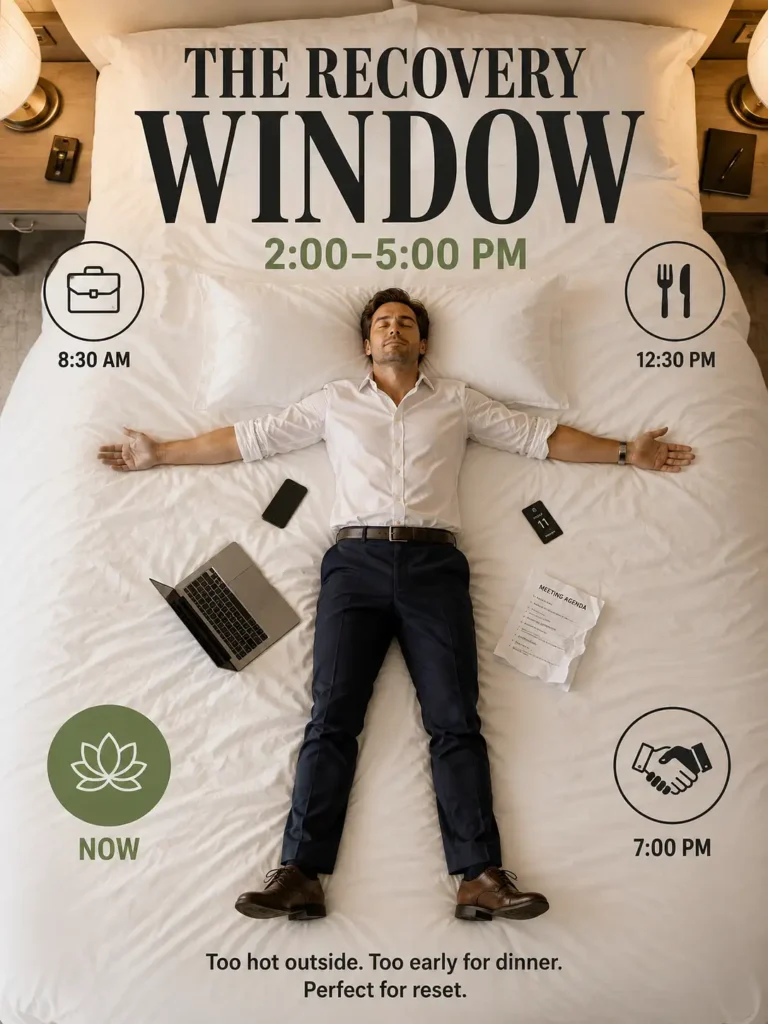
What the treatment does is real, even if marketing copy oversells it. Massage stimulates blood flow, delivering oxygen to overworked tissues and reducing swelling especially in legs and feet after long flights, and it activates the body’s “rest and digest” mode, reducing cortisol and helping you unwind both physically and mentally. The cortisol effect, to be honest about it, is modest — a comprehensive meta-analysis found that massage’s effect on cortisol is small or inconsistent across studies, so the main recovery win appears to come from autonomic calming rather than big hormonal swings. The autonomic shift is the real product. Switching the nervous system out of fight-or-flight is what makes the difference between walking into a 7:30 dinner sharp versus walking in foggy.
For travellers based in Sathorn, the best hotel spa Bangkok lane has gained an interesting new entrant — divana Komorebi Spa at the Grand Nikko Bangkok Sathorn, which fuses divana’s twenty-plus years of Thai wellness expertise with Japanese aromatherapy and the Omotenashi service philosophy from the Nikko side. It sits on the 12th floor of the hotel, has five private treatment rooms (couples’ rooms included), and is built around the Komorebi concept — the Japanese term for sunlight filtering through leaves. The pairing matters because Thai and Japanese wellness traditions approach the body from two genuinely different angles: Thai treatments lean toward stretching, pressure points, and deep musculoskeletal work; Japanese spa traditions lean toward scent, water, and parasympathetic calm. Combining them in one ninety-minute slot is a more complete recovery than either tradition alone tends to deliver.
The other practical advantage for someone with a packed schedule is that booking in-house lets you bookend the treatment with a nap. Treatment ends at 4pm, room at 4:05, twenty minutes flat on the bed before showering for dinner. That sequence — flight stiffness out, parasympathetic system reset, twenty-minute nap, shower — is the closest thing to a hard reset the body gets on a five-day trip.
Bangkok’s BTS and MRT stop running around midnight, and there is no late-night equivalent. A 1am taxi ride from Thong Lor back to Sathorn is forty minutes minimum and depends entirely on the driver knowing the route, which is not a given. If a dinner is going to run late, factor the ride home into the dinner itself. Don’t assume the trains are an option after the late dessert course.
Cash is still useful in a way most corporate travellers from card-only economies underestimate. Many Sathorn coffee shops and most street vendors are still cash-first; the small Family Mart pickup of water and snacks before a 9am meeting is faster with notes than with a foreign Visa.
The third one is about meetings themselves. Thai business culture leans relational. Expect the first meeting to be more about reading each other than closing anything. In business, establishing personal relationships first is of the utmost importance, so expect there to be meals and entertaining. It’s in subsequent meetings they’ll make important decisions. The dinner is not a courtesy. The dinner is the meeting.
A well-handled Bangkok business trip ends with you flying out roughly the same person you flew in as. Not depleted. Not coming home to two days of recovery before you can function. Some of that is luck — the right flight times, no delays, no meetings rescheduled into bad slots — but most of it is structural choices made before the plane lands. Where to stay. How to handle the first night. Where to put the recovery hour. Whether to treat the dinner like work or like a break.
Bangkok rewards travellers who plan around its geography rather than against it. The ones who stay in Sukhumvit because TripAdvisor told them to, and then Grab back and forth to Sathorn three times a day, fly home wrecked. The ones who base themselves where the work actually is, and use the dead afternoon hours for genuine recovery, fly home with the deal closed and enough left in the tank to be normal at home for a week. Same city, same trip, very different outcomes.

The brochure version is a family parked beside a gorge a thousand kilometres from anywhere, an espresso machine humming off...
Read moreDetails
Copyright © 2024 NoodleMagazine - All Right Reserved