
Your Bathroom Fan Is Why the Vanity Is Swelling
Quick answer: the exhaust fan is the only thing standing between your shower steam and every surface in the bathroom,...
Read moreDetails

There’s a whole industry built on selling lottery systems, hot-number trackers, wheeling software, “balanced” selection methods, all promising to tip the odds your way. Almost none of it does anything and being clear about why is worth more than any system, because it saves you from spending real money chasing a mathematical illusion. There’s exactly one strategy idea in the whole category that changes an actual outcome and it’s not the one you’d expect. So here’s the honest breakdown: the math you can’t beat, the myths that persist anyway and the single true wrinkle.

Start with the fact everything else has to bend around. In Powerball, you pick 5 numbers from 69 plus one from 26, which works out to exactly 292,201,338 possible combinations. One of them wins the jackpot. That makes your odds 1 in 292.2 million on any given ticket and that number is fixed by the structure of the game itself.
Nothing about how you choose your numbers changes it. Not frequency charts, not lucky stores, not the phase of the moon. To feel the scale, 1 in 292 million is roughly the odds of flipping a coin and getting heads 28 times in a row. Every strategy that claims to improve your “chances of winning” is making a claim against this constant and the constant doesn’t budge.
Most lottery “strategies” are the same handful of fallacies wearing different names. They persist because the human brain is a pattern-finding machine and randomness is genuinely hard to accept.
The idea that some numbers are “due” or that frequently-drawn numbers are “hot” is the gambler’s fallacy, plain and simple. Each draw is an independent event. The machine has no memory of last week. A number that hasn’t appeared in fifty draws has exactly the same probability next draw as one that came up yesterday, because past frequency has zero predictive power over independent random events. Any pattern you see in the history is just randomness doing what randomness does, which includes streaks and clusters that look meaningful and aren’t.
You’ll hear that Quick Pick (the terminal’s random numbers) is luckier, often backed by the stat that 70 to 80% of jackpot winners used Quick Pick. That stat is real and it means nothing, because 70 to 80% of all tickets sold are Quick Picks. The win rate just tracks the ticket volume. Self-picked and machine-picked numbers have mathematically identical odds. The lottery’s random generator is certified equivalent to the ball machine.
Wheeling, playing many combinations in a structured way, gets sold as a way to improve your odds and in the sense people mean, it doesn’t. Buying more combinations gives you more chances, sure, but only in the trivial way that buying more tickets always does. Ten tickets make your odds 10 in 292 million instead of 1, still functionally zero. Wheeling doesn’t extract any advantage per rupee spent; it just organizes a lot of spending. If someone’s selling it as a system that beats the odds, they’re selling the gambler’s fallacy with a spreadsheet attached.
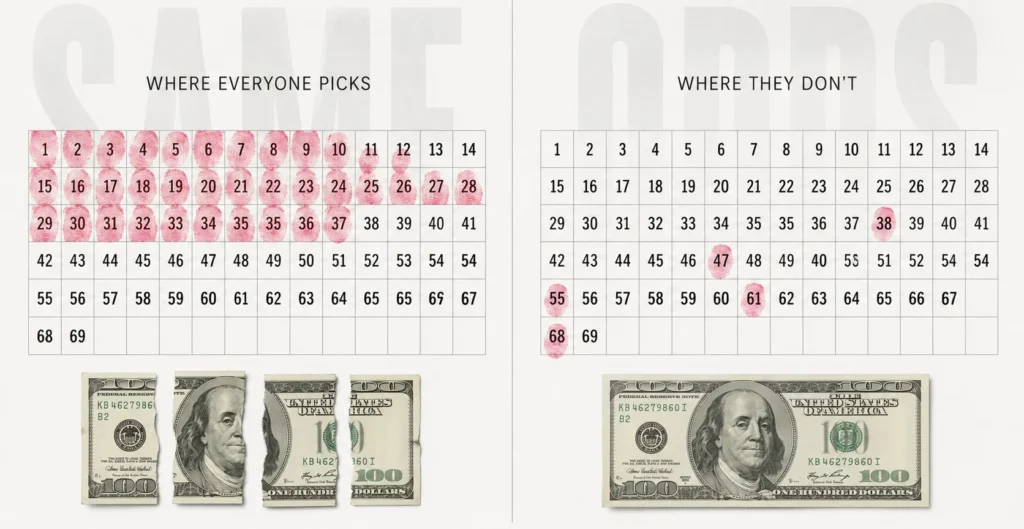
Here’s the part worth knowing, because it’s the only strategy idea in the whole space that changes a real outcome and it’s not about winning, it’s about not sharing.
Your odds of hitting the jackpot are fixed no matter what you pick. But if you win, whether you split the prize with other winners depends on whether other people picked your same numbers. And people pick predictably, birthdays (so numbers 1 to 31 are wildly over-chosen), obvious patterns, last week’s winning numbers, sequences like 1-2-3-4-5. So choosing numbers that avoid those crowded patterns, higher numbers above 31, unusual spreads, doesn’t make you more likely to win, but it does slightly lower the chance you’d have to split a jackpot if you did.
That’s the honest version of “strategy.” It changes the size of a hypothetical payout, not the probability of getting one. Real, but narrow and worth being precise about, because it’s the thing the systems distort into a false promise about odds.
Once you accept the odds can’t be beaten, the sensible way to play falls out on it’s own and it’s about your relationship to the money, not the numbers.
The clean takeaway is that the lottery is a game of pure chance with a fixed, immovable house edge and the only real choice you have is how much you’re willing to spend for the small thrill of being in it. Play for the flicker of fun if you like it, keep it cheap and ignore anyone selling a system, because the honest truth is more useful than their fantasy: there’s no way to pick better numbers, only a tiny way to avoid sharing if lightning ever strikes.

Quick answer: the exhaust fan is the only thing standing between your shower steam and every surface in the bathroom,...
Read moreDetails
Copyright © 2024 NoodleMagazine - All Right Reserved