Your Bathroom Fan Is Why the Vanity Is Swelling
Quick answer: the exhaust fan is the only thing standing between your shower steam and every surface in the bathroom,...
Read moreDetails

You’re standing in your kitchen in a house east of I-35 and the faucet pressure has been getting weaker for about three months. Not dramatically, not all at once, just a slow fade. You adjust the handle wider, tell yourself it’s fine, and forget about it until the next morning when it’s a little worse. That pressure isn’t coming back on its own, and the reason it’s dropping has nothing to do with the city’s water supply. It’s happening inside your walls and under your foundation, and it’s been building for years before you noticed.
Austin plumbing doesn’t fail the way plumbing fails in other cities. Two things are quietly working against every house in this metro, the clay soil underneath and the mineral-loaded water running through it. Here’s a quick look at how the four most common failures show up and what’s actually causing them.
| Problem | What causes it in Austin | First sign you’ll notice |
|---|---|---|
| Slab leaks | Clay soil expanding and contracting under the foundation, cracking pipe joints | Warm spot on the floor, new foundation cracks |
| Water heater failure | Limestone-filtered water depositing calcium sediment on heating elements | Popping or rumbling sounds from the tank |
| Sewer line blockage | Live oak or cedar roots entering pipe joints, soil settling creating pipe bellies | Multiple drains backing up at the same time |
| Unexplained high water bill | Hidden leak pushing usage into Austin Water’s higher pricing tier | Bill jumps 40-60 dollars with no change in routine |
Now the detail on each one, because the specifics matter more than the summary.
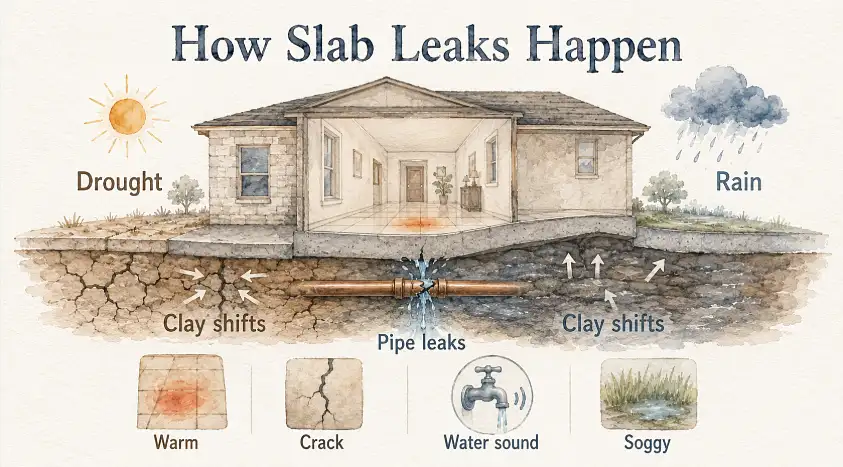
You’re walking through the hallway barefoot and one section of the tile feels warm. Not where the heating runs, not near a vent, just a random patch of warmth that wasn’t there a month ago.
Most Austin homes sit on a concrete slab poured directly on the ground, no basement, no crawl space. The water lines run through or beneath that slab. And the ground is Blackland Prairie clay, the stuff local contractors call “black gumbo,” which swells when it absorbs water and shrinks when it dries out.
Austin’s weather cycle makes this worse. A long summer drought dries the clay and it contracts, pulling away from the foundation. Fall rains come and the clay swells back, but not evenly. The soil pushes up in some places and settles in others. Pipes that were sitting fine for years suddenly have stress on joints they weren’t designed to handle. A joint pulls apart a fraction of an inch and hot water starts leaking under the concrete.
Early warning signs worth knowing:
The homes east of I-35 get the worst of this because the clay content is highest there. Older neighborhoods like Hyde Park and Brentwood, built on 1960s-era clay pipes, are particularly vulnerable because those materials were never designed for decades of ground movement.
If there’s a warm spot on your floor you can’t explain, that’s a same-day call to a Plumber in Austin who can run a camera or pressure test before the soil around your foundation absorbs enough water to make the whole problem compound.
You bought the water heater when you moved in. The manufacturer said ten to twelve years. It’s been four and a half, and it’s started making a popping sound during heating cycles.
Here’s what happened inside the tank. Austin’s water comes from the Colorado River through limestone terrain. That geology loads the water with calcium and magnesium minerals. When hard water sits in a tank, the minerals separate out and settle as sediment on the bottom and on heating elements. That sediment layer insulates the element from the water, which is why the popping starts, the element overheats locally and creates steam bubbles that burst through the mineral crust.
According to Austin Water’s 2025 Consumer Confidence Report, city-wide total hardness averages 93 parts per million, with a range of 70 to 126 ppm. That’s moderately hard to hard on the USGS scale. Some independent measurements and local plumber reports cite higher readings, commonly in the 150 to 260-plus range, depending on source blending, season, or specific neighborhood, which is enough to drive noticeable scale buildup over time. Far East Austin and certain outlying areas have occasional reports of discolored or mineral-heavy water that residents describe as chalky, though discoloration can also involve pipe sediment or iron alongside the mineral content.
Sounds and signs that mean the sediment has reached a problem level:
Plumbers in Austin regularly see water heaters with significant scale buildup that reduces efficiency and shortens service life well below the expected ten to twelve years, particularly when annual maintenance gets skipped. That’s not usually a defective unit; it’s a unit operating in water conditions that benefit from annual flushing to reach the full expected lifespan.
The numbers on this are straightforward:
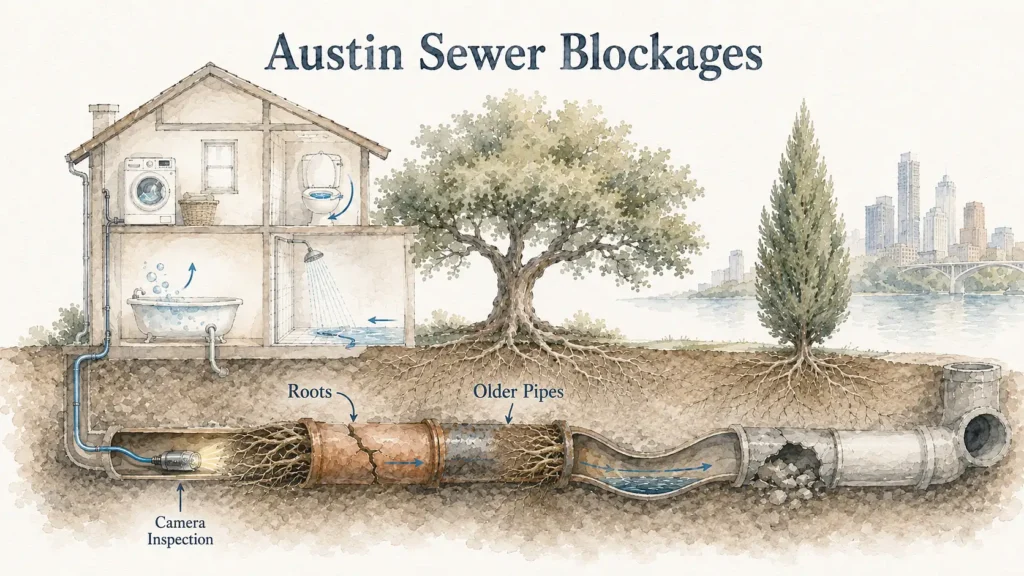
You’re running the washing machine and the bathtub drain starts gurgling. Or you flush upstairs and the ground-floor shower backs up. Those aren’t separate problems, they’re both symptoms of a blockage in the main sewer line between your house and the city connection.
In a generic plumbing article this is where someone tells you “tree roots can infiltrate your pipes.” In Austin the story is more specific.
The live oak root systems on the east side are wide, aggressive, and shallow. They spread laterally looking for moisture, and a sewer line with even a hairline crack at a joint is a moisture source. Once a root tip finds its way in, it grows. Not fast, but relentlessly. Over months and years a web of fine roots fills the pipe interior until wastewater can’t pass through. The blockage builds gradually, which is why the first sign is usually a slow drain rather than a sudden backup.
In the Hill Country neighborhoods on the west side, cedar and juniper roots cause the same problem through the same mechanism. Different tree, same result.
The age of the pipe matters enormously. Houses built before the early 1990s often used clay or cast-iron sewer lines. Clay is porous at the joints and brittle under ground movement. Cast iron corrodes from the inside over decades, especially in hard water. Both are significantly more vulnerable to root intrusion than the PVC used in newer construction, and Austin has a lot of housing stock from the 1960s through 1980s sitting on original lines.
A camera inspection of the sewer line is the only way to know what you’re actually dealing with, whether it’s roots, a collapsed section, or soil settlement creating a belly in the pipe. That inspection typically runs a couple hundred dollars and tells you more in twenty minutes than a year of guessing.
You open the Austin Water bill and the number doesn’t make sense. Forty or sixty dollars higher than last month, no change in routine, no pool filled, no extra lawn watering.
The generic advice here is “you might have a leak.” The Austin-specific part is why the financial hit is worse than the water waste alone.
Austin Water charges a base rate up to a certain usage threshold, then bumps you to a higher rate per gallon once you cross it. A hidden leak doesn’t just waste water at the base rate. If the extra gallons push you past the threshold, everything above it costs more. A leak adding 2,000 gallons a month can effectively double its own financial impact by triggering the tier jump.
Here’s the check you can do right now, takes two minutes:
That’s it. If the meter’s moving with everything off, don’t wait for the next bill. Every day a hidden leak runs, the clay soil around your foundation is absorbing water it shouldn’t be, which means more swelling, more pressure on the slab, and a bigger structural problem building underneath the plumbing problem you already have. The leak and the foundation damage feed each other.
Austin’s plumbing problems come down to two forces that aren’t going to stop. The clay soil moves with every weather cycle and stresses everything buried in or under the slab. The hard water builds mineral deposits inside every pipe, fixture, and appliance it touches. What you can control is whether you catch the warm spot, the pressure drop, the gurgling drain, or the bill that doesn’t add up, and deal with it before both forces have had time to make it worse.

Quick answer: the exhaust fan is the only thing standing between your shower steam and every surface in the bathroom,...
Read moreDetails
Copyright © 2024 NoodleMagazine - All Right Reserved