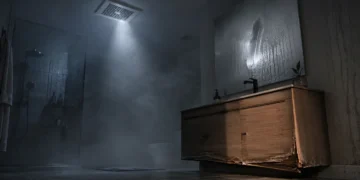
Your Bathroom Fan Is Why the Vanity Is Swelling
Quick answer: the exhaust fan is the only thing standing between your shower steam and every surface in the bathroom,...
Read moreDetails

So you’re getting ready to sell and you’re thinking about what to fix up first, and the obvious answers are the kitchen, the bathroom, maybe repaint the front of the house. Nobody’s first thought is “I should buy a shed.” But here’s the thing that real estate agents know and most homeowners don’t: the shed itself isn’t what adds the value. It’s what the shed lets you do with the rest of the yard. Clear the bikes off the lawn, get the mower out of sight, move the camping gear and the kids’ old trampoline and the pool noodles and the broken chairs into a proper storage structure, and suddenly the backyard looks thirty percent bigger than it did ten minutes ago. That perception shift is what changes what a buyer puts on paper.
And the data backs this up pretty clearly. A national survey run by Hort Innovation together with Raine & Horne, polling around a hundred real estate agents across Australia, found that roughly 40 percent of agents believe a well-presented lawn can lift a home’s value by more than 20 percent. Nearly a quarter of agents surveyed believed it could add 30 percent or more. And 93 percent of agents said they’d tell vendors to sort the lawn out before listing. Not the kitchen splashback. Not the ensuite tiles. The lawn.
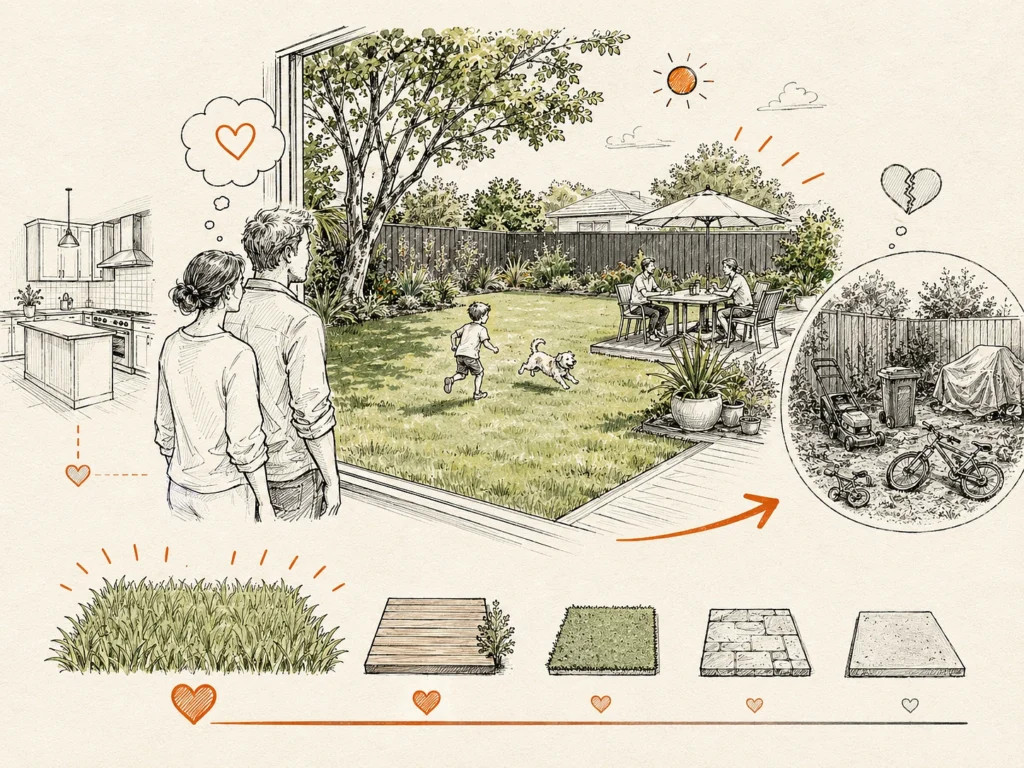
This is the bit that catches people off guard. Ask most Australian homeowners which part of their property they value the most and the outdoor space comes up consistently ahead of the kitchen, which is the room that gets all the renovation budget. Agents see this play out at open homes constantly, buyers spend more emotional energy reacting to the backyard than to almost any other part of the house.
Think about what that means when a buyer walks through your place. They’ve seen the bedrooms, they’ve opened the pantry, they’ve checked the bathroom grout, and then they step out the back door. If what they see is open grass, a bit of shade, maybe a deck, space to put a table and chairs, their brain goes “yes, I can see myself here on a Saturday.” If what they see is a lawnmower parked on the grass next to three bikes and a wheelie bin with a tarp draped over something unidentifiable, that imagination shuts down and it doesn’t come back.
What do Australian family buyers actually want to see out there?
The Hort Innovation research makes this pretty clear:
Two-thirds of family buyers want grass. Real grass, not synthetic. And they want to see it, not guess that it exists underneath a pile of outdoor furniture and garden tools. That’s the whole game.
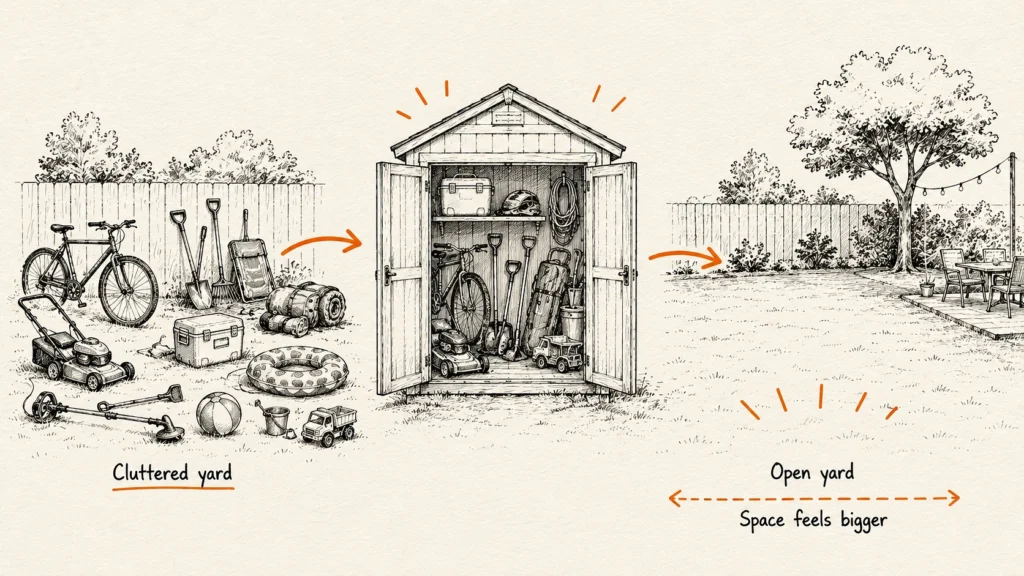
Worth being honest about this because most articles about outdoor storage pretend the shed itself is the selling point and it isn’t. Nobody walks through an open home, sees a shed in the corner of the yard, and thinks “incredible shed, I must buy this property.” What they think is “this backyard is huge” or “this backyard feels cramped” and the difference between those two reactions is almost always whether or not there’s stuff sitting on the lawn.
A properly sized tool sheds setup does one job that matters for the sale, it moves everything off the grass and behind a door. Bicycles, the mower, the whipper snipper, garden tools, camping gear, pool equipment, the esky, the kids’ outdoor toys. Once it’s all inside and the door is closed, the lawn reads as open usable space rather than overflow storage. That’s the value. Not the structure, the yard without the clutter on it.
Staging professionals have been saying this for years but the message keeps getting lost because it sounds too simple. A decluttered exterior doesn’t just photograph better for the listing, it physically changes how much space buyers think they’re getting, and that changes what they’re prepared to pay.
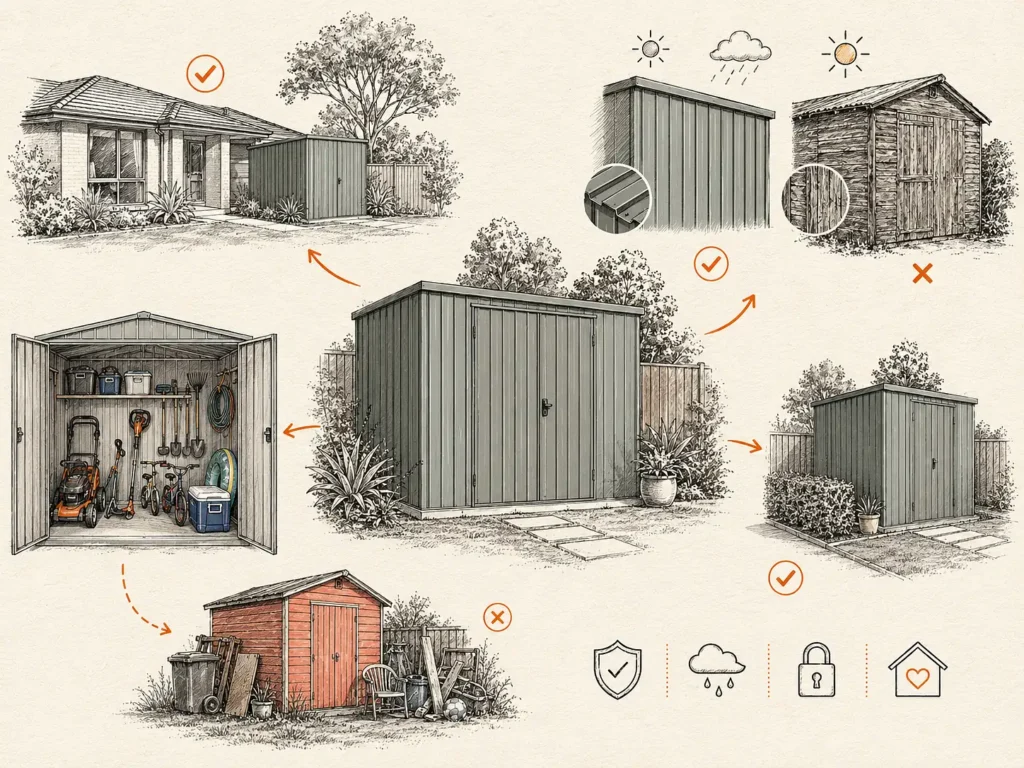
If you’re buying a storage structure to improve presentation, a few details separate something that helps from something that becomes its own problem.
Does it match the house or fight it?
This is the one agents care about most. A shed in Colorbond Monument or Pale Eucalypt blends into most Australian residential palettes without pulling the eye away from the house. It reads as part of the property rather than something that got dropped in from Bunnings last weekend. Raw galvanised steel or a bright primary colour does the opposite, it says temporary, it says afterthought, and agents notice.
Steel or timber?
Australian conditions are harsh on timber that isn’t maintained and let’s be realistic about how often most people actually reseal a timber shed. Coastal salt, summer heat, humidity up north, UV everywhere, timber needs regular attention or it starts looking worse than having no shed at all. Heavy-duty steel handles the climate without the maintenance cycle and still looks the same in five years as it did on day one.
How big should it actually be?
Bigger than you think. Walk around your yard and genuinely inventory what needs to go inside:
Then buy the shed that fits all of it with room to move around inside, because a shed that’s too small just relocates the overflow problem from the lawn to a pile next to the shed, which looks worse. You want the door closed and nothing visible outside it.
Keep the area around it clean. A shed surrounded by weeds with a wheelie bin leaning against it sends the same cluttered signal you were trying to fix. The point is that the shed creates visual order in the yard. If the shed itself looks neglected, you’ve traded one problem for another.
This is where the maths gets interesting and also where most homeowners are making the wrong call about where to put their pre-sale money.
| Upgrade | Typical cost | Impact on buyer perception |
|---|---|---|
| Kitchen renovation | $40,000 – $60,000 | High, but buyers often want to customise anyway |
| Bathroom renovation | $20,000 – $30,000 | Moderate, depends on current condition |
| Interior repaint | $5,000 – $15,000 | Moderate, expected rather than impressive |
| Outdoor storage + lawn cleanup | $2,000 – $5,000 | High, changes perceived yard size immediately |
The Hort Innovation and Raine & Horne data suggests lawn presentation alone can shift perceived value by 20 percent or more. Even if you take the conservative end of that and assume your property only captures a fraction of the theoretical uplift, the return on a couple of thousand dollars’ worth of shed plus a weekend of clearing the yard is wildly disproportionate to what it costs.
A kitchen renovation takes months. It costs tens of thousands. And there’s a genuine chance the buyer walks in and thinks “nice kitchen, but I would’ve done it differently” which is the renovation equivalent of lighting money on fire. A shed and a clear lawn take a weekend and cost less than most people spend on staging the living room, and the effect on the buyer is immediate and visceral because it changes how much space they think the property has.
Ninety-three percent of agents tell vendors to fix the lawn. That number is absurdly high for a profession that rarely agrees on anything. The reason they keep saying it is because they’ve watched the same thing happen hundreds of times. Buyer walks out the back door. Buyer sees open green space that looks ready to use. Buyer pictures their kids running around on it, or a table set up for Christmas lunch, or just themselves sitting in a chair doing absolutely nothing on a Sunday morning. Buyer makes a stronger offer.
The shed made that scene possible by taking everything that would have broken the mental picture and putting it behind a door. That’s the job. Nothing more complicated than that. A structure in the corner of the yard that nobody looks at twice, doing its work quietly by keeping the rest of the space looking like space rather than storage.

Quick answer: the exhaust fan is the only thing standing between your shower steam and every surface in the bathroom,...
Read moreDetails
Copyright © 2024 NoodleMagazine - All Right Reserved