
Budgeting an Interstate Move: The Numbers to Sort Before the Boxes
Moving states costs most Australian households somewhere between $2,000 and $6,000 for the transport alone, before stamp duty, storage or any of...
Read moreDetails

The invoice was due three weeks ago. Client’s gone quiet. Rent isn’t.
This is the moment payday lenders are built for — not in a helpful way, in a predatory one. They know exactly who’s desperate enough to ignore a 400% APR, and freelancers end up in that position more often than most.
A salaried worker borrowing against next Friday’s paycheck at least knows next Friday’s paycheck is coming. Freelancers don’t have that. A slow month, a client who disputes an invoice, a project that stalls — any of it can push repayment out of reach. And payday loan repayment windows don’t flex. Two weeks is two weeks, whether you got paid or not.
The Consumer Financial Protection Bureau found that the majority of payday loan revenue comes from borrowers who take out ten or more loans per year. That’s not a coincidence — the product is structured around rollover. Miss your window, pay a fee, extend. Miss again, pay again. For someone with irregular income, that cycle is easy to fall into and genuinely hard to exit.
What makes it worse for freelancers specifically:
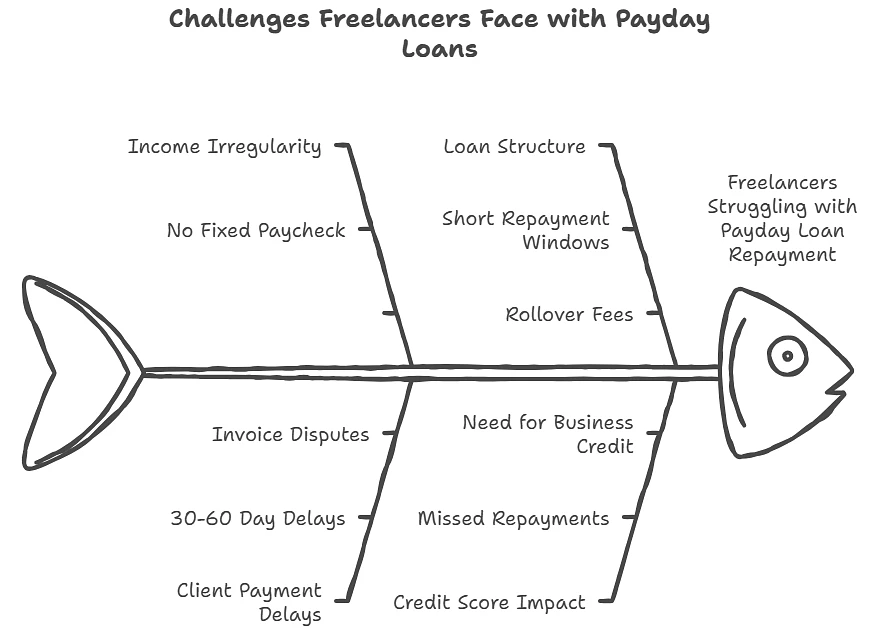
The CFPB documents a typical two-week payday loan fee that translates to roughly 400% APR. That number sounds abstract until you run it on a real amount.
Borrow $500. Can’t repay in two weeks — client still hasn’t paid. Roll it over. Roll it again. By the third cycle you’ve paid more in fees than the original loan, and still owe the principal. This isn’t a rare outcome, it’s how the math works at 400% annualized.
Payday loans don’t come with income consistency checks. That’s a feature for them, not a bug. A freelancer walks in with some proof of recent earnings, gets approved in hours, and the lender collects fees regardless of whether next month looks anything like last month.
Banks and credit unions ask harder questions — self-employment income, tax returns, irregular deposits. That friction feels annoying when you need cash fast. It also exists because those lenders are actually checking whether repayment is realistic.

Moving states costs most Australian households somewhere between $2,000 and $6,000 for the transport alone, before stamp duty, storage or any of...
Read moreDetails
Copyright © 2024 NoodleMagazine - All Right Reserved